MPSC Public Administration Paper I 2025 – Section A

Maharashtra Government Jobs Other Jobs 2025

  • Year 2025
  • Conducted By Maharashtra Public Service Commission
  • Questions 3
  • Languages Marathi & English & Hindi

Exam Details

Detail Information
Examination Public Administration Paper - I
Year 2025
Conducting Body Maharashtra Public Service Commission
Paper Public Administration Paper - I
Subject Public Administration
Number of Questions 3
Question Type Descriptive / Subjective

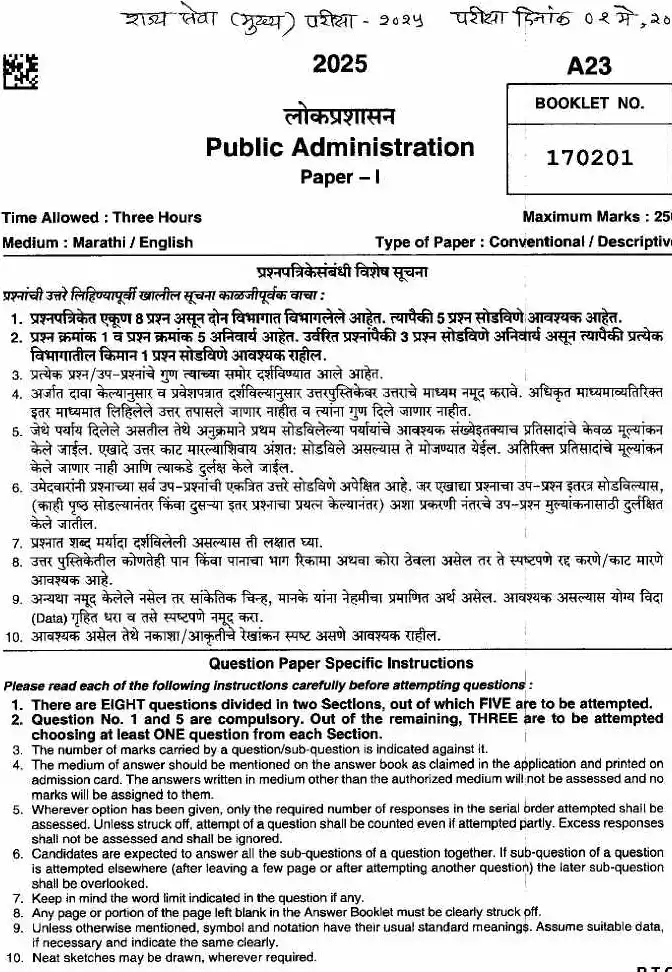
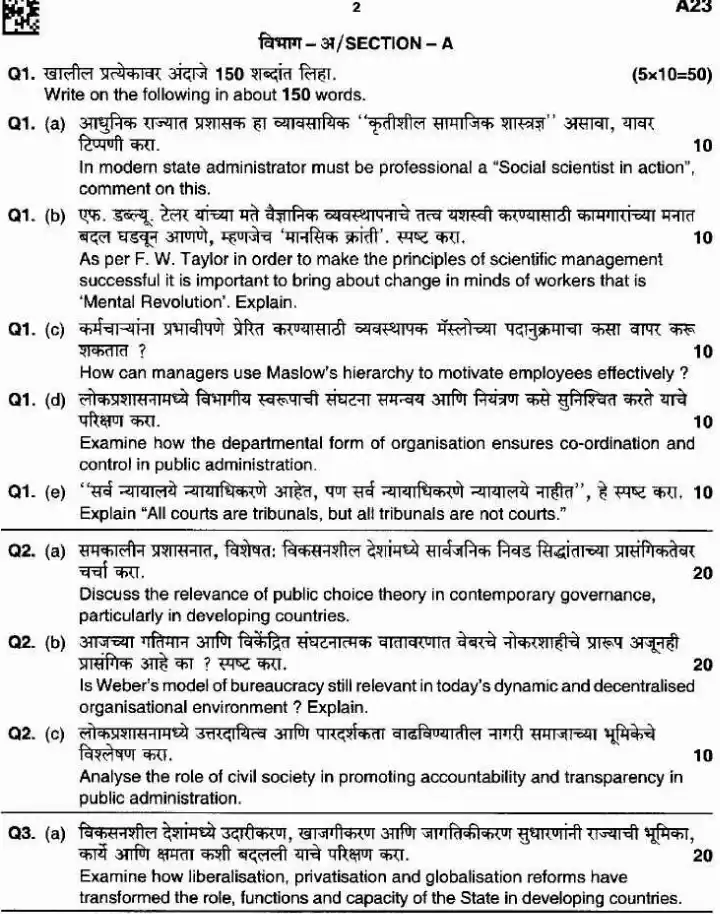
Page 1 provides the official examination instructions for the Maharashtra Public Service Commission State Services Main Examination, Public Administration Paper I. It outlines a two-section pattern, compulsory questions, and rules for answer medium, partial attempts, and answer submission. Page 2 contains the corrected OCR for Section A (Q1–Q3) with multi-part descriptive questions. Q1 includes five sub-parts (a–e) covering professional social science in administration, Taylor's Mental Revolution, Maslow's hierarchy for motivation, departmental coordination, and tribunals vs courts. Q2 contains three sub-parts addressing public choice theory in developing countries, Weber's bureaucracy in a dynamic environment, and civil society’s role in accountability and transparency. Q3 focuses on liberalisation, privatisation, and globalisation reforms altering the state’s role in developing countries. The JSON includes SEO metadata, topics, keywords, FAQs, and image SEO fields prepared for integration.

Major Topics Covered

  • Public Administration
  • Public Choice Theory
  • Weberian Bureaucracy
  • Maslow's Hierarchy
  • Mental Revolution
  • Departmentalization
  • Coordination and Control
  • Courts and Tribunals
  • Civil Society
  • Accountability
  • Transparency
  • Public Governance
  • Developmental States
  • Liberalisation
  • Privatisation
  • Globalisation
  • Administrative Theory
  • Democratic Governance
  • Organisational Change
  • Public Sector Reforms

Why This Paper is Important

  • Useful for Public Administration Paper - I preparation
  • Helps understand the latest exam pattern
  • Useful for practice and self-assessment
  • Covers frequently asked General Studies topics
  • Helpful for analysing question trends

Related Resources

Instructions

  • प्रश्नपत्रिकेसंबंधी विशेष सूचना प्रश्नांची उत्तरे लिहिण्यापूर्वी खालील सूचना काळजीपूर्वक वाचा :
  • प्रश्नपत्रिकेत एकूण 8 प्रश्न असून दोन विभागात विभागलेले आहेत. त्यापैकी 5 प्रश्न सोडविणे आवश्यक आहेत.
  • प्रश्न क्रमांक 1 व प्रश्न क्रमांक 5 अनिवार्य आहेत. उर्वरित प्रश्नांपैकी 3 प्रश्न सोडविणे अनिवार्य असून त्यापैकी प्रत्येक विभागातील किमान 1 प्रश्न सोडविणे आवश्यक राहील.
  • प्रत्येक प्रश्न/उप-प्रश्नांचे गुण त्याच्या समोर दर्शविण्यात आले आहेत.
  • अर्जात दावा केल्यानुसार व प्रवेशपत्रात दर्शविल्यानुसार उत्तरपुस्तिकेवर उत्तराचे माध्यम नमूद करावे. अधिकृत माध्यमाव्यतिरिक्त इतर माध्यमात लिहिलेले उत्तर तपासले जाणार नाहीत व त्यांना गुण दिले जाणार नाहीत.
  • जेथे पर्याय दिलेले असतील तेथे अनुक्रमाने प्रथम सोडविलेल्या पर्यायांचे आवश्यक संख्येइतक्याच प्रतिसादांचे केवळ मूल्यांकन केले जाईल. एखादे उत्तर काट मारल्याशिवाय अंशत: सोडविले असल्यास ते मोजण्यात येईल. अतिरिक्त प्रतिसादांचे मूल्यांकन केले जाणार नाही आणि त्याकडे दुर्लक्ष केले जाईल.
  • उमेदवारांनी प्रश्नाच्या सर्व उप-प्रश्नोची एकत्रित उत्तरे सोडविणे अपेक्षित आहे. जर एखाद्या प्रश्नाचा उप-प्रश्न इतरत्र सोडविल्यास, (काही पृष्ठ सोडल्यानंतर किंवा दुसऱ्या इतर प्रश्नाचा प्रयत्न केल्यानंतर) अशा प्रकरणी नंतरचे उप~प्रश्न मुल्यांकनासाठी दुर्लक्षित \ast SE केले जातील.
  • प्रश्नात शब्द मर्यादा दर्शविलेली असल्यास ती लक्षात घ्या. ⋇
  • उत्तर पुस्तिकेतील कोणतेही पान किंवा पानाचा भाग रिकामा अथवा कोरा ठेवला असेल तर ते स्पष्टपणे रद्द करणे/काट मारणे आवश्यक आहे.
  • अन्यथा नमूद केलेले नसेल तर सांकेतिक चिन्ह, मानके यांना नेहमीचा प्रमाणित अर्थ असेल. आवश्यक असल्यास योग्य विदा (Data) गृहित धरा व तसे स्पष्टपणे नमूद करा.
  • आवश्यक असेल तेथे नकाशा/आकृतीचे रेखांकन स्पष्ट असणे आवश्यक राहील.

  • There are EIGHT questions divided in two Sections, out of which FIVE are to be attempted.
  • Question No. 1 and 5 are compulsory.
  • Out of the remaining, THREE are to be attempted choosing at least ONE question from each Section.
  • The number of marks carried by a question/sub-question is indicated against it.
  • The medium of answer should be mentioned on the answer book as claimed in the application and printed on admission card.
  • The answers written in medium other than the authorized medium will not be assessed and no marks will be assigned to them.
  • Wherever option has been given, only the required number of responses in the serial brder attempted shall be assessed.
  • Unless struck off, attempt of a question shall be counted even if attempted partly.
  • Excess responses shall not be assessed and shall be ignored.
  • Candidates are expected to answer all the sub-questions of a question together.
  • If sub-question of a question is attempted elsewhere (after leaving a few page or after attempting another question) the later sub-question shall be overlooked.
  • Keep in mind the word limit indicated in the question if any.
  • Any page or portion of the page left blank in the Answer Booklet must be clearly struck off.
  • Unless otherwise mentioned, symbol and notation have their usual standard meanings.
  • Assume suitable data, if necessary and indicate the same clearly.
  • Neat sketches may be drawn, wherever required. P.T.O. \mathbf i

Questions (page 2)

Q1.

() Q1. (a) आधुनिक राज्यात प्रशासक हा व्यावसायिक 'क्रियशील सामाजिक शास्त्रज्ञ' असावा, यावर टिप्पणी करा.
In modern state administrator must be professional a "Social scientist in action", comment on this. Q1. (b) एफ. डब्ल्यू. टेलर यांच्या मते वैज्ञानिक व्यवस्थापनाच्या तत्व यशस्वी करण्यासाठी कामगारांच्या मनात बदल घडवून आणणे, म्हणजेच ‘मानसिक क्रांती’. स्पष्ट करा.
As per F. W. Taylor, to make the principles of scientific management successful it is important to bring about change in minds of workers that is 'Mental Revolution'. Explain. Q1.
(c) शकतात ?
How can managers use Maslow's hierarchy to motivate employees effectively? Q1. (d) परिक्षण करा.
Examine how the departmental form of organisation ensures co-ordination and control in public administration. Q1. (e) Explain "All courts are tribunals, but all tribunals are not courts."
Explain "All courts are tribunals, but all tribunals are not courts."
() (b) एफ. डब्ल्यू. टेलर यांच्या मते वैज्ञानिक व्यवस्थापनाच्या तत्व यशस्वी करण्यासाठी कामगारांच्या मनात बदल घडवून आणणे, म्हणजेच ‘मानसिक क्रांती’. स्पष्ट करा.
As per F. W. Taylor, to make the principles of scientific management successful it is important to bring about change in minds of workers that is 'Mental Revolution'. Explain.

() (c) शकतात ?
How can managers use Maslow's hierarchy to motivate employees effectively?

() (d) परिक्षण करा.
Examine how the departmental form of organisation ensures co-ordination and control in public administration.

() (e) Explain "All courts are tribunals, but all tribunals are not courts."
Explain "All courts are tribunals, but all tribunals are not courts."

Q2. Q2.

() Q2. (a) समकालीन प्रशासनात, विशेषत: विकसनशील देशांमध्ये सार्वजनिक निवड सिद्धांताच्या प्रासंगिकतेवर चर्चा करा.
Discuss the relevance of public choice theory in contemporary governance, particularly in developing countries. Q2. (b) आजच्या गतिमान आणि विकेंद्रित संघटनात्मक वातावरणात वेबरचे नोकरशाहीचे प्रारूप अजूनही प्रासंगिक आहे का ? स्पष्ट करा.
Is Weber's model of bureaucracy still relevant in today's dynamic and decentralised organisational environment? Explain. Q2.
(c) लोकप्रशासनामध्ये उत्तरदायित्व आणि पारदर्शकता वाढविण्यातील नागरी समाजाच्या भूमिकेचे विश्लेषण करा.
Analyse the role of civil society in promoting accountability and transparency in public administration.

() (b) आजच्या गतिमान आणि विकेंद्रित संघटनात्मक वातावरणात वेबरचे नोकरशाहीचे प्रारूप अजूनही प्रासंगिक आहे का ? स्पष्ट करा.

() (c) लोकप्रशासनामध्ये उत्तरदायित्व आणि पारदर्शकता वाढविण्यातील नागरी समाजाच्या भूमिकेचे विश्लेषण करा.

  • (c) लोकप्रशासनामध्ये उत्तरदायित्व आणि पारदर्शकता वाढविण्यातील नागरी समाजाच्या भूमिकेचे विश्लेषण करा.
    Analyse the role of civil society in promoting accountability and transparency in public administration.
  • (b) आजच्या गतिमान आणि विकेंद्रित संघटनात्मक वातावरणात वेबरचे नोकरशाहीचे प्रारूप अजूनही प्रासंगिक आहे का ? स्पष्ट करा.
  • (c) लोकप्रशासनामध्ये उत्तरदायित्व आणि पारदर्शकता वाढविण्यातील नागरी समाजाच्या भूमिकेचे विश्लेषण करा.

Q3.

() Q3. (a) विकसनशील देशांमध्ये उदारीकरण, खाजगीकरण आणि जागतिकीकरण सुधारणांनी राज्याची भूमिका, कार्ये आणि क्षमता कशी बदलली याचे परिक्षण करा.
Examine how liberalisation, privatisation and globalisation reforms have transformed the role, functions and capacity of the State in developing countries.

Question paper preview

Scanned pages 1–2 for reference. Download the official PDF for the full paper.

Page 1
MPSC Public Administration Paper I 2025 – Section A — page 1 instructions scan PDF download
Page 2
MPSC Public Administration Paper I 2025 – Section A — page 1 instructions scan PDF download

Free question paper download

Download question paper PDF

  • 236 KB
  • 4 pages
  • PDF format

Frequently asked questions

How many questions are in the paper and how are they arranged?

There are eight questions divided into two sections; five must be attempted. Q1 and Q5 are compulsory; at least one question from each section must be attempted.

Which questions are compulsory?

Question 1 and Question 5 are compulsory.

How many questions must be attempted in total?

Five questions in total, with at least one from each section.

How should the medium of answers be indicated?

Indicate the medium on the answer book as claimed in the application; answers in any other medium will not be assessed.

What if a candidate answers more than required or partly answers a question?

Only the required number of responses in serial order will be assessed; extra responses will be ignored.

Should sub-questions be answered together?

Candidates are expected to answer all sub-questions of a question together; later sub-questions attempted after leaving pages or attempting other questions may be overlooked.

← Back to Other Jobs papers