
Geology Paper II
- Year 2025
- Conducted By Maharashtra Public Service Commission
- Questions 8
- Maximum Marks 250
- Duration Three Hours
- Languages English & Hindi
Exam Details
| Detail | Information |
|---|---|
| Examination | MPSC State Services Main Examination |
| Year | 2025 |
| Conducting Body | Maharashtra Public Service Commission |
| Paper | Geology Paper II |
| Subject | Geology |
| Duration | Three Hours |
| Maximum Marks | 250 |
| Number of Questions | 8 |
| Question Type | Mixed |
This page hosts the MPSC State Services Main Examination (2025) question paper conducted by Maharashtra Public Service Commission. Subject: Geology. Maximum marks: 250. Duration: Three Hours. Question type: mixed. Read exam instructions and page-2 questions online, or download the official PDF for offline practice. This previous year Maharashtra Public Service Commission State Services Main Examination question paper (2025) is useful for Other Jobs aspirants preparing for Maharashtra government recruitment. The paper was conducted by MPSC and reflects the official exam pattern, marking scheme and difficulty level seen in recent cycles. Use it for timed practice, topic-wise revision and understanding how questions are framed in the real examination. Download the free PDF on QuizCurrent to read instructions, attempt MCQs and compare your answers with the study notes provided on this page. Key syllabus areas include Geology, Crystallography, Crystal symmetry, Crystallographic axes, Crystal forms, Provenance studies, Heavy minerals, Inosilicates. Useful for MPSC State Services Main Examination preparation. Helps understand the latest exam pattern. Useful for practice and self-assessment.
Major Topics Covered
- Geology
- Crystallography
- Crystal symmetry
- Crystallographic axes
- Crystal forms
- Provenance studies
- Heavy minerals
- Inosilicates
- Single/double chain silicates
- Zeolite facies
- Mineral paragenesis
- Metamorphism
- Index minerals
- Isogrades
- Glacial environment
- Granite classification
- Petrogenesis
- Metamorphic zones
- Mineral properties
- Optical properties of minerals
Why This Paper is Important
- Useful for MPSC State Services Main Examination preparation
- Helps understand the latest exam pattern
- Useful for practice and self-assessment
- Covers frequently asked General Studies topics
- Helpful for analysing question trends
Related Resources
Instructions
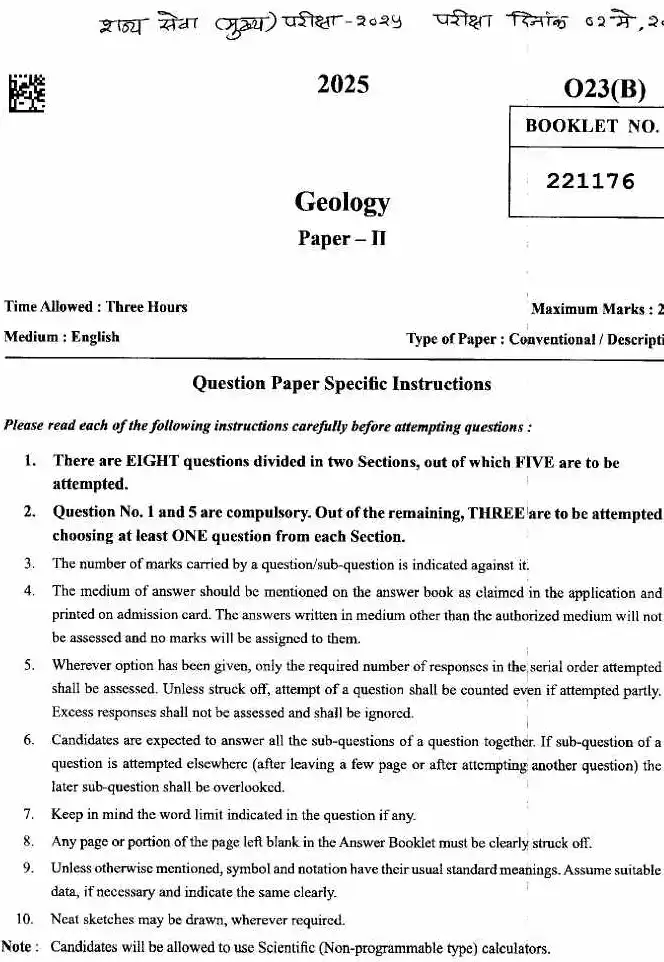
- श्राल्य सेम (प्रथ्रा) परीक्षा-१०२५ परीक्षा सिनांक ७२ मे ,२०२६ 2025 O23(B) BOOKLET NO. 221176 Geology Paper - II Time Allowed : Three Hours Maximum Marks: 250 Medium: English Type of Paper: Conventional / Descriptive
- There are EIGHT questions divided in two Sections, out of which FIVE are to be
- attempted. Question No. 1 and 5 are compulsory. Out of the remaining, THREE are to be attempted
- choosing at least ONE question from each Section. \bf *SE The number of marks carried by a question/sub-question is indicated against it.
- * > The medium of answer should be mentioned on the answer book as claimed in the application and
- printed on admission card.
- The answers written in medium other than the authorized medium will not be assessed and no marks will be assigned to them.
- Wherever option has been given, only the required number of responses in the serial order attempted
- Unless struck off, attempt of a question shall be counted even if attempted partly.
- Excess responses shall not be assessed and shall be ignored.
- Candidates are expected to answer all the sub-questions of a question together.
- question is attempted elsewhere (after leaving a few page or after attempting another question) the later sub-question shall be overlooked.
- Keep in mind the word limit indicated in the question if any.
- Any page or portion of the page left blank in the Answer Booklet must be clearly struck off.
- Unless otherwise mentioned, symbol and notation have their usual standard meanings.
- data, if necessary and indicate the same clearly.
- Neat sketches may be drawn, wherever required.
- Note: Candidates will be allowed to use Scientific (Non-programmable type) calculators.
Questions (page 2)
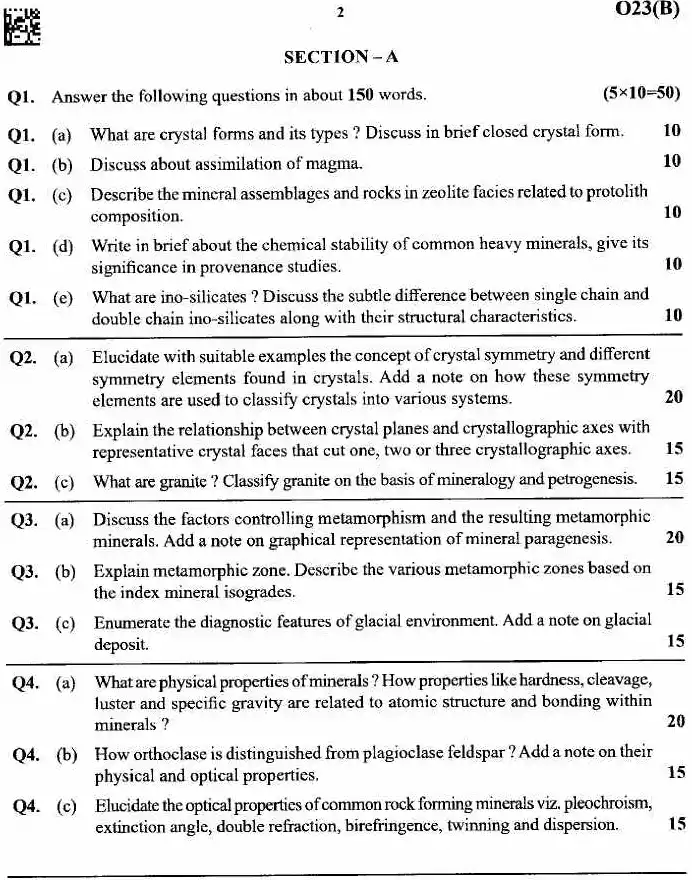
Q2. Q1(b) 10 Describe the mineral assemblages and rocks in zeolite facies related to protolith composition.
Q3. Q1
(c) 10 Write in brief about the chemical stability of common heavy minerals, give its significance in provenance studies.
Q4. Q1(d) 10 What are ino-silicates? Discuss the subtle difference between single chain and double chain ino-silicates along with their structural characteristics.
Q5. Q1(e) 10 Elucidate with suitable examples the concept of crystal symmetry and different symmetry elements found in crystals.
Q6. Q2(a) 20 symmetry elements found in crystals. Add a note on how these symmetry elements are used to classify crystals into various systems. Explain the relationship between crystal planes and crystallographic axes with representative crystal faces that cut one, two or three crystallographic axes.
Q7. Q2(b) 15 What are granite? Classify granite on the basis of mineralogy and petrogenesis.
Q8. Q2
(c) 15 Discuss the factors controlling metamorphism and the resulting metamorphic minerals.
Q9. Q3(a) 20 minerals. Add a note on graphical representation of mineral paragenesis. Explain metamorphic zone. Describe the various metamorphic zones based on the index mineral isogrades.
Q10. Q3(b) 15 the index mineral isogrades. Enumerate the diagnostic features of glacial environment. Add a note on glacial deposit.
Q11. Q3
(c) 15 What are physical properties of minerals? How properties like hardness, cleavage, luster and specific gravity are related to atomic structure and bonding within minerals? How orthoclase is distinguished from plagioclase feldspar? Add a note on their physical and optical properties.
Q12. Q4(a) 20 (a) luster and specific gravity are related to atomic structure and bonding within minerals? How orthoclase is distinguished from plagioclase feldspar? Add a note on their physical and optical properties.
Question paper preview
Scanned pages 1–2 for reference. Download the official PDF for the full paper.
Free question paper download
Download question paper PDF
Your download starts in 10s
Preparing your question paper file…
Frequently asked questions
What is the coordinating examination for Geology Paper II?
MPSC State Services Main Examination for Maharashtra, Geology Paper II.
What is the medium of the Geology Paper II paper?
Medium: English.
How many questions must be attempted in total?
Eight questions are to be attempted in two Sections, with five to be attempted overall.
Which questions are compulsory?
Question No. 1 and Question No. 5 are compulsory.
How should candidates choose questions to attempt?
Out of the remaining questions, THREE must be attempted, choosing at least ONE question from each Section.
What is the duration of the exam?
Time Allowed: Three Hours.