UPSC Civil Services Main 2016 Botany Paper II PDF

Central Government Jobs Other Jobs 2016

  • Year 2016
  • Conducted By UPSC
  • Questions 8
  • Maximum Marks 250
  • Duration Three Hours
  • Languages English & Hindi

Exam Details

Detail Information
Examination Civil Services Main Examination
Year 2016
Conducting Body UPSC
Paper Botany Paper II
Subject Botany
Duration Three Hours
Maximum Marks 250
Number of Questions 8
Question Type Mixed

This is the Botany Paper II from the UPSC Civil Services Main Examination held in 2016. The paper is designed to test in-depth knowledge of Botany, with a total of 8 questions divided into two sections. Candidates are required to answer five questions in total, with questions 1 and 5 being compulsory, and at least one question from each section. The exam duration is three hours, and it carries a maximum of 250 marks. This paper is crucial for aspirants aiming for success in the Civil Services examination, providing a clear understanding of the expected difficulty and subject coverage.

Major Topics Covered

  • Polyteny
  • Polyploidy
  • Recombination frequencies
  • Chi-square test
  • Goodness of fit
  • C-value paradox
  • Chemical mutagens
  • FISH (Fluorescence In Situ Hybridization)
  • Nucleosome structure
  • Translocations
  • Gene linkage
  • Meiosis

Why This Paper is Important

  • Useful for Civil Services Main Examination preparation
  • Helps understand the latest exam pattern
  • Useful for practice and self-assessment
  • Covers frequently asked General Studies topics
  • Helpful for analysing question trends

Related Resources

  • UPSC Civil Services Main Examination 2016 Botany Paper I
  • UPSC Civil Services Main Examination 2015 Botany Paper II
  • UPSC Civil Services Main Examination 2016 General Studies Paper I
  • UPSC Civil Services Main 2016 Botany Paper II Answer Key
  • UPSC Civil Services Main Botany Syllabus
  • UPSC Mains Optional Subjects Syllabus
  • UPSC Civil Services Main Exam Pattern
  • UPSC Mains Optional Subject Exam Pattern

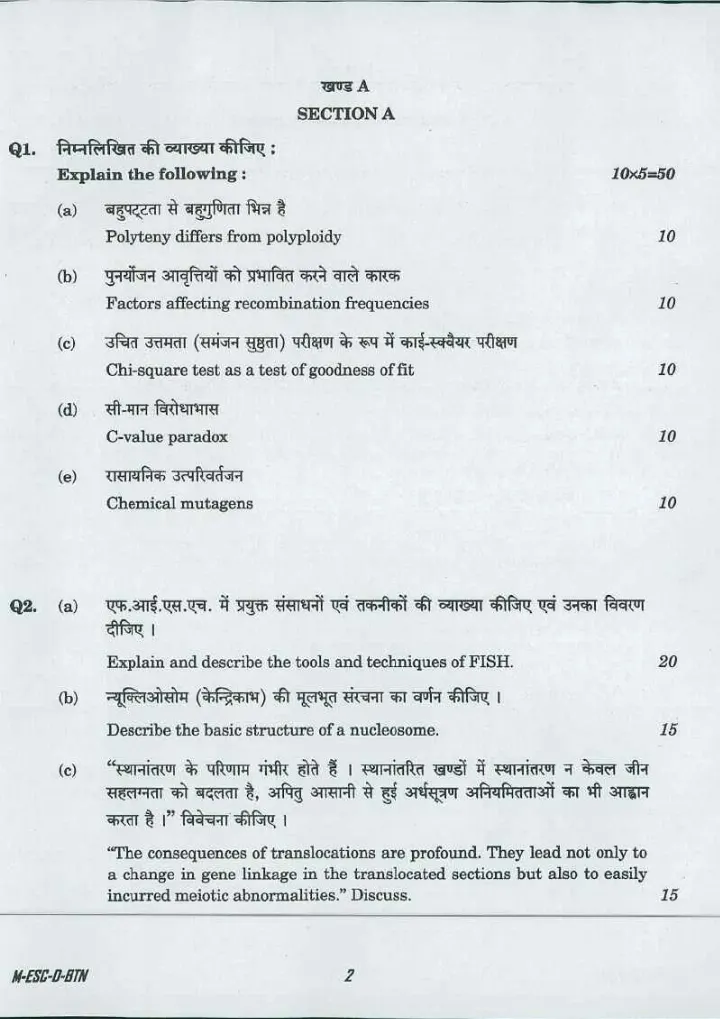
Instructions

  • पुस्तिका के मुख-पृष्ठ पर अंकित निर्दिष्ट स्थान पर किया जाना चाहिए ।
  • उल्लिखित माध्यम के अतिरिक्त अन्य किसी माध्यम में लिखे गए उत्तर पर कोई अंक नहीं मिलेंगे ।
  • प्रश्नों में शब्द सीमा, जहाँ विनिर्दिष्ट है, का अनुसरण किया जाना चाहिए ।
  • जहाँ आवश्यक हो, अपने उत्तर को उपयुक्त आरेखों / चित्रों द्वारा दर्शाएँ ।
  • इन्हें प्रश्न का उत्तर देने के लिए दिए गए स्थान में ही बनाना है ।
  • प्रश्नों के उत्तरों की गणना क्रमानुसार की जाएगी ।
  • यदि काटा नहीं हो, तो प्रश्न के उत्तर की गणना की जाएगी चाहे वह उत्तर अंशतः दिया गया हो ।
  • प्रश्न-सह-उत्तर पुस्तिका में खाली छोड़ा हुआ पृष्ठ या उसके अंश को स्पष्ट रूप से काटा जाना चाहिए ।

  • Please read each of the following instructions carcfully before attempting questions: There are EIGHT questions divided in TWO SECTIONS and printed both in HINDI and in ENGLISH.
  • Candidate has to attempt FIVE questions in all.
  • Questions no. 1 and 5 are compulsory and out of the remaining, any THREE are to be attempted choosing at least ONE from each section.
  • The number of marks carried by a question / part is indicated against it.
  • Answers must be written in the medium authorized in the Admission Certificate which must be stated clearly on the cover of this Question-cum-Answer (QCA) Booklet in the space provided.
  • No marks will be given for answers written in a medium other than the authorized one.
  • Word limit in questions, wherever specified, should be adhered to.
  • Diagrams/Figures, wherever required, may be drawn in the space provided for answering the question itself.
  • Attempts of questions shall be counted in sequential order.
  • Unless struck off, attempt of a question shall be counted even if attempted partly.
  • Any page or portion of the page left blank in the Question-cum-Answer Booklet must be clearly struck off.

Questions (page 2)

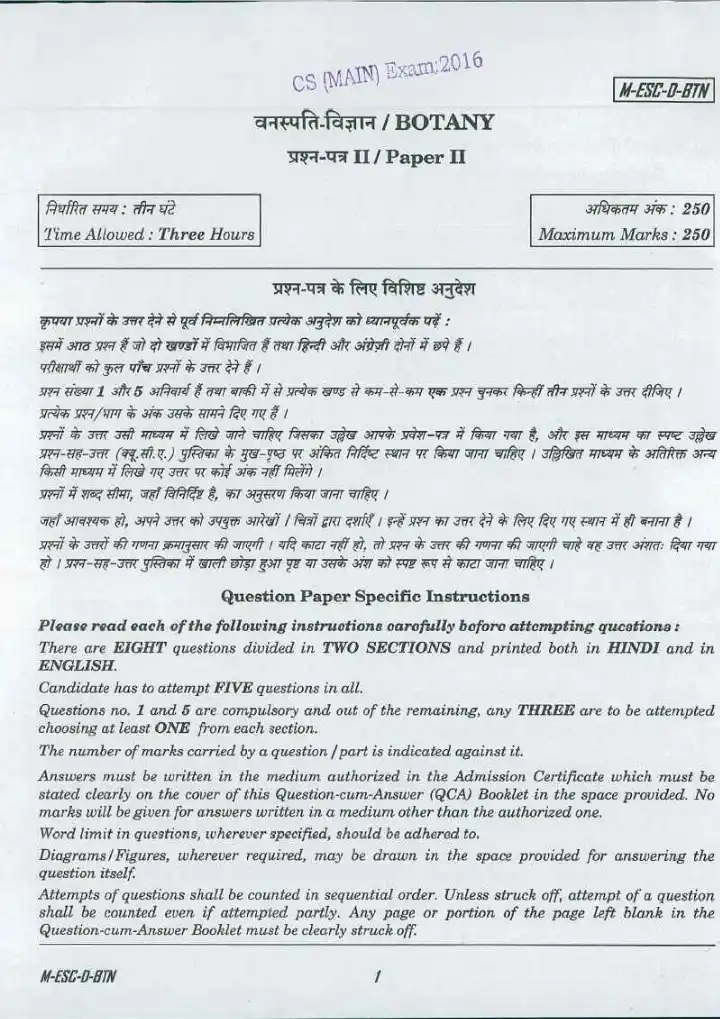
Section A

Q1. निम्नलिखित की व्याख्या कीजिए :
Explain the following :

(a) बहुपट्टता से बहुगुणिता भिन्न है
Polyteny differs from polyploidy

(b) पुनर्योजन आवृत्तियों को प्रभावित करने वाले कारक
Factors affecting recombination frequencies

(c) उचित उत्तमता (समंजन सुष्ठता) परीक्षण के रूप में काई-स्क्वैयर परीक्षण
Chi-square test as a test of goodness of fit

(d) सी-मान विरोधाभास
C-value paradox

(e) रासायनिक उत्परिवर्तजन
Chemical mutagens
Section A

Q2.

(a) एफ.आई.एस.एच. में प्रयुक्त संसाधनों एवं तकनीकों की व्याख्या कीजिए एवं उनका विवरण दीजिए ।
Explain and describe the tools and techniques of FISH.

(b) न्यूक्लिओसोम (केन्द्रिकाभ) की मूलभूत संरचना का वर्णन कीजिए ।
Describe the basic structure of a nucleosome.

(c) “स्थानांतरण के परिणाम गंभीर होते हैं । स्थानांतरित खण्डों में स्थानांतरण न केवल जीन सहलग्नता को बदलता है, अपितु आसानी से हुई अर्धसूत्रण अनियमितताओं का भी आह्वान करता है ।” विवेचना कीजिए ।
"The consequences of translocations are profound. They lead not only to a change in gene linkage in the translocated sections but also to easily incurred meiotic abnormalities." Discuss.

Question paper preview

Scanned pages 1–2 for reference. Download the official PDF for the full paper.

Page 1
UPSC Civil Services Main 2016 Botany Paper II question paper page 1 instructions scan PDF download
Page 2
UPSC Civil Services Main 2016 Botany Paper II question paper page 1 instructions scan PDF download

Free question paper download

Download question paper PDF

  • 3.8 MB
  • 6 pages
  • PDF format

Frequently asked questions

What is the name of the exam?

The exam is the Civil Services Main Examination.

Which paper is this question paper for?

This is for Botany Paper II.

What is the conducting body for this exam?

The conducting body is UPSC (Union Public Service Commission).

In which year was this exam conducted?

This exam was conducted in 2016.

What is the maximum marks for Botany Paper II?

The maximum marks for Botany Paper II is 250.

What is the time allowed for this paper?

The time allowed for this paper is Three Hours.

← Back to Other Jobs papers