UPSC Civil Services Philosophy Paper I 2025 Question Paper PDF

Central Government Jobs Other Jobs 2025

  • Year 2025
  • Conducted By UPSC
  • Questions 8
  • Maximum Marks 250
  • Duration Three Hours
  • Languages Hindi & English

Exam Details

Detail Information
Examination UPSC Civil Services Main Examination
Year 2025
Conducting Body UPSC
Paper Philosophy Paper - I
Subject Philosophy
Duration Three Hours
Maximum Marks 250
Number of Questions 8
Question Type Descriptive / Subjective

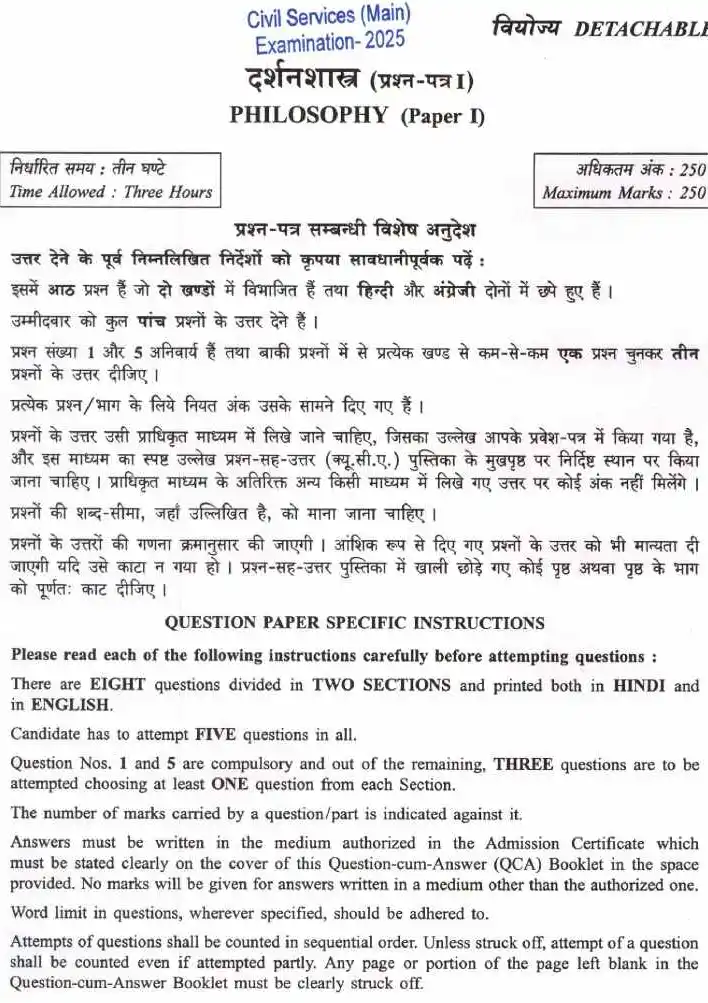
This is the Philosophy Paper I for the UPSC Civil Services Main Examination held in 2025. The paper is divided into two sections and contains eight questions, with candidates required to answer five. Questions 1 and 5 are compulsory, and at least one question must be attempted from each section. The paper is printed in both Hindi and English, and answers must be written in the authorized medium specified in the admission certificate. The maximum marks for the paper are 250, with a time limit of three hours. This paper is crucial for aspirants aiming to score well in the UPSC Civil Services Mains.

Major Topics Covered

  • Plato's Theory of Forms
  • Aristotle's Metaphysics (Matter and Form)
  • Sartre's Existentialism (Being-for-itself, Being-in-itself)
  • Russell's Theory of Descriptions
  • Kant's Phenomena and Noumena
  • Hegel's Philosophy
  • Rationalism (Descartes)
  • Spinoza's Philosophy
  • Hume's Philosophy (Causality)
  • Kant's Response to Hume
  • Wittgenstein's Philosophy of Language

Why This Paper is Important

  • Useful for UPSC Civil Services Main Examination preparation
  • Helps understand the latest exam pattern
  • Useful for practice and self-assessment
  • Covers frequently asked General Studies topics
  • Helpful for analysing question trends

Related Resources

  • UPSC Civil Services Main Examination Philosophy Paper II 2025
  • UPSC Civil Services Main Examination General Studies Paper I 2025
  • UPSC Civil Services Main Examination General Studies Paper II 2025
  • UPSC Civil Services Main Examination General Studies Paper III 2025
  • UPSC Civil Services Main Examination General Studies Paper IV 2025
  • UPSC Civil Services Main Examination Philosophy Paper I Answer Key 2025
  • UPSC Civil Services Main Examination Philosophy Syllabus
  • UPSC Civil Services Main Examination Syllabus

Instructions

  • पुस्तिका के मुखपृष्ठ पर निर्दिष्ट स्थान पर किया जाना चाहिए।
  • प्राधिकृत माध्यम के अतिरिक्त अन्य किसी माध्यम में लिखे गए उत्तर पर कोई अंक नहीं मिलेंगे।
  • प्रश्नों की शब्द-सीमा, जहाँ उल्लिखित है, को माना जाना चाहिए ।
  • प्रश्नों के उत्तरों की गणना क्रमानुसार की जाएगी।
  • आंशिक रूप से दिए गए प्रश्नों के उत्तर को भी मान्यता दी जाएगी यदि उसे काटा न गया हो ।
  • प्रश्न-सह-उत्तर पुस्तिका में खाली छोड़े गए कोई पृष्ठ अथवा पृष्ठ के भाग को पूर्णतः काट दीजिए ।

  • There are EIGHT questions divided in TWO SECTIONS and printed both in HINDI and in ENGLISH.
  • Candidate has to attempt FIVE questions in all.
  • Question Nos. 1 and 5 are compulsory and out of the remaining, THREE questions are to be attempted choosing at least ONE question from each Section.
  • The number of marks carried by a question/part is indicated against it.
  • Answers must be written in the medium authorized in the Admission Certificate which must be stated clearly on the cover of this Question-cum-Answer (QCA) Booklet in the space provided.
  • No marks will be given for answers written in a medium other than the authorized one.
  • Word limit in questions, wherever specified, should be adhered to.
  • Attempts of questions shall be counted in sequential order.
  • Unless struck off, attempt of a question shall be counted even if attempted partly.
  • Any page or portion of the page left blank in the Question-cum-Answer Booklet must be clearly struck off.

Questions (page 2)

Section A

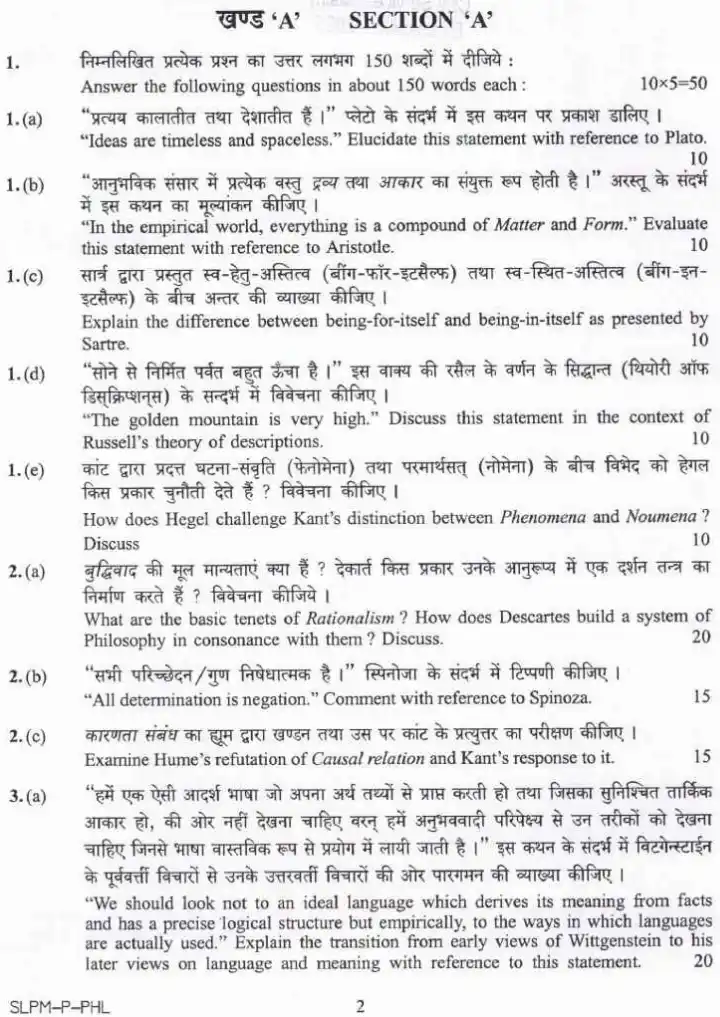
Q1. निम्नलिखित प्रत्येक प्रश्न का उत्तर लगभग 150 शब्दों में दीजिये:
Answer the following questions in about 150 words each:

(1.(a)) "प्रत्यय कालातीत तथा देशातीत हैं।" प्लेटो के संदर्भ में इस कथन पर प्रकाश डालिए।
"Ideas are timeless and spaceless." Elucidate this statement with reference to Plato.

(1.(b)) "आनुभविक संसार में प्रत्येक वस्तु द्रव्य तथा आकार का संयुक्त रूप होती है।" अरस्तू के संदर्भ में इस कथन का मूल्यांकन कीजिए।
"In the empirical world, everything is a compound of Matter and Form." Evaluate this statement with reference to Aristotle.

(1.(c)) सार्त्र द्वारा प्रस्तुत स्व-हेतु-अस्तित्व (बींग-फॉर-इटसैल्फ) तथा स्व-स्थित-अस्तित्व (बींग-इन-इटसैल्फ) के बीच अन्तर की व्याख्या कीजिए ।
Explain the difference between being-for-itself and being-in-itself as presented by Sartre.

(1.(d)) "सोने से निर्मित पर्वत बहुत ऊँचा है।" इस वाक्य की रसेल के वर्णन के सिद्धान्त (थियोरी ऑफ डिसक्रिप्शन्स) के सन्दर्भ में विवेचना कीजिए।
"The golden mountain is very high." Discuss this statement in the context of Russell's theory of descriptions.

(1.(e)) कांट द्वारा प्रदत्त घटना-संवृति (फेनोमेना) तथा परमार्थसत् (नोमेना) के बीच विभेद को हेगल किस प्रकार चुनौती देते हैं ? विवेचना कीजिए ।
How does Hegel challenge Kant's distinction between Phenomena and Noumena? Discuss.

(a) "Ideas are timeless and spaceless." Elucidate this statement with reference to Plato. 10 “आनुभविक संसार में प्रत्येक वस्तु द्रव्य तथा आकार का संयुक्त रूप होती है।” अरस्तू के संदर्भ 1.

(b) में इस कथन का मूल्यांकन कीजिए। "In the empirical world, everything is a compound of Matter and Form." Evaluate this statement with reference to Aristotle. 10 सार्त्र द्वारा प्रस्तुत स्व-हेतु-अस्तित्व (बींग-फॉर-इटसैल्फ) तथा स्व-स्थित-अस्तित्व (बींग-इन- 1.

(c) इटसैल्फ) के बीच अन्तर की व्याख्या कीजिए । Explain the difference between being-for-itself and being-in-itself as presented by Sartre. “सोने से निर्मित पर्वत बहुत ऊँचा है।” इस वाक्य की रसैल के वर्णन के सिद्धान्त (थियोरी ऑफ 1.

(d) डिसक्रिप्शनस) के सन्दर्भ में विवेचना कीजिए। "The golden mountain is very high." Discuss this statement in the context of Russell's theory of descriptions. 10 कांट द्वारा प्रदत्त घटना-संवृति (फेनोमेना) तथा परमार्थसत् (नोमेना) के बीच विभेद को हेगल 1.

(e) किस प्रकार चुनौती देते हैं ? विवेचना कीजिए । How does Hegel challenge Kant's distinction between Phenomena and Noumena? Discuss बुद्धिवाद की मूल मान्यताएं क्या हैं ? देकार्त किस प्रकार उनके आनुरूप्य में एक दर्शन तन्त्र का 2.
Section A

Q2. (2.(a)) बुद्धिवाद की मूल मान्यताएं क्या हैं ? देकार्त किस प्रकार उनके आनुरूप्य में एक दर्शन तन्त्र का निर्माण करते हैं ? विवेचना कीजिये ।
What are the basic tenets of Rationalism? How does Descartes build a system of Philosophy in consonance with them? Discuss. (2.(b)) "सभी परिच्छेदन/गुण निषेधात्मक है।" स्पिनोजा के संदर्भ में टिप्पणी कीजिए।
"All determination is negation." Comment with reference to Spinoza. (2.(c)) कारणता संबंध का ह्यूम द्वारा खण्डन तथा उस पर कांट के प्रत्युत्तर का परीक्षण कीजिए ।
Examine Hume's refutation of Causal relation and Kant's response to it.

(2.(a)) बुद्धिवाद की मूल मान्यताएं क्या हैं ? देकार्त किस प्रकार उनके आनुरूप्य में एक दर्शन तन्त्र का निर्माण करते हैं ? विवेचना कीजिये ।
What are the basic tenets of Rationalism? How does Descartes build a system of Philosophy in consonance with them? Discuss.

(2.(b)) "सभी परिच्छेदन/गुण निषेधात्मक है।" स्पिनोजा के संदर्भ में टिप्पणी कीजिए।
"All determination is negation." Comment with reference to Spinoza.

(2.(c)) कारणता संबंध का ह्यूम द्वारा खण्डन तथा उस पर कांट के प्रत्युत्तर का परीक्षण कीजिए ।
Examine Hume's refutation of Causal relation and Kant's response to it.

Section A

Q3. (3.(a)) "हमें एक ऐसी आदर्श भाषा जो अपना अर्थ तथ्यों से प्राप्त करती हो तथा जिसका सुनिश्चित तार्किक आकार हो, की ओर नहीं देखना चाहिए वरन् हमें अनुभववादी परिपेक्ष्य से उन तरीकों को देखना चाहिए जिनसे भाषा वास्तविक रूप से प्रयोग में लायी जाती है।" इस कथन के संदर्भ में विटगेन्स्टाईन के पूर्ववर्त्ती विचारों से उनके उत्तरवर्ती विचारों की ओर पारगमन की व्याख्या कीजिए ।
"We should look not to an ideal language which derives its meaning from facts and has a precise logical structure but empirically, to the ways in which languages are actually used." Explain the transition from early views of Wittgenstein to his later views on language and meaning with reference to this statement.

(3.(a)) "हमें एक ऐसी आदर्श भाषा जो अपना अर्थ तथ्यों से प्राप्त करती हो तथा जिसका सुनिश्चित तार्किक आकार हो, की ओर नहीं देखना चाहिए वरन् हमें अनुभववादी परिपेक्ष्य से उन तरीकों को देखना चाहिए जिनसे भाषा वास्तविक रूप से प्रयोग में लायी जाती है।" इस कथन के संदर्भ में विटगेन्स्टाईन के पूर्ववर्त्ती विचारों से उनके उत्तरवर्ती विचारों की ओर पारगमन की व्याख्या कीजिए ।
"We should look not to an ideal language which derives its meaning from facts and has a precise logical structure but empirically, to the ways in which languages are actually used." Explain the transition from early views of Wittgenstein to his later views on language and meaning with reference to this statement.

Question paper preview

Scanned pages 1–2 for reference. Download the official PDF for the full paper.

Page 1
UPSC Civil Services Main Examination 2025 Philosophy Paper I question paper page 1 instructions scan PDF download. Includes exam name, paper name, time, marks, and detailed instructions in Hindi and English.
Page 2
UPSC Civil Services Main Examination 2025 Philosophy Paper I question paper page 1 instructions scan PDF download. Includes exam name, paper name, time, marks, and detailed instructions in Hindi and English.

Free question paper download

Download question paper PDF

  • 2.2 MB
  • 4 pages
  • PDF format

Frequently asked questions

What is the name of the exam for which this paper is intended?

This paper is for the UPSC Civil Services Main Examination.

What is the subject and paper number?

The subject is Philosophy, and this is Paper I.

What is the year of this question paper?

The year of this question paper is 2025.

Who conducts the Civil Services Main Examination?

The examination is conducted by the UPSC (Union Public Service Commission).

What is the maximum marks for Philosophy Paper I?

The maximum marks for Philosophy Paper I are 250.

What is the time allowed to complete the paper?

The time allowed to complete the paper is three hours.

← Back to Other Jobs papers