Section A
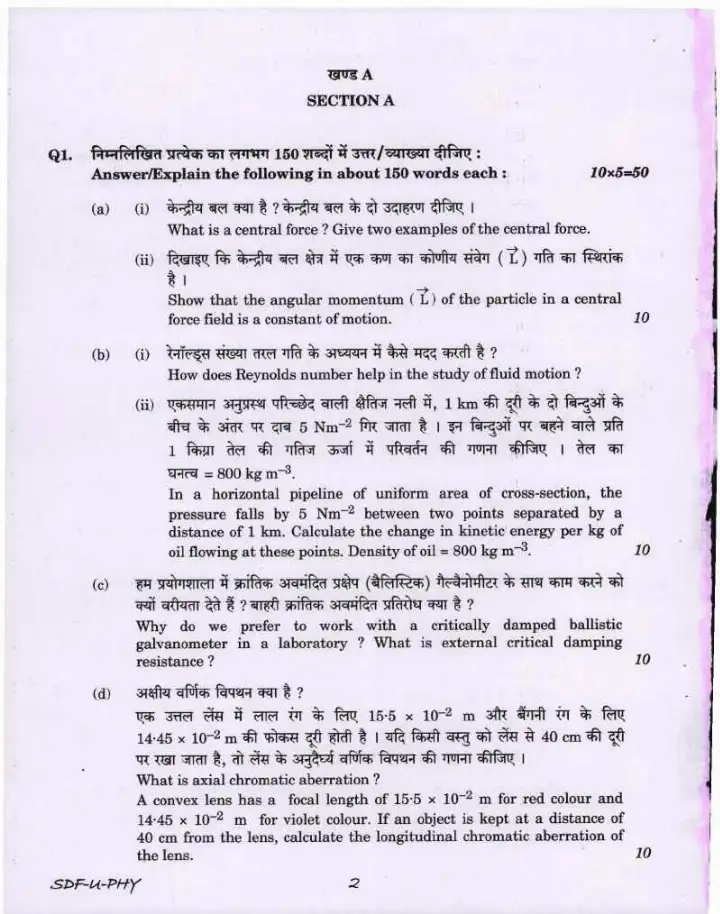
Q1. Answer/Explain the following in about 150 words each:
(a) केन्द्रीय बल क्या है ? केन्द्रीय बल के दो उदाहरण दीजिए ।
What is a central force? Give two examples of the central force.
(b) दिखाइए कि केन्द्रीय बल क्षेत्र में एक कण का कोणीय संवेग गति का स्थिरांक है ।
Show that the angular momentum of the particle in a central force field is a constant of motion.
(c) रेनॉल्ड्स संख्या तरल गति के अध्ययन में कैसे मदद करती है ?
How does Reynolds number help in the study of fluid motion?
(d) एकसमान अनुप्रस्थ परिच्छेद वाली क्षैतिज नली में, 1 km की दूरी के दो बिन्दुओं के बीच के अंतर पर दाब 5 Nm-2 गिर जाता है । इन बिन्दुओं पर बहने वाले प्रति 1 किग्रा तेल की गतिज ऊर्जा में परिवर्तन की गणना कीजिए । तेल का घनत्व = 800 kg m-3 .
In a horizontal pipeline of uniform area of cross-section, the pressure falls by 5 Nm-2 between two points separated by a distance of 1 km. Calculate the change in kinetic energy per kg of oil flowing at these points. Density of oil = 800 kg m-3 .
(e) हम प्रयोगशाला में क्रांतिक अवमंदित प्रक्षेप (बैलिस्टिक) गैल्वैनोमीटर के साथ काम करने को क्यों वरीयता देते हैं ? बाहरी क्रांतिक अवमंदित प्रतिरोध क्या है ?
Why do we prefer to work with a critically damped ballistic galvanometer in a laboratory ? What is external critical damping resistance?
(f) अक्षीय वर्णिक विपथन क्या है ? एक उत्तल लेंस में लाल रंग के लिए 15.5 × 10⁻² m और बैंगनी रंग के लिए की फोकस दूरी होती है। यदि किसी वस्तु को लेंस से 40 cm की दूरी पर रखा जाता है, तो लेंस के अनुदैर्घ्य वर्णिक विपथन की गणना कीजिए ।
What is axial chromatic aberration? A convex lens has a focal length of 15.5 × 10⁻² m for red colour and 14.45 × 10⁻² m for violet colour. If an object is kept at a distance of 40 cm from the lens, calculate the longitudinal chromatic aberration of the lens.