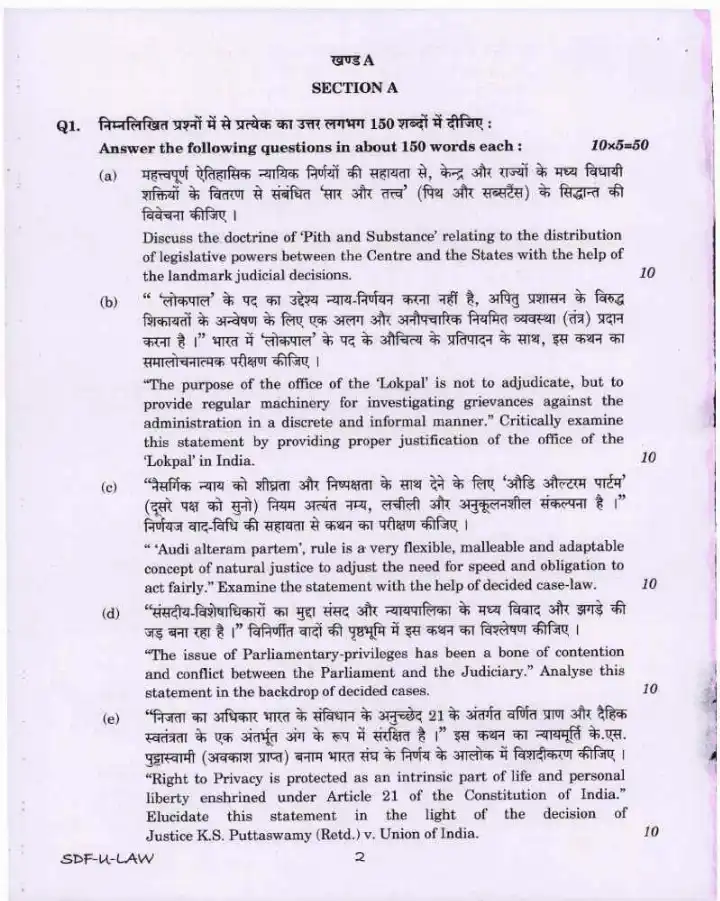
Section A
Q1. Answer the following questions in about 150 words each :
निम्नलिखित प्रश्नों में से प्रत्येक का उत्तर लगभग 150 शब्दों में दीजिए :
(a) महत्त्वपूर्ण ऐतिहासिक न्यायिक निर्णयों की सहायता से, केन्द्र और राज्यों के मध्य विधायी शक्तियों के वितरण से संबंधित ‘सार और तत्त्व’ (पिथ और सब्सटैंस) के सिद्धान्त की विवेचना कीजिए ।
Discuss the doctrine of 'Pith and Substance' relating to the distribution of legislative powers between the Centre and the States with the help of the landmark judicial decisions.
(b) “लोकपाल’ के पद का उद्देश्य न्याय-निर्णयन करना नहीं है, अपितु प्रशासन के विरुद्ध शिकायतों के अन्वेषण के लिए एक अलग और अनौपचारिक नियमित व्यवस्था (तंत्र) प्रदान करना है।” भारत में ‘लोकपाल’ के पद के औचित्य के प्रतिपादन के साथ, इस कथन का समालोचनात्मक परीक्षण कीजिए ।
"The purpose of the office of the 'Lokpal' is not to adjudicate, but to provide regular machinery for investigating grievances against the administration in a discrete and informal manner." Critically examine this statement by providing proper justification of the office of the 'Lokpal' in India.
(c) “नैसर्गिक न्याय को शीघ्रता और निष्पक्षता के साथ देने के लिए ‘औडि औल्टरम पार्टम’ (दूसरे पक्ष को सुनो) नियम अत्यंत नम्य, लचीली और अनुकूलनशील संकल्पना है।” निर्णयज वाद-विधि की सहायता से कथन का परीक्षण कीजिए ।
"Audi alteram partem', rule is a very flexible, malleable and adaptable concept of natural justice to adjust the need for speed and obligation to act fairly." Examine the statement with the help of decided case-law.
(d) “संसदीय-विशेषाधिकारों का मुद्दा संसद और न्यायपालिका के मध्य विवाद और झगड़े की जड़ बना रहा है ।” विनिर्णीत वादों की पृष्ठभूमि में इस कथन का विश्लेषण कीजिए ।
"The issue of Parliamentary-privileges has been a bone of contention and conflict between the Parliament and the Judiciary." Analyse this statement in the backdrop of decided cases.
(e) “निजता का अधिकार भारत के संविधान के अनुच्छेद 21 के अंतर्गत वर्णित प्राण और दैहिक स्वतंत्रता के एक अंतर्भूत अंग के रूप में संरक्षित है ।” इस कथन का न्यायमूर्ति के.एस. पुट्टास्वामी (अवकाश प्राप्त) बनाम भारत संघ के निर्णय के आलोक में विशदीकरण कीजिए ।
"Right to Privacy is protected as an intrinsic part of life and personal liberty enshrined under Article 21 of the Constitution of India." Elucidate this statement in the light of the decision of Justice K.S. Puttaswamy (Retd.) v. Union of India.