UPSC Civil Services Mains 2019 Geology Paper I PDF

Central Government Jobs Other Jobs 2019

  • Year 2019
  • Conducted By UPSC
  • Questions 8
  • Maximum Marks 250
  • Duration Three Hours
  • Languages English & Hindi

Exam Details

Detail Information
Examination UPSC Civil Services Main Examination
Year 2019
Conducting Body UPSC
Paper Geology Paper - I
Subject Geology
Duration Three Hours
Maximum Marks 250
Number of Questions 8
Question Type Descriptive / Subjective

This is the Geology Paper I from the UPSC Civil Services Main Examination held in 2019. The paper carried a maximum of 250 marks and allowed three hours for completion. It consists of eight descriptive questions divided into two sections, with candidates required to answer five questions in total, including compulsory questions 1 and 5. This paper is crucial for aspirants aiming to secure a position in the Civil Services, providing insights into the depth and breadth of geological knowledge assessed by the UPSC.

Major Topics Covered

  • Geological Formations
  • Geological Events
  • Dating Methods
  • Glacio-fluvial Deposits
  • Glacio-fluvial Landforms
  • Satellite Remote Sensing
  • Aerial Photographs
  • Himalayan Tectonics
  • Brittle Deformation
  • Ductile Deformation
  • Folds
  • Continental Drift Theory
  • Satellite Image Resolutions
  • Geology

Why This Paper is Important

  • Useful for UPSC Civil Services Main Examination preparation
  • Helps understand the latest exam pattern
  • Useful for practice and self-assessment
  • Covers frequently asked General Studies topics
  • Helpful for analysing question trends

Related Resources

  • UPSC Civil Services Mains 2019 Geology Paper II
  • UPSC Civil Services Mains 2018 Geology Paper I
  • UPSC Civil Services Mains 2020 Geology Paper I
  • UPSC Civil Services Mains 2019 Geology Paper I Answer Key
  • UPSC Civil Services Mains Geology Syllabus
  • UPSC Civil Services Mains Exam Pattern
  • UPSC Civil Services Examination
  • UPSC State PSC Exams

Instructions

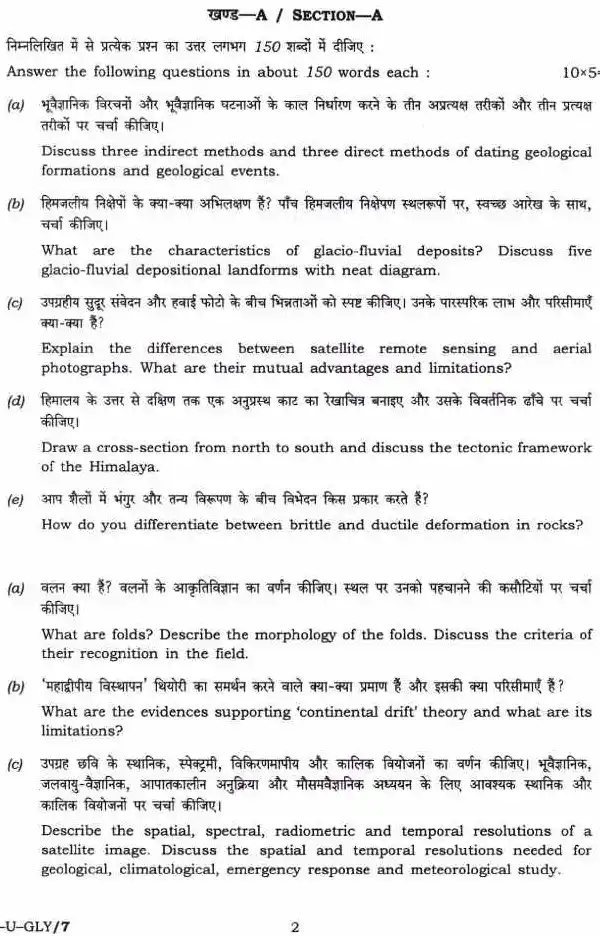
  • इसमें आठ प्रश्न हैं जो दो खण्डों में विभाजित हैं तथा हिन्दी एवं अंग्रेजी दोनों में छपे हैं।
  • उम्मीदवार को कुल पाँच प्रश्नों के उत्तर देने हैं।
  • प्रश्न संख्या 1 और 5 अनिवार्य हैं तथा बाकी प्रश्नों में से प्रत्येक खण्ड से कम-से-कम एक प्रश्न चुनकर तीन प्रश्नों के उत्तर दीजिए।
  • प्रत्येक प्रश्न/भाग के अंक उसके सामने दिए गए हैं।
  • प्रश्नों के उत्तर उसी माध्यम में लिखे जाने चाहिए जिसका उल्लेख आपके प्रवेश-पत्र में किया गया है, और इस माध्यम का स्पष्ट उल्लेख प्रश्न-सह-उत्तर (क्यू० सी० ए०) पुस्तिका के मुखपृष्ठ पर अंकित निर्दिष्ट स्थान पर किया जाना चाहिए।
  • उल्लिखित माध्यम के अतिरिक्त अन्य किसी माध्यम में लिखे गए उत्तर पर कोई अंक नहीं मिलेंगे।
  • प्रश्नों में शब्द-सीमा, जहाँ विनिर्दिष्ट है, का अनुसरण किया जाना चाहिए।
  • प्रश्न का उत्तर देते समय, जहाँ आवश्यक हो, उत्तरों के लिए दिए गए स्थान में ही आरेख/चित्र बनाइए।
  • प्रश्नों के उत्तरों की गणना क्रमानुसार की जाएगी।
  • यदि काटा नहीं हो, तो प्रश्न के उत्तर की गणना की जाएगी चाहे वह उत्तर अंशतः दिया गया हो।
  • प्रश्न-सह-उत्तर पुस्तिका में खाली छोड़ा हुआ पृष्ठ या उसके अंश को स्पष्ट रूप से काटा जाना चाहिए।

  • There are EIGHT questions divided in two Sections and printed both in HINDI and in ENGLISH.
  • Candidate has to attempt FIVE questions in all.
  • Question Nos. 1 and 5 are compulsory and out of the remaining, THREE are to be attempted choosing at least ONE from each Section.
  • The number of marks carried by a question/part is indicated against it.
  • Answers must be written in the medium authorized in the Admission Certificate which must be stated clearly on the cover of this Question-cum-Answer (QCA) Booklet in the space provided.
  • No marks will be given for answers written in a medium other than the authorized one.
  • Word limit in questions, wherever specified, should be adhered to.
  • Diagrams/Sketches, wherever required, may be drawn in the space provided for answering the question itself.
  • Attempts of questions shall be counted in sequential order.
  • Unless struck off, attempt of a question shall be counted even if attempted partly.
  • Any page or portion of the page left blank in the Ouestion-cum-Answer Booklet must be clearly struck off.

Questions (page 2)

Section A

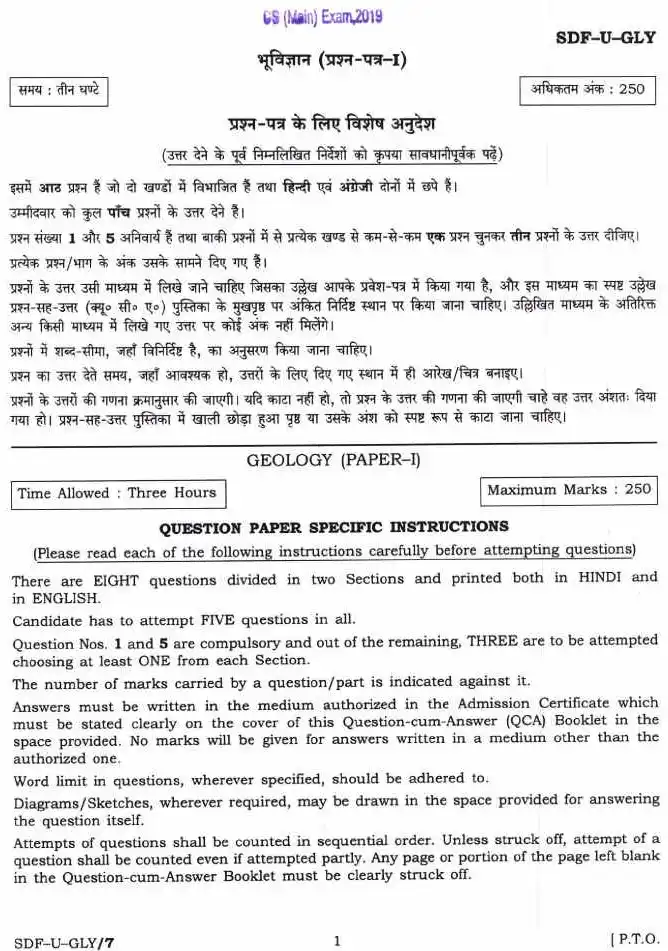
Q1. Answer the following questions in about 150 words each :
निम्नलिखित में से प्रत्येक प्रश्न का उत्तर लगभग 150 शब्दों में दीजिए :

(a) भूवैज्ञानिक विरचनों और भूवैज्ञानिक घटनाओं के काल निर्धारण करने के तीन अप्रत्यक्ष तरीकों और तीन प्रत्यक्ष तरीकों पर चर्चा कीजिए।

Discuss three indirect methods and three direct methods of dating geological formations and geological events.

(b) हिमजलीय निक्षेपों के क्या-क्या अभिलक्षण हैं? पाँच हिमजलीय निक्षेपण स्थलरूपों पर, स्वच्छ आरेख के साथ, चर्चा कीजिए।

What are the characteristics of glacio-fluvial deposits? Discuss five glacio-fluvial depositional landforms with neat diagram.

(c) उपग्रहीय सुदूर संवेदन और हवाई फोटो के बीच भिन्नताओं को स्पष्ट कीजिए। उनके पारस्परिक लाभ और परिसीमाएँ क्या-क्या है?

Explain the differences between satellite remote sensing and aerial photographs. What are their mutual advantages and limitations?

(d) हिमालय के उत्तर से दक्षिण तक एक अनुप्रस्थ काट का रेखाचित्र बनाइए और उसके विवर्तनिक ढाँचे पर चर्चा कीजिए।

Draw a cross-section from north to south and discuss the tectonic framework of the Himalaya.

(e) आप शैलों में भंगुर और तन्य विरूपण के बीच विभेदन किस प्रकार करते हैं?

How do you differentiate between brittle and ductile deformation in rocks?
Section A

Q2.

(a) वलन क्या हैं? वलनों के आकृतिविज्ञान का वर्णन कीजिए। स्थल पर उनको पहचानने की कसौटियों पर चर्चा कीजिए।

What are folds? Describe the morphology of the folds. Discuss the criteria of their recognition in the field.

(b) 'महाद्वीपीय विस्थापन' थियोरी का समर्थन करने वाले क्या-क्या प्रमाण हैं और इसकी क्या परिसीमाएँ हैं ?

What are the evidences supporting 'continental drift' theory and what are its limitations?

(c) उपग्रह छवि के स्थानिक, स्पेक्ट्रमी, विकिरणमापीय और कालिक वियोजनों का वर्णन कीजिए। भूवैज्ञानिक, जलवायु-वैज्ञानिक, आपातकालीन अनुक्रिया और मौसमवैज्ञानिक अध्ययन के लिए आवश्यक स्थानिक और कालिक वियोजनों पर चर्चा कीजिए।

Describe the spatial, spectral, radiometric and temporal resolutions of a satellite image. Discuss the spatial and temporal resolutions needed for geological, climatological, emergency response and meteorological study.

Question paper preview

Scanned pages 1–2 for reference. Download the official PDF for the full paper.

Page 1
UPSC Civil Services Mains 2019 Geology Paper I question paper page 1 instructions scan PDF download
Page 2
UPSC Civil Services Mains 2019 Geology Paper I question paper page 1 instructions scan PDF download

Free question paper download

Download question paper PDF

  • 1.3 MB
  • 4 pages
  • PDF format

Frequently asked questions

What is the name of the exam?

The exam is the UPSC Civil Services Main Examination.

What is the subject of this paper?

This paper is for Geology, specifically Paper I.

What year is this question paper from?

This question paper is from the year 2019.

Who conducts the Civil Services Examination?

The Union Public Service Commission (UPSC) conducts the Civil Services Examination.

What is the maximum marks for Geology Paper I?

The maximum marks for Geology Paper I is 250.

What is the time allowed for Geology Paper I?

The time allowed for Geology Paper I is Three Hours.

← Back to Other Jobs papers