Combined Geo-Scientist Main 2023 Geo-Physics Paper III PDF

Central Government Jobs Other Jobs 2023

  • Year 2023
  • Conducted By UPSC
  • Questions 10
  • Maximum Marks 200
  • Duration Three Hours
  • Languages English

Exam Details

Detail Information
Examination Combined Geo-Scientist (Main) Examination
Year 2023
Conducting Body UPSC
Paper GEO-PHYSICS PAPER-III
Subject Geo-Physics
Duration Three Hours
Maximum Marks 200
Number of Questions 10
Question Type Mixed

This document contains the Combined Geo-Scientist (Main) Examination 2023 question paper for Geo-Physics Paper III. Conducted by UPSC, this paper is designed to assess candidates' in-depth knowledge of Geo-Physics. It consists of 10 questions spread across two sections, with a total maximum mark of 200 and a time limit of three hours. Candidates are required to attempt six questions in total, including compulsory questions 1 and 6, and four additional questions chosen from the remaining eight (two from each section). The paper is to be answered in English only. This paper is a crucial resource for aspirants preparing for the Geo-Scientist examination, providing insights into the exam pattern, question types, and difficulty level.

Major Topics Covered

  • Geoid height anomaly
  • Isostatic density distribution
  • Seismic signal reflection
  • Gravity anomalies
  • Magnetic anomalies
  • P-wave and S-wave refraction
  • Mode conversion
  • Signal processing
  • Remote sensing
  • Electromagnetic radiation
  • Coastal aquifers
  • Reflection and transmission coefficients
  • Crustal density
  • Mountain range formation

Why This Paper is Important

  • Useful for Combined Geo-Scientist (Main) Examinatio preparation
  • Helps understand the latest exam pattern
  • Useful for practice and self-assessment
  • Covers frequently asked General Studies topics
  • Helpful for analysing question trends

Related Resources

  • Combined Geo-Scientist (Main) Examination 2023 - Geology Paper-I
  • Combined Geo-Scientist (Main) Examination 2023 - Geology Paper-II
  • Combined Geo-Scientist (Main) Examination 2023 - Geophysics Paper-I
  • Combined Geo-Scientist (Main) Examination 2023 - Geophysics Paper-II
  • Combined Geo-Scientist (Main) Examination 2023 - Chemistry Paper-I
  • Combined Geo-Scientist (Main) Examination 2023 - Chemistry Paper-II
  • Combined Geo-Scientist (Main) Examination 2023 Geo-Physics Paper III Answer Key
  • Combined Geo-Scientist (Main) Examination Syllabus

Instructions

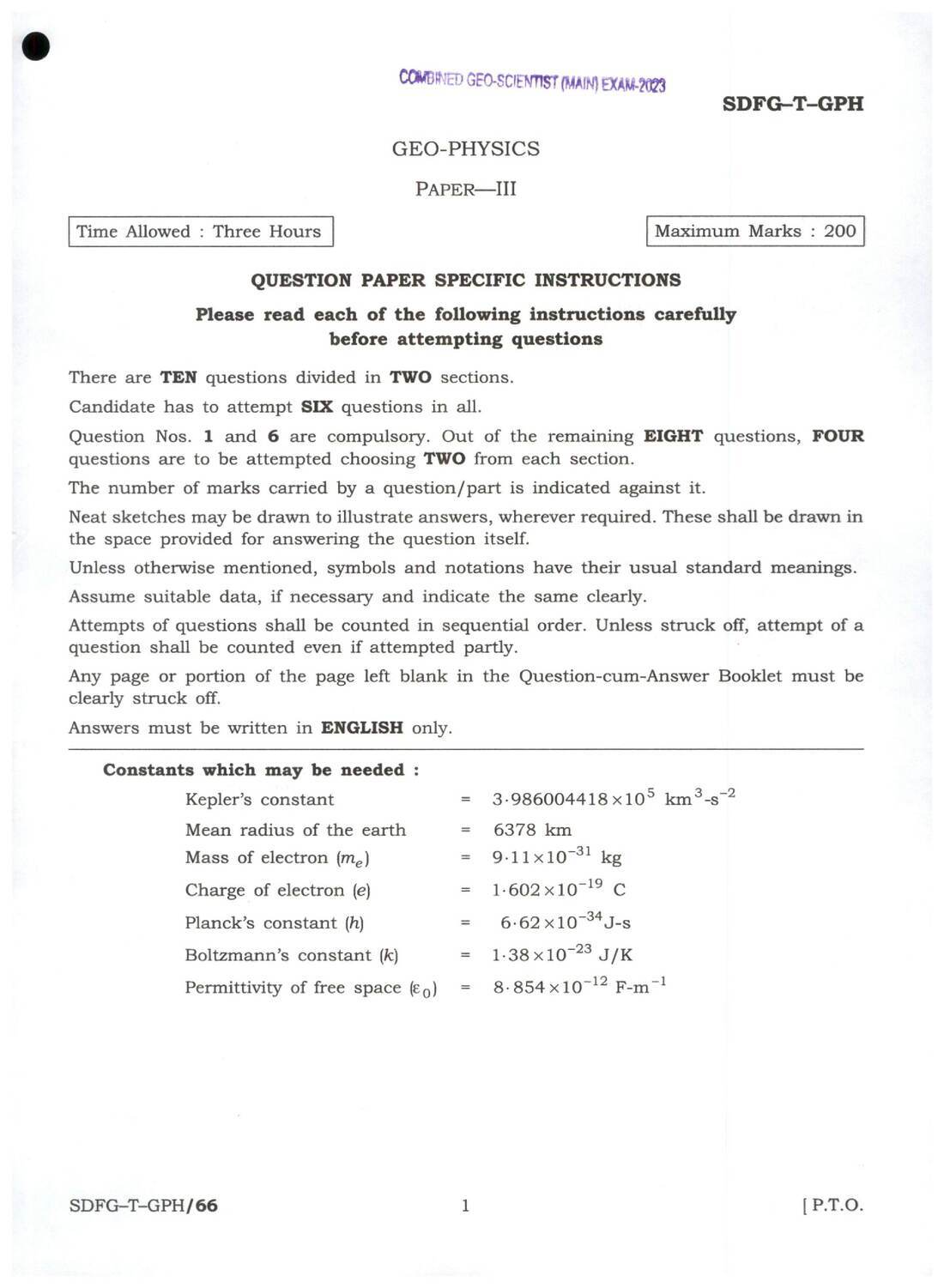
  • There are TEN questions divided in TWO sections.
  • Candidate has to attempt SIX questions in all.
  • Out of the remaining EIGHT questions, FOUR questions are to be attempted choosing TWO from each section.
  • The number of marks carried by a question/part is indicated against it.
  • Neat sketches may be drawn to illustrate answers, wherever required.
  • These shall be drawn in the space provided for answering the question itself.
  • Unless otherwise mentioned, symbols and notations have their usual standard meanings.
  • Assume suitable data, if necessary and indicate the same clearly.
  • Attempts of questions shall be counted in sequential order.
  • Unless struck off, attempt of a question shall be counted even if attempted partly.
  • Any page or portion of the page left blank in the Question-cum-Answer Booklet must be clearly struck off.
  • Answers must be written in ENGLISH only.

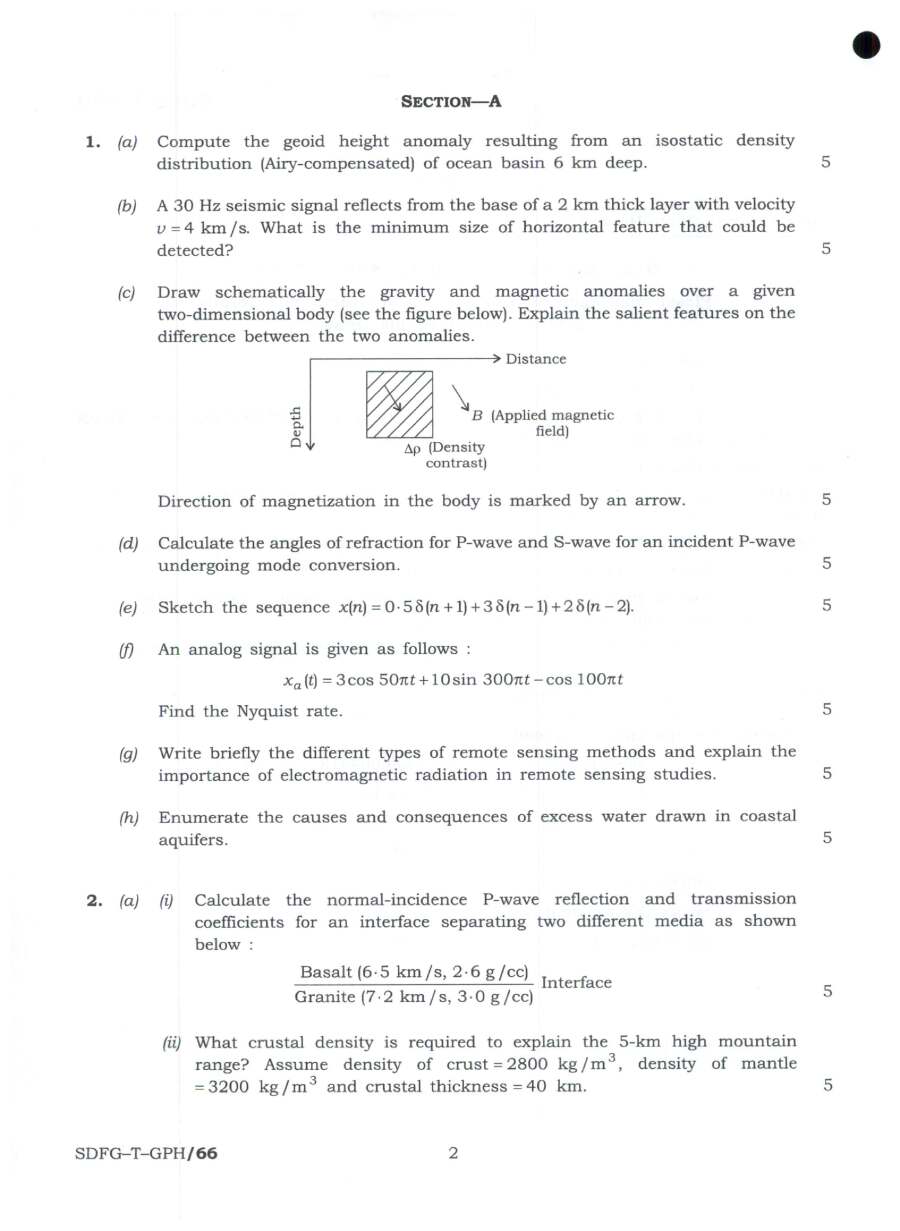
Questions (page 2)

Section A

Q1.

(a) Compute the geoid height anomaly resulting from an isostatic density distribution (Airy-compensated) of ocean basin 6 km deep.

(b) A 30 Hz seismic signal reflects from the base of a 2 km thick layer with velocity v = 4 km/s. What is the minimum size of horizontal feature that could be detected?

(c) Draw schematically the gravity and magnetic anomalies over a given two-dimensional body (see the figure below). Explain the salient features on the difference between the two anomalies.
Direction of magnetization in the body is marked by an arrow.

(d) Calculate the angles of refraction for P-wave and S-wave for an incident P-wave undergoing mode conversion.

(e) Sketch the sequence x(n) = 0.5delta(n+1) + 3delta(n-1) + 2delta(n-2).

(f) An analog signal is given as follows :
xa(t) = 3cos 50pi t + 10sin 300pi t - cos 100pi t
Find the Nyquist rate.

(g) Write briefly the different types of remote sensing methods and explain the importance of electromagnetic radiation in remote sensing studies.

(h) Enumerate the causes and consequences of excess water drawn in coastal aquifers.
Section A

Q2.

(a) (i) Calculate the normal-incidence P-wave reflection and transmission coefficients for an interface separating two different media as shown below:
Basalt (6.5 km/s, 2.6 g/cc) Interface
Granite (7.2 km/s, 3.0 g/cc)
(ii) What crustal density is required to explain the 5-km high mountain range? Assume density of crust = 2800 kg/m^3, density of mantle = 3200 kg/m^3 and crustal thickness = 40 km.

Question paper preview

Scanned pages 1–2 for reference. Download the official PDF for the full paper.

Page 1
Combined Geo-Scientist Main 2023 Geo-Physics Paper III question paper page 1 instructions and exam header scan PDF download
Page 2
Combined Geo-Scientist Main 2023 Geo-Physics Paper III question paper page 1 instructions and exam header scan PDF download

Free question paper download

Download question paper PDF

  • 2.0 MB
  • 6 pages
  • PDF format

Frequently asked questions

What is the name of the examination?

The examination is the Combined Geo-Scientist (Main) Examination.

Which paper is this question paper for?

This is the Geo-Physics Paper-III.

What is the conducting body for this exam?

The examination is conducted by UPSC (Union Public Service Commission).

What is the year of this examination?

The year of the examination is 2023.

What is the maximum marks for Geo-Physics Paper-III?

The maximum marks for Geo-Physics Paper-III is 200.

What is the time allowed to complete the paper?

The time allowed to complete the paper is Three Hours.

← Back to Other Jobs papers