Combined Geo-Scientist Main 2023 Chemistry Paper II PDF

Central Government Jobs Other Jobs 2023

  • Year 2023
  • Conducted By UPSC
  • Questions 15
  • Maximum Marks 200
  • Duration Three Hours
  • Languages English

Exam Details

Detail Information
Examination Combined Geo-Scientist (Main) Examination
Year 2023
Conducting Body UPSC
Paper Chemistry Paper-II
Subject Chemistry
Duration Three Hours
Maximum Marks 200
Number of Questions 15
Question Type Mixed

This is the official question paper for the Combined Geo-Scientist (Main) Examination 2023, specifically for Chemistry Paper II, conducted by UPSC. The paper carries a maximum of 200 marks and is allocated a duration of three hours. It consists of fifteen questions divided into three sections, with specific instructions on the number of questions to be attempted from each section. Section A is compulsory, followed by a selection of questions from Sections B and C. This paper is crucial for candidates aspiring to join the geological services, testing their in-depth knowledge of chemistry.

Major Topics Covered

  • Physical Chemistry
  • Chemical Kinetics
  • Thermodynamics
  • Electrochemistry
  • Solid State Chemistry
  • Solutions
  • Surface Chemistry

Why This Paper is Important

  • Useful for Combined Geo-Scientist (Main) Examinatio preparation
  • Helps understand the latest exam pattern
  • Useful for practice and self-assessment
  • Covers frequently asked General Studies topics
  • Helpful for analysing question trends

Related Resources

  • Combined Geo-Scientist (Main) Examination 2023 - Geology Paper-I
  • Combined Geo-Scientist (Main) Examination 2023 - Geology Paper-II
  • Combined Geo-Scientist (Main) Examination 2023 - Chemistry Paper-I
  • Combined Geo-Scientist (Main) Examination 2022 - Chemistry Paper-II
  • Combined Geo-Scientist (Main) Examination 2023 Chemistry Paper-II Answer Key
  • Combined Geo-Scientist (Main) Examination Syllabus
  • UPSC Chemistry Syllabus for Mains
  • Combined Geo-Scientist (Main) Examination Pattern

Instructions

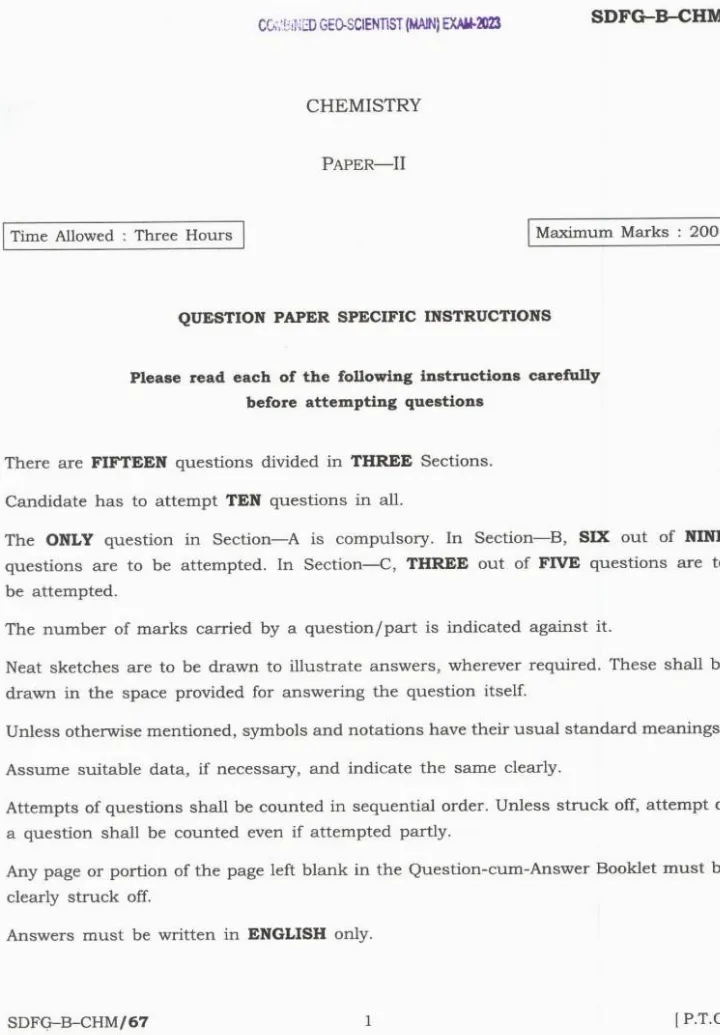
  • There are FIFTEEN questions divided in THREE Sections.
  • Candidate has to attempt TEN questions in all.
  • The ONLY question in Section-A is compulsory.
  • In Section-B, SIX out of NINE questions are to be attempted.
  • In Section-C, THREE out of FIVE questions are to be attempted.
  • The number of marks carried by a question/part is indicated against it.
  • Neat sketches are to be drawn to illustrate answers, wherever required.
  • These shall be drawn in the space provided for answering the question itself.
  • Unless otherwise mentioned, symbols and notations have their usual standard meanings.
  • Assume suitable data, if necessary, and indicate the same clearly.
  • Attempts of questions shall be counted in sequential order.
  • Unless struck off, attempt of a question shall be counted even if attempted partly.
  • Any page or portion of the page left blank in the Question-cum-Answer Booklet must be clearly struck off.
  • Answers must be written in ENGLISH only.

Questions (page 2)

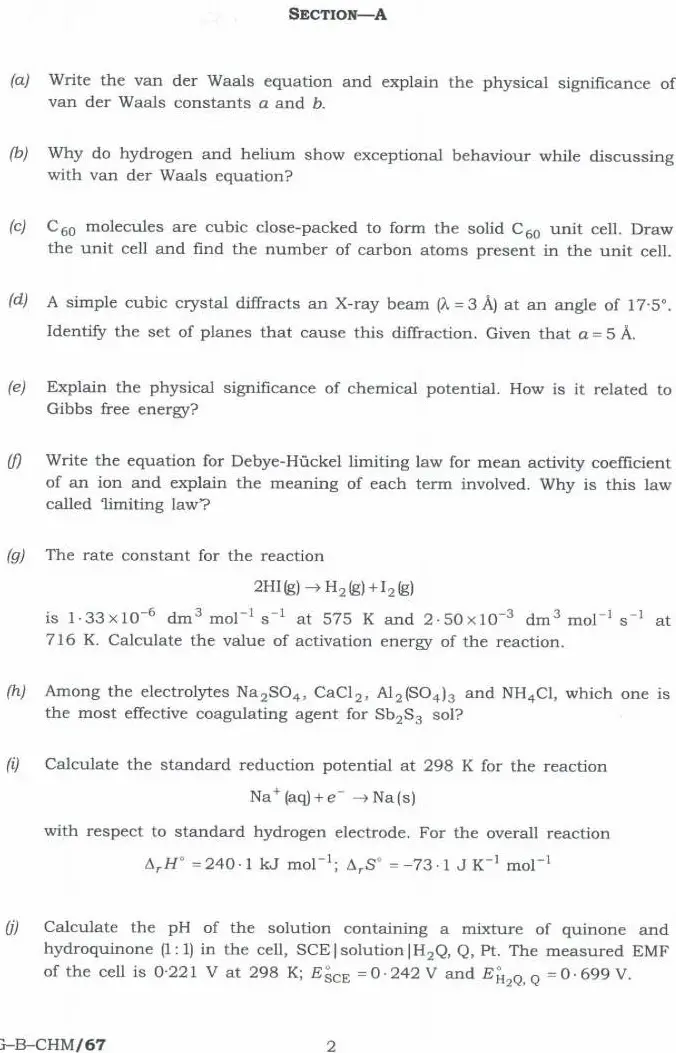
Section A

Q1.

(a) Write the van der Waals equation and explain the physical significance of van der Waals constants a and b.

(b) Why do hydrogen and helium show exceptional behaviour while discussing with van der Waals equation?

(c) C_{60} molecules are cubic close-packed to form the solid C_{60} unit cell. Draw the unit cell and find the number of carbon atoms present in the unit cell.

(d) A simple cubic crystal diffracts an X-ray beam (λ = 3 \text Å) at an angle of 17.5°. Identify the set of planes that cause this diffraction. Given that a = 5 \text Å.

(e) Explain the physical significance of chemical potential. How is it related to Gibbs free energy?

(f) Write the equation for Debye-Hückel limiting law for mean activity coefficient of an ion and explain the meaning of each term involved. Why is this law called limiting law?

(g) The rate constant for the reaction 2HI(g) → H2(g) + I2(g) is 1.33 × 10⁻⁶ dm3 mol-1 s-1 at 575 K and 2.50 × 10⁻³ dm3 mol-1 s-1 at 716 K. Calculate the value of activation energy of the reaction.

(h) Among the electrolytes Na2SO4, CaCl2, Al2(SO4)_3 and NH4Cl, which one is the most effective coagulating agent for Sb2S3 sol?

(i) Calculate the standard reduction potential at 298 K for the reaction Na^ + (aq) + e^- → Na (s) with respect to standard hydrogen electrode. For the overall reaction \Deltar H\circ = 240 \cdot 1 \text kJ mol-1; \Deltar S\circ = -73 \cdot 1 \text J K-1 \text mol-1

(j) Calculate the pH of the solution containing a mixture of quinone and hydroquinone (1:1) in the cell, SCE | solution |H2Q, Q, Pt. The measured EMF of the cell is 0.221 V at 298 K; ESCE\circ = 0.242 V and EH2Q, Q\circ = 0.699 V.
Question paper preview

Scanned pages 1–2 for reference. Download the official PDF for the full paper.

Page 1
Combined Geo-Scientist Main 2023 Chemistry Paper II question paper page 1 instructions scan PDF download
Page 2
Combined Geo-Scientist Main 2023 Chemistry Paper II question paper page 1 instructions scan PDF download

Free question paper download

Download question paper PDF

  • 1.8 MB
  • 6 pages
  • PDF format

Frequently asked questions

What is the name of the examination?

The examination is the Combined Geo-Scientist (Main) Examination.

Which year is this question paper for?

This question paper is for the 2023 examination.

Who conducts the Combined Geo-Scientist Examination?

The examination is conducted by UPSC (Union Public Service Commission).

What is the subject and paper code for this question paper?

The subject is Chemistry, and the paper is Paper-II with the code SDFG-B-CHM.

What is the maximum marks for Chemistry Paper-II?

The maximum marks for Chemistry Paper-II is 200.

What is the time allowed to complete the paper?

The time allowed to complete the paper is Three Hours.

← Back to Other Jobs papers