Section A
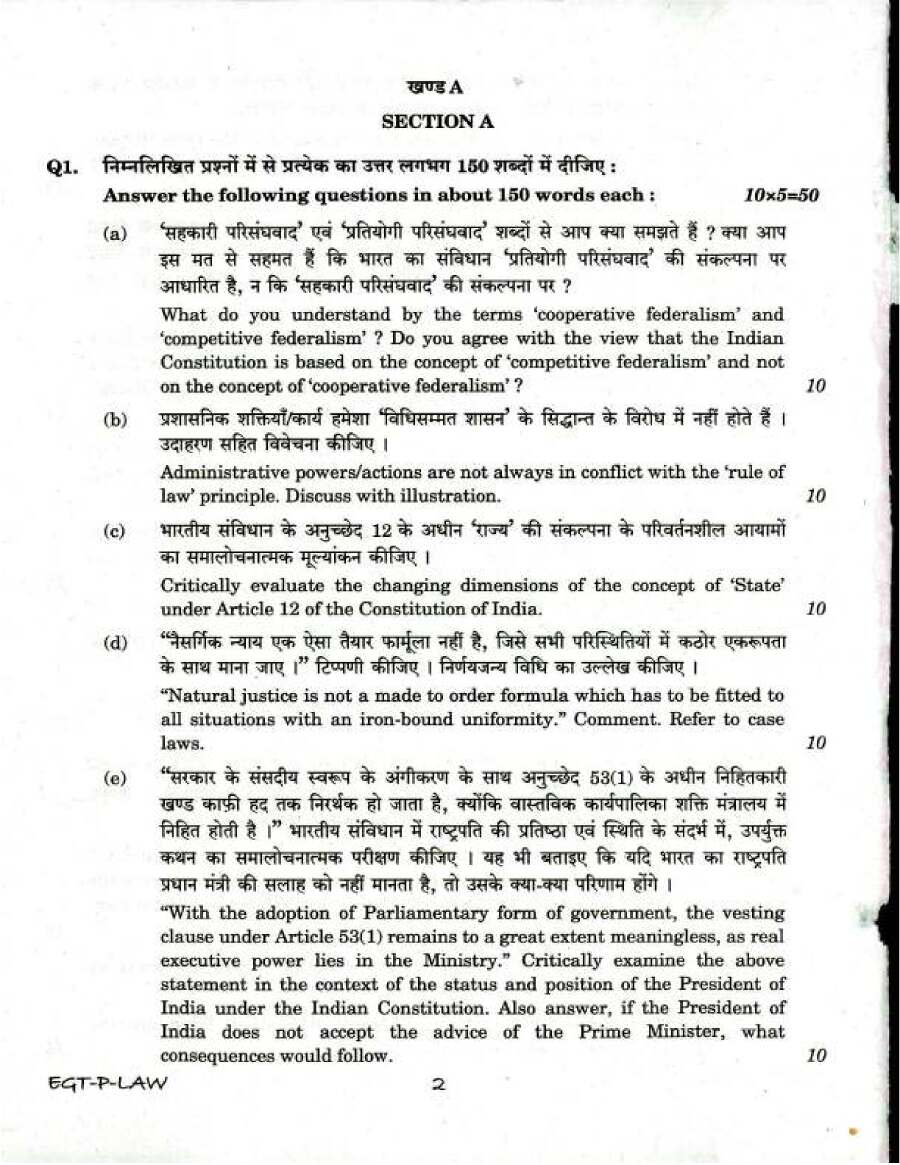
Q1.
Answer the following questions in about 150 words each :
निम्नलिखित प्रश्नों में से प्रत्येक का उत्तर लगभग 150 शब्दों में दीजिए :
(a)
‘सहकारी परिसंघवाद’ एवं ‘प्रतियोगी परिसंघवाद’ शब्दों से आप क्या समझते हैं ? क्या आप इस मत से सहमत हैं कि भारत का संविधान ‘प्रतियोगी परिसंघवाद’ की संकल्पना पर आधारित है, न कि ‘सहकारी परिसंघवाद’ की संकल्पना पर ?
What do you understand by the terms 'cooperative federalism' and 'competitive federalism' ? Do you agree with the view that the Indian Constitution is based on the concept of 'competitive federalism' and not on the concept of 'cooperative federalism' ?
(b)
प्रशासनिक शक्तियाँ/कार्य हमेशा ‘विधिसम्मत शासन’ के सिद्धान्त के विरोध में नहीं होते हैं । उदाहरण सहित विवेचना कीजिए ।
Administrative powers/actions are not always in conflict with the 'rule of law' principle. Discuss with illustration.
(c)
भारतीय संविधान के अनुच्छेद 12 के अधीन ‘राज्य’ की संकल्पना के परिवर्तनशील आयामों का समालोचनात्मक मूल्यांकन कीजिए ।
Critically evaluate the changing dimensions of the concept of 'State' under Article 12 of the Constitution of India.
(d)
“नैसर्गिक न्याय एक ऐसा तैयार फार्मूला नहीं है, जिसे सभी परिस्थितियों में कठोर एकरूपता के साथ माना जाए ।” टिप्पणी कीजिए । निर्णयजन्य विधि का उल्लेख कीजिए ।
"Natural justice is not a made to order formula which has to be fitted to all situations with an iron-bound uniformity." Comment. Refer to case laws.
(e)
“सरकार के संसदीय स्वरूप के अंगीकरण के साथ अनुच्छेद 53(1) के अधीन निहितकारी खण्ड काफ़ी हद तक निरर्थक हो जाता है, क्योंकि वास्तविक कार्यपालिका शक्ति मंत्रालय में निहित होती है ।” भारतीय संविधान में राष्ट्रपति की प्रतिष्ठा एवं स्थिति के संदर्भ में, उपर्युक्त कथन का समालोचनात्मक परीक्षण कीजिए । यह भी बताइए कि यदि भारत का राष्ट्रपति प्रधान मंत्री की सलाह को नहीं मानता है, तो उसके क्या-क्या परिणाम होंगे ।
"With the adoption of Parliamentary form of government, the vesting clause under Article 53(1) remains to a great extent meaningless, as real executive power lies in the Ministry." Critically examine the above statement in the context of the status and position of the President of India under the Indian Constitution. Also answer, if the President of India does not accept the advice of the Prime Minister, what consequences would follow.