UPSC Civil Services Main 2019 General Studies Paper II PDF

Central Government Jobs Other Jobs 2019

  • Year 2019
  • Conducted By UPSC
  • Questions 20
  • Maximum Marks 250
  • Duration Three Hours
  • Languages English & Hindi

Exam Details

Detail Information
Examination UPSC Civil Services Main Examination
Year 2019
Conducting Body UPSC
Paper General Studies Paper II
Subject General Studies
Duration Three Hours
Maximum Marks 250
Number of Questions 20
Question Type Descriptive / Subjective

This is the General Studies Paper II from the UPSC Civil Services Main Examination held in 2019. The paper consists of 20 descriptive questions, divided into two sections, requiring answers in 150 and 250 words respectively. It tests candidates' understanding of Indian Constitution, governance, policy-making, socio-economic development, and international relations. With a maximum of 250 marks and a time limit of three hours, this paper is crucial for aspirants aiming to assess their analytical and writing skills in depth. Analyzing this paper helps in understanding the depth and breadth of topics expected in the UPSC Mains.

Major Topics Covered

  • Indian Constitution
  • Separation of Powers
  • Checks and Balance
  • Central Administrative Tribunal
  • Judicial Authority
  • Policy Making
  • Farmers' Organisations
  • Legislative Powers
  • Federal Supremacy
  • Harmonious Construction
  • Secularism
  • Human Development
  • Inclusive Development
  • Poverty
  • Hunger
  • Social Expenditure
  • Information and Communication Technology (ICT)
  • Governance

Why This Paper is Important

  • Useful for UPSC Civil Services Main Examination preparation
  • Helps understand the latest exam pattern
  • Useful for practice and self-assessment
  • Covers frequently asked General Studies topics
  • Helpful for analysing question trends

Related Resources

  • UPSC Civil Services Main 2019 General Studies Paper I
  • UPSC Civil Services Main 2019 Essay Paper
  • UPSC Civil Services Main 2019 Optional Subject Papers
  • UPSC Civil Services Preliminary 2019 Question Paper
  • UPSC Civil Services Main 2019 General Studies Paper II Answer Key
  • UPSC Civil Services Main Syllabus
  • UPSC General Studies Paper II Syllabus
  • UPSC Civil Services Main Exam Pattern

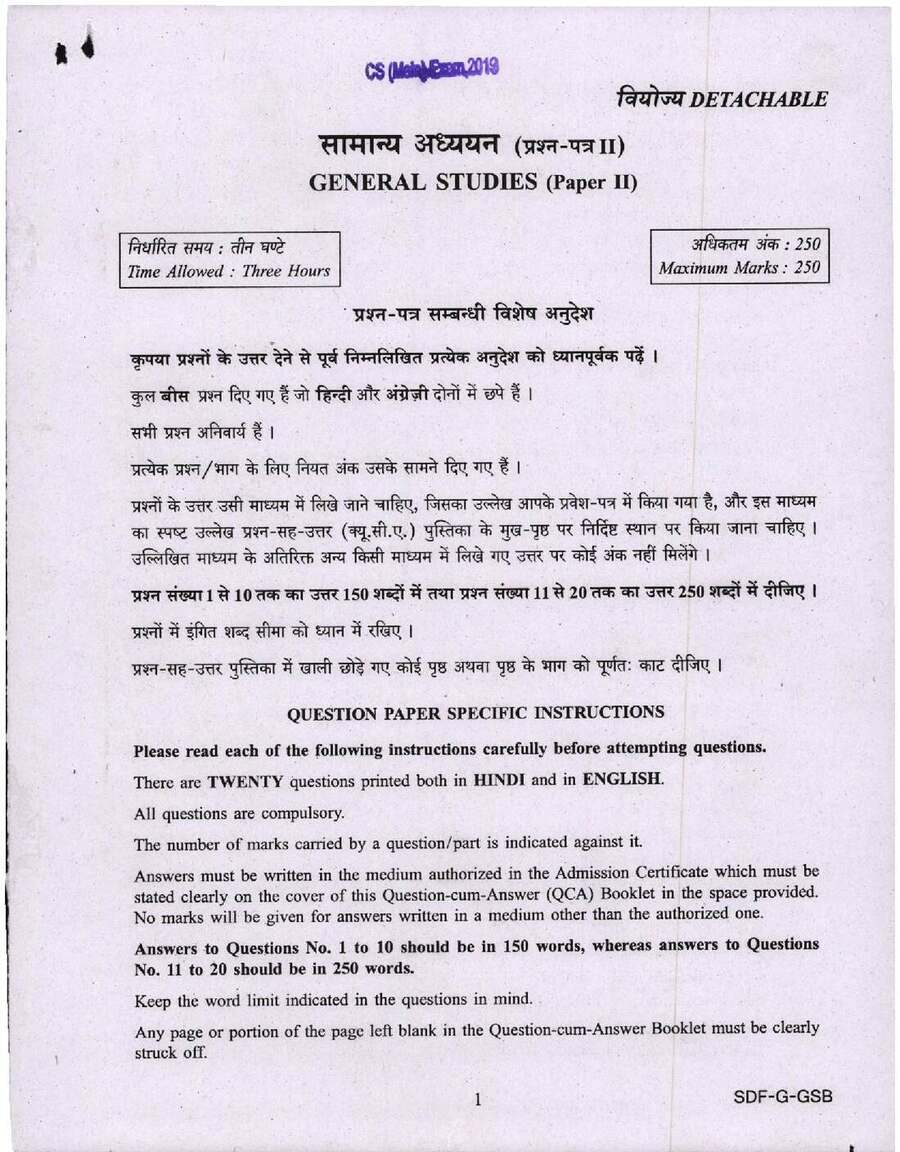
Instructions

  • पुस्तिका के मुख-पृष्ठ पर निर्दिष्ट स्थान पर किया जाना चाहिए।
  • उल्लिखित माध्यम के अतिरिक्त अन्य किसी माध्यम में लिखे गए उत्तर पर कोई अंक नहीं मिलेंगे।
  • प्रश्न संख्या 1 से 10 तक का उत्तर 150 शब्दों में तथा प्रश्न संख्या 11 से 20 तक का उत्तर 250 शब्दों में दीजिए ।
  • प्रश्नों में इंगित शब्द सीमा को ध्यान में रखिए ।
  • प्रश्न-सह-उत्तर पुस्तिका में खाली छोड़े गए कोई पृष्ठ अथवा पृष्ठ के भाग को पूर्णत: काट दीजिए।

  • There are TWENTY questions printed both in HINDI and in ENGLISH.
  • The number of marks carried by a question/part is indicated against it.
  • Answers must be written in the medium authorized in the Admission Certificate which must be stated clearly on the cover of this Question-cum-Answer (QCA) Booklet in the space provided.
  • No marks will be given for answers written in a medium other than the authorized one.
  • Answers to Questions No. 1 to 10 should be in 150 words, whereas answers to Questions No. 11 to 20 should be in 250 words.
  • Keep the word limit indicated in the questions in mind.
  • Any page or portion of the page left blank in the Question-cum-Answer Booklet must be clearly struck off.

Questions (page 2)

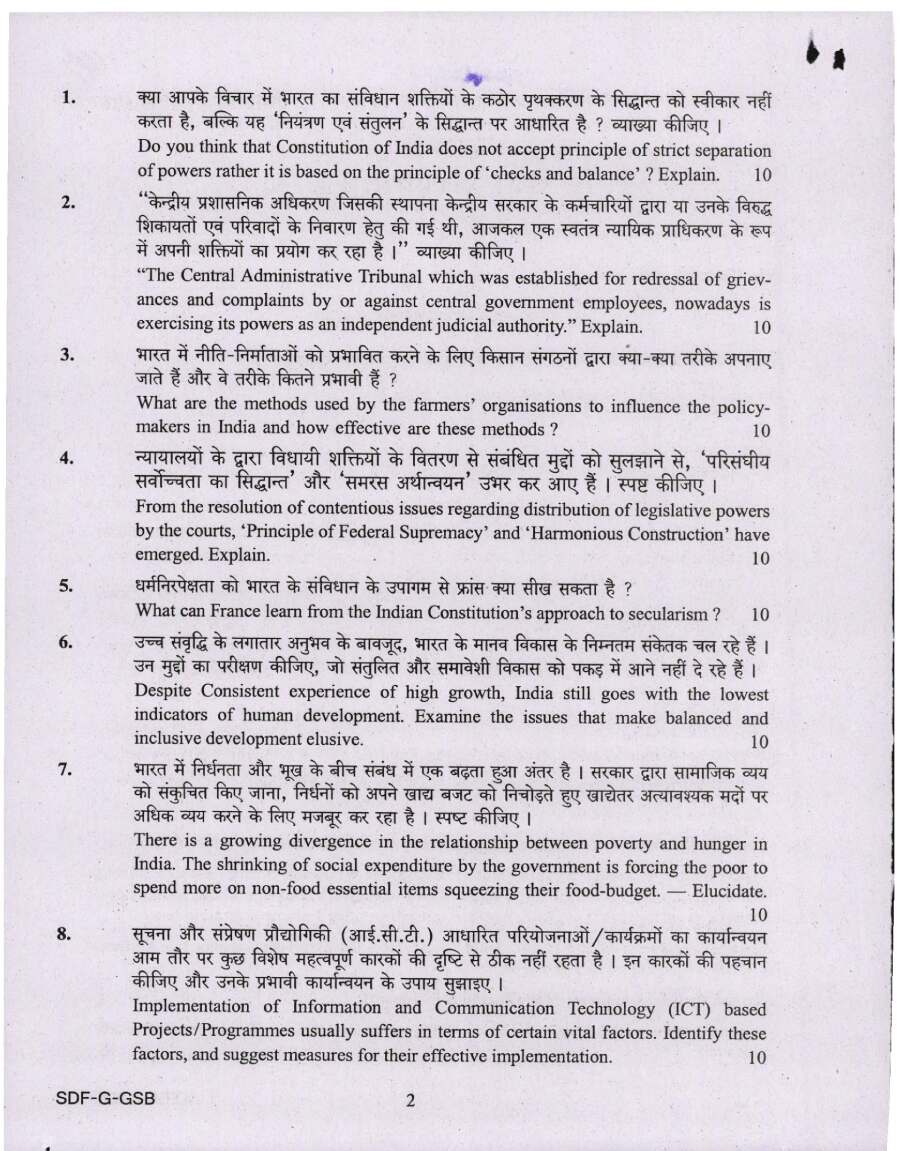
Q1.

(a) क्या आपके विचार में भारत का संविधान शक्तियों के कठोर पृथक्करण के सिद्धान्त को स्वीकार नहीं करता है, बल्कि यह ‘नियंत्रण एवं संतुलन’ के सिद्धान्त पर आधारित है ? व्याख्या कीजिए ।
Do you think that Constitution of India does not accept principle of strict separation of powers rather it is based on the principle of 'checks and balance' ? Explain.
Q2.

(a) “केन्द्रीय प्रशासनिक अधिकरण जिसकी स्थापना केन्द्रीय सरकार के कर्मचारियों द्वारा या उनके विरुद्ध शिकायतों एवं परिवादों के निवारण हेतु की गई थी, आजकल एक स्वतंत्र न्यायिक प्राधिकरण के रूप में अपनी शक्तियों का प्रयोग कर रहा है।” व्याख्या कीजिए।
"The Central Administrative Tribunal which was established for redressal of griev- ances and complaints by or against central government employees, nowadays is exercising its powers as an independent judicial authority." Explain.

Q3.

(a) भारत में नीति-निर्माताओं को प्रभावित करने के लिए किसान संगठनों द्वारा क्या-क्या तरीके अपनाए जाते हैं और वे तरीके कितने प्रभावी हैं ?
What are the methods used by the farmers' organisations to influence the policy- makers in India and how effective are these methods?

Q4.

(a) न्यायालयों के द्वारा विधायी शक्तियों के वितरण से संबंधित मुद्दों को सुलझाने से, ‘परिसंघीय सर्वोच्चता का सिद्धान्त' और 'समरस अर्थान्वयन' उभर कर आए हैं। स्पष्ट कीजिए।
From the resolution of contentious issues regarding distribution of legislative powers by the courts, 'Principle of Federal Supremacy' and 'Harmonious Construction' have emerged. Explain.

Q5.

(a) धर्मनिरपेक्षता को भारत के संविधान के उपागम से फ्रांस क्या सीख सकता है ?
What can France learn from the Indian Constitution's approach to secularism?

Q6.

(a) उच्च संवृद्धि के लगातार अनुभव के बावजूद, भारत के मानव विकास के निम्नतम संकेतक चल रहे हैं। उन मुद्दों का परीक्षण कीजिए, जो संतुलित और समावेशी विकास को पकड़ में आने नहीं दे रहे हैं।
Despite Consistent experience of high growth, India still goes with the lowest indicators of human development. Examine the issues that make balanced and inclusive development elusive.

Q7.

(a) भारत में निर्धनता और भूख के बीच संबंध में एक बढ़ता हुआ अंतर है । सरकार द्वारा सामाजिक व्यय को संकुचित किए जाना, निर्धनों को अपने खाद्य बजट को निचोड़ते हुए खाद्येतर अत्यावश्यक मदों पर अधिक व्यय करने के लिए मजबूर कर रहा है। स्पष्ट कीजिए।
There is a growing divergence in the relationship between poverty and hunger in India. The shrinking of social expenditure by the government is forcing the poor to spend more on non-food essential items squeezing their food-budget. - Elucidate.

Q8.

(a) सूचना और संप्रेषण प्रौद्योगिकी (आई.सी.टी.) आधारित परियोजनाओं/कार्यक्रमों का कार्यान्वयन आम तौर पर कुछ विशेष महत्वपूर्ण कारकों की दृष्टि से ठीक नहीं रहता है। इन कारकों की पहचान कीजिए और उनके प्रभावी कार्यान्वयन के उपाय सुझाइए।
Implementation of Information and Communication Technology (ICT) based Projects/Programmes usually suffers in terms of certain vital factors. Identify these factors, and suggest measures for their effective implementation.

Question paper preview

Scanned pages 1–2 for reference. Download the official PDF for the full paper.

Page 1
UPSC Civil Services Main 2019 General Studies Paper II question paper page 1 instructions scan PDF download
Page 2
UPSC Civil Services Main 2019 General Studies Paper II question paper page 1 instructions scan PDF download

Free question paper download

Download question paper PDF

  • 2.2 MB
  • 4 pages
  • PDF format

Frequently asked questions

What is the name of the exam?

The exam is the UPSC Civil Services Main Examination.

What year is this question paper from?

This question paper is from the year 2019.

Who conducts the Civil Services Main Examination?

The examination is conducted by the Union Public Service Commission (UPSC).

What is the subject of this paper?

The subject is General Studies, specifically Paper II.

What is the maximum marks for this paper?

The maximum marks for General Studies Paper II is 250.

What is the time allowed to complete this paper?

The time allowed is Three Hours.

← Back to Other Jobs papers