UPSC Civil Services Main Philosophy Paper I 2019 Question Paper PDF

Central Government Jobs Other Jobs 2019

  • Year 2019
  • Conducted By UPSC
  • Questions 8
  • Maximum Marks 250
  • Duration Three Hours
  • Languages Hindi & English

Exam Details

Detail Information
Examination Civil Services Main Examination
Year 2019
Conducting Body UPSC
Paper Philosophy Paper - I
Subject Philosophy
Duration Three Hours
Maximum Marks 250
Number of Questions 8
Question Type Mixed

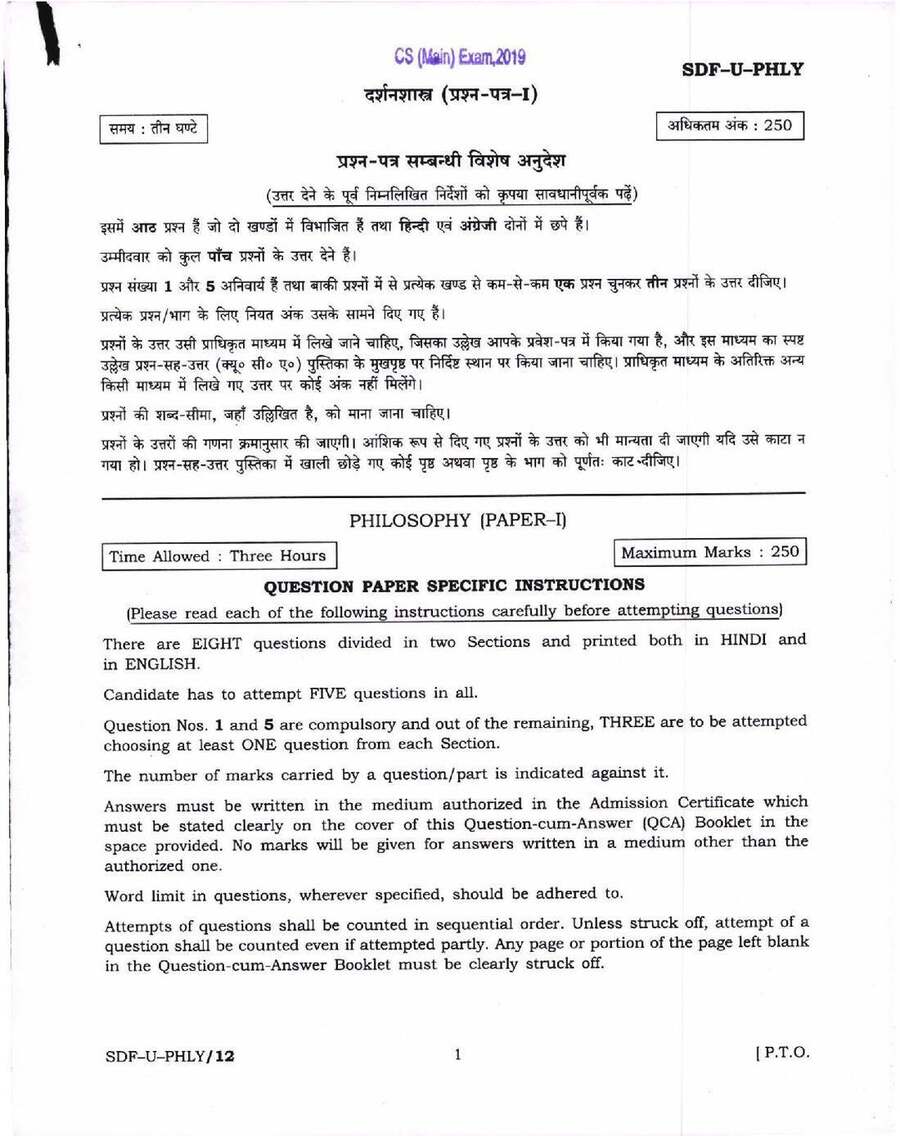
This is the Philosophy Paper I from the UPSC Civil Services Main Examination held in 2019. The paper is divided into two sections with a total of eight questions, and candidates are required to answer five questions in all. Compulsory questions are number 1 and 5, with at least one question to be attempted from each section. The paper carries a maximum of 250 marks and is to be completed within three hours. This question paper is crucial for aspirants aiming to understand the depth and breadth of philosophical concepts tested in the UPSC Mains exam.

Major Topics Covered

  • Plato's Allegory of Cave
  • Husserl's Phenomenology
  • Hegel's Dialectics
  • Descartes' Philosophy
  • Quine's Arguments
  • Logical Positivism
  • Aristotle's Substance
  • Spinoza's Philosophy
  • Heidegger's Dasein
  • Wittgenstein's Philosophy of Language
  • Moore's Common-Sense Realism

Why This Paper is Important

  • Useful for Civil Services Main Examination preparation
  • Helps understand the latest exam pattern
  • Useful for practice and self-assessment
  • Covers frequently asked General Studies topics
  • Helpful for analysing question trends

Related Resources

  • UPSC Civil Services Main Examination 2018 Philosophy Paper I
  • UPSC Civil Services Main Examination 2020 Philosophy Paper I
  • UPSC Civil Services Main Examination 2019 Philosophy Paper II
  • UPSC Civil Services Main Examination 2019 General Studies Paper I
  • UPSC Civil Services Main Examination 2019 Philosophy Paper I Answer Key
  • Philosophy Paper I 2019 UPSC Mains Answer Key
  • UPSC Civil Services Main Examination Philosophy Syllabus
  • Philosophy Optional Subject Syllabus UPSC Mains

Instructions

  • इसमें आठ प्रश्न हैं जो दो खण्डों में विभाजित हैं तथा हिन्दी एवं अंग्रेजी दोनों में छपे हैं।
  • उम्मीदवार को कुल पाँच प्रश्नों के उत्तर देने हैं।
  • प्रश्न संख्या 1 और 5 अनिवार्य हैं तथा बाकी प्रश्नों में से प्रत्येक खण्ड से कम-से-कम एक प्रश्न चुनकर तीन प्रश्नों के उत्तर दीजिए।
  • प्रत्येक प्रश्न/भाग के लिए नियत अंक उसके सामने दिए गए हैं।
  • प्रश्नों के उत्तर उसी प्राधिकृत माध्यम में लिखे जाने चाहिए, जिसका उल्लेख आपके प्रवेश-पत्र में किया गया है, और इस माध्यम का स्पष्ट उल्लेख प्रश्न-सह-उत्तर (क्यू॰ सी॰ ए॰) पुस्तिका के मुखपृष्ठ पर निर्दिष्ट स्थान पर किया जाना चाहिए।
  • प्राधिकृत माध्यम के अतिरिक्त अन्य किसी माध्यम में लिखे गए उत्तर पर कोई अंक नहीं मिलेंगे।
  • प्रश्नों की शब्द-सीमा, जहाँ उल्लिखित है, को माना जाना चाहिए।
  • प्रश्नों के उत्तरों की गणना क्रमानुसार की जाएगी।
  • आंशिक रूप से दिए गए प्रश्नों के उत्तर को भी मान्यता दी जाएगी यदि उसे काटा न गया हो।
  • प्रश्न-सह-उत्तर पुस्तिका में खाली छोड़े गए कोई पृष्ठ अथवा पृष्ठ के भाग को पूर्णतः काट दीजिए।

  • There are EIGHT questions divided in two Sections and printed both in HINDI and in ENGLISH.
  • Candidate has to attempt FIVE questions in all.
  • Question Nos. 1 and 5 are compulsory and out of the remaining, THREE are to be attempted choosing at least ONE question from each Section.
  • The number of marks carried by a question/part is indicated against it.
  • Answers must be written in the medium authorized in the Admission Certificate which must be stated clearly on the cover of this Question-cum-Answer (QCA) Booklet in the space provided.
  • No marks will be given for answers written in a medium other than the authorized one.
  • Word limit in questions, wherever specified, should be adhered to.
  • Attempts of questions shall be counted in sequential order.
  • Unless struck off, attempt of a question shall be counted even if attempted partly.
  • Any page or portion of the page left blank in the Question-cum-Answer Booklet must be clearly struck off.

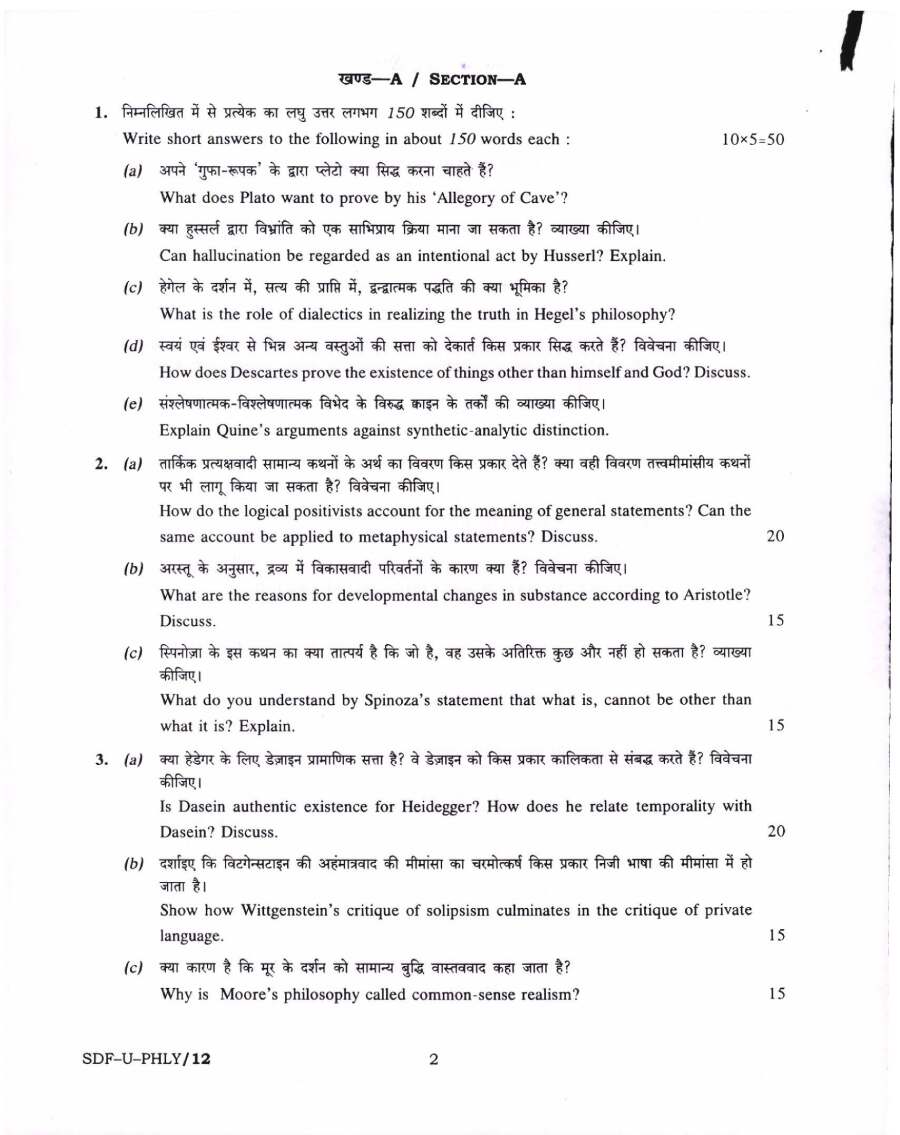
Questions (page 2)

Section A

Q1. निम्नलिखित में से प्रत्येक का लघु उत्तर लगभग 150 शब्दों में दीजिए: Write short answers to the following in about 150 words each:

(a) अपने 'गुफा-रूपक' के द्वारा प्लेटो क्या सिद्ध करना चाहते हैं?
What does Plato want to prove by his 'Allegory of Cave'?

(b) क्या हुस्सर्ल द्वारा विभ्रांति को एक साभिप्राय क्रिया माना जा सकता है? व्याख्या कीजिए।
Can hallucination be regarded as an intentional act by Husserl? Explain.

(c) हेगेल के दर्शन में, सत्य की प्राप्ति में, द्वन्द्वात्मक पद्धति की क्या भूमिका है?
What is the role of dialectics in realizing the truth in Hegel's philosophy?

(d) स्वयं एवं ईश्वर से भिन्न अन्य वस्तुओं की सत्ता को देकार्त किस प्रकार सिद्ध करते हैं? विवेचना कीजिए।
How does Descartes prove the existence of things other than himself and God? Discuss.

(e) संश्लेषणात्मक-विश्लेषणात्मक विभेद के विरुद्ध क्वाइन के तर्कों की व्याख्या कीजिए।
Explain Quine's arguments against synthetic-analytic distinction.
Section A

Q2.

(a) तार्किक प्रत्यक्षवादी सामान्य कथनों के अर्थ का विवरण किस प्रकार देते हैं? क्या वही विवरण तत्त्वमीमांसीय कथनों पर भी लागू किया जा सकता है? विवेचना कीजिए।
How do the logical positivists account for the meaning of general statements? Can the same account be applied to metaphysical statements? Discuss.

(b) अरस्तू के अनुसार, द्रव्य में विकासवादी परिवर्तनों के कारण क्या हैं? विवेचना कीजिए।
What are the reasons for developmental changes in substance according to Aristotle? Discuss.

(c) स्पिनोज़ा के इस कथन का क्या तात्पर्य है कि जो है, वह उसके अतिरिक्त कुछ और नहीं हो सकता है? व्याख्या कीजिए।
What do you understand by Spinoza's statement that what is, cannot be other than what it is? Explain.

Section A

Q3.

(a) क्या हेडेगर के लिए डेज़ाइन प्रामाणिक सत्ता है? वे डेज़ाइन को किस प्रकार कालिकता से संबद्ध करते हैं? विवेचना कीजिए।
Is Dasein authentic existence for Heidegger? How does he relate temporality with Dasein? Discuss.

(b) दर्शाइए कि विटगेन्सटाइन की अहंमात्रवाद की मीमांसा का चरमोत्कर्ष किस प्रकार निजी भाषा की मीमांसा में हो जाता है।
Show how Wittgenstein's critique of solipsism culminates in the critique of private language.

(c) क्या कारण है कि मूर के दर्शन को सामान्य बुद्धि वास्तववाद कहा जाता है?
Why is Moore's philosophy called common-sense realism?

Question paper preview

Scanned pages 1–2 for reference. Download the official PDF for the full paper.

Page 1
UPSC Civil Services Main Examination 2019 Philosophy Paper I question paper page 1 instructions scan PDF download
Page 2
UPSC Civil Services Main Examination 2019 Philosophy Paper I question paper page 1 instructions scan PDF download

Free question paper download

Download question paper PDF

  • 1.2 MB
  • 4 pages
  • PDF format

Frequently asked questions

What is the name of the exam?

The exam is the Civil Services Main Examination.

Which paper is this question set for?

This is for Philosophy Paper - I.

What is the conducting body?

The conducting body is UPSC.

In which year was this exam conducted?

This exam was conducted in 2019.

What is the maximum marks for this paper?

The maximum marks for this paper are 250.

What is the time allowed to complete the paper?

The time allowed is Three Hours.

← Back to Other Jobs papers