
College Lecturer Botany-II 2014 Question Paper PDF | RPSC
- Year 2014
- Conducted By RPSC
- Questions 150
- Duration 3 Hours
- Languages English & Hindi
Exam Details
| Detail | Information |
|---|---|
| Examination | College Lecturer Exam |
| Year | 2014 |
| Conducting Body | RPSC |
| Paper | Botany-II |
| Subject | Botany |
| Duration | 3 Hours |
| Number of Questions | 150 |
| Question Type | Objective (MCQ) |
This is the Botany-II paper for the College Lecturer examination conducted by RPSC in 2014. The paper consists of 150 objective-type questions and is designed to be completed within 3 hours. Aspirants can use this previous year's question paper to understand the exam pattern, difficulty level, and important topics covered in Botany. Practicing with this paper will help in effective preparation for the RPSC College Lecturer recruitment exam. This previous year COLLEGE LECTURER 2014 question paper (2014) is useful for Lecturer aspirants preparing for Rajasthan government recruitment. The paper was conducted by RPSC and reflects the official exam pattern, marking scheme and difficulty level seen in recent cycles. Use it for timed practice, topic-wise revision and understanding how questions are framed in the real examination. Download the free PDF on QuizCurrent to read instructions, attempt MCQs and compare your answers with the study notes provided on this page. Key syllabus areas include Osmotic Potential, Pressure Potential, Diffusion Pressure Deficit, Photosynthesis, Osmosis, Calvin Cycle, Imbibition Pressure, Root Pressure. Useful for College Lecturer Exam preparation. Helps understand the latest exam pattern. Useful for practice and self-assessment.
Major Topics Covered
- Osmotic Potential
- Pressure Potential
- Diffusion Pressure Deficit
- Photosynthesis
- Osmosis
- Calvin Cycle
- Imbibition Pressure
- Root Pressure
- Capillary Action
- Stomatal Index
- CAM Plants
- Malic Acid
- Chloroplast
- Starch
- Phosphoenolpyruvate
- Trace Elements
- Minor Essential Elements
Why This Paper is Important
- Useful for College Lecturer Exam preparation
- Helps understand the latest exam pattern
- Useful for practice and self-assessment
- Covers frequently asked General Studies topics
- Helpful for analysing question trends
Related Resources
- College Lecturer Botany-I 2014 Question Paper
- RPSC College Lecturer General Studies 2014 Question Paper
- Previous Year Botany Papers for State PSC Exams
- College Lecturer Botany-II 2014 Answer Key
- RPSC Botany Answer Key 2014
- College Lecturer Botany Syllabus
- RPSC Botany Syllabus
- College Lecturer Exam Pattern
Instructions
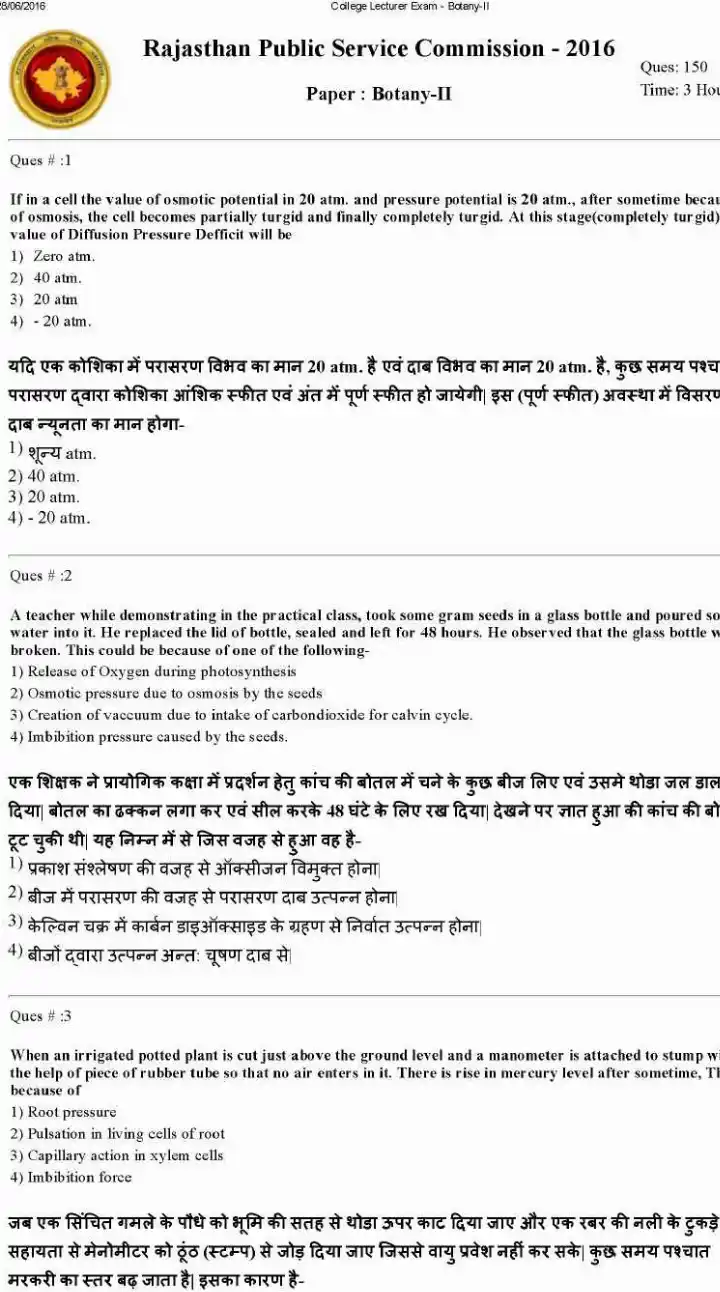
- -20 atm. यदि एक कोशिका में परासरण विभव का मान 20 atm. है एवं दाब विभव का मान 20 atm. है, कुछ समय पश्चात परासरण द्वारा कोशिका आंशिक स्फीत एवं अंत में पूर्ण स्फीत हो जायेगी| इस (पूर्ण स्फीत) अवस्था में विसरण दाब न्यूनता का मान होगा- ^{1)} शुन्य atm. 2) 40 atm.
- Imbibition force जब एक सिंचित गमले के पौधे को भूमि की सतह से थोडा ऊपर काट दिया जाए और एक रबर की नली के ट्कड़े की सहायता से मेनोमीटर को ठूंठ (स्टम्प) से जोड़ दिया जाए जिससे वायु प्रवेश नहीं कर सके| कुछ समय पश्चात मरकरी का स्तर बढ़ जाता है| इसका कारण है- ^{1)} मूल दाब 1/43
- Ques # 2 A teacher while demonstrating in the practical class, took some gram seeds in a glass bottle and poured some water into it.
- He replaced the lid of bottle, sealed and left for 48 hours.
- He observed that the glass bottle was broken.
- This could be because of one of the following-
- Osmotic pressure due to osmosis by the seeds
- Creation of vaccuum due to intake of carbondioxide for calvin cycle.
Questions (page 2)
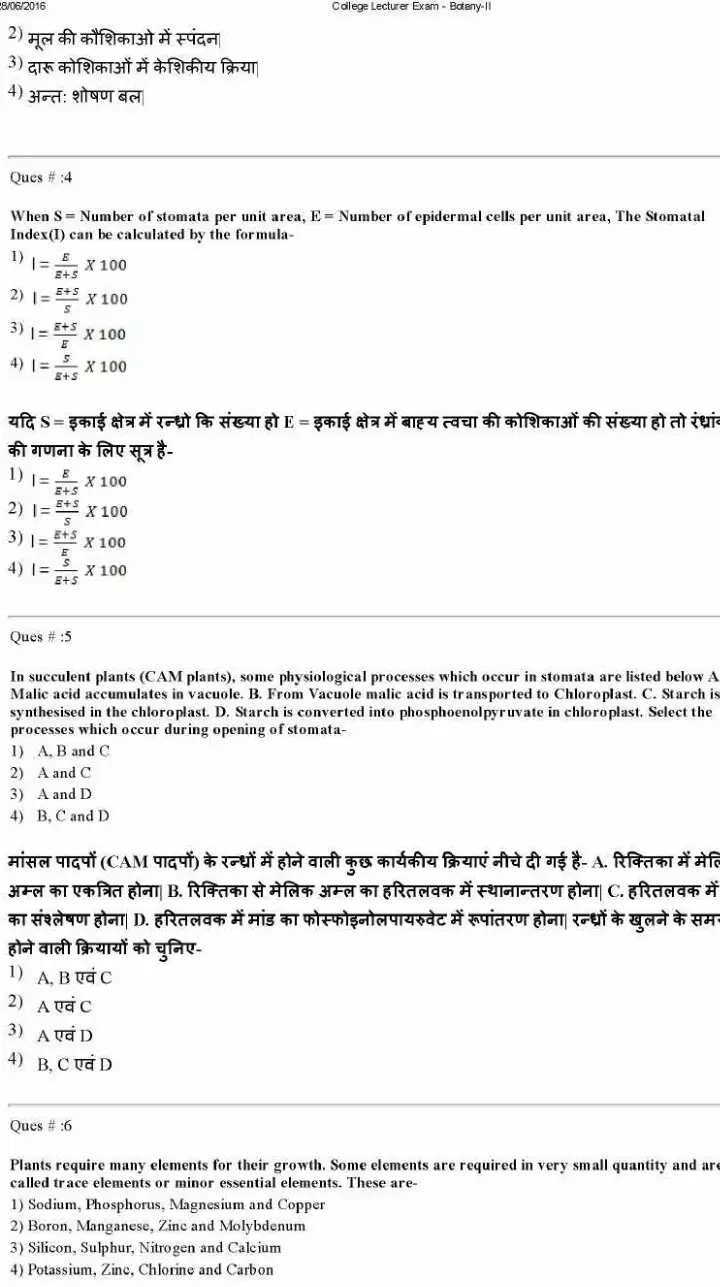
Q5. In succulent plants (CAM plants), some physiological processes which occur in stomata are listed below A. Malic acid accumulates in vacuole. B. From Vacuole malic acid is transported to Chloroplast. C. Starch is synthesised in the chloroplast. D. Starch is converted into phosphoenolpyruvate in chloroplast. Select the processes which occur during opening of stomata-
- (1) A, B एवं C
- (2) A एवं C
- (3) A एवं D
- (4) B, C एवं D
Q6. Plants require many elements for their growth. Some elements are required in very small quantity and are called trace elements or minor essential elements. These are-
- (1) Sodium, Phosphorus, Magnesium and Copper
- (2) Boron, Manganese, Zinc and Molybdenum
- (3) Silicon, Sulphur, Nitrogen and Calcium
- (4) Potassium, Zinc, Chlorine and Carbon
Question paper preview
Scanned pages 1–2 for reference. Download the official PDF for the full paper.
Free question paper download
Download question paper PDF
Your download starts in 10s
Preparing your question paper file…
Frequently asked questions
What is the name of the exam?
The exam is the College Lecturer Exam.
Which year is this question paper from?
This question paper is from the year 2014.
Who conducts the College Lecturer exam?
The Rajasthan Public Service Commission (RPSC) conducts the College Lecturer exam.
What is the subject of this paper?
This paper is for Botany-II.
What is the total number of questions in the paper?
There are 150 questions in the paper.
What is the time duration for the exam?
The time allowed for the exam is 3 Hours.