College Lecturer 2014 English Literature I Question Paper PDF

Rajasthan Government Jobs Lecturer 2014

  • Year 2014
  • Conducted By RPSC
  • Questions 150
  • Duration 3 Hours
  • Languages English

Exam Details

Detail Information
Examination College Lecturer Exam
Year 2014
Conducting Body RPSC
Paper English-Literature-I
Subject English Literature
Duration 3 Hours
Number of Questions 150
Question Type Objective (MCQ)

This is the question paper for the College Lecturer Examination held in 2014, specifically for the English Literature Paper I, conducted by the Rajasthan Public Service Commission (RPSC). The exam allowed 3 hours to answer 150 objective questions. This paper is a valuable resource for aspirants preparing for similar examinations, offering insights into the types of questions asked, the difficulty level, and the subject matter covered in English Literature for lecturer positions in Rajasthan.

Major Topics Covered

  • English Literature
  • Literary Criticism
  • Figures of Speech
  • Poetry Analysis

Why This Paper is Important

  • Useful for College Lecturer Exam preparation
  • Helps understand the latest exam pattern
  • Useful for practice and self-assessment
  • Covers frequently asked General Studies topics
  • Helpful for analysing question trends

Related Resources

  • College Lecturer 2016 English Literature Paper I
  • College Lecturer 2014 English Literature Paper II
  • RPSC Grade I Teacher English Literature
  • College Lecturer 2014 English Literature I Answer Key
  • College Lecturer English Literature Syllabus
  • RPSC Lecturer Exam Syllabus
  • College Lecturer Exam Pattern
  • RPSC Lecturer Exam Pattern

Instructions

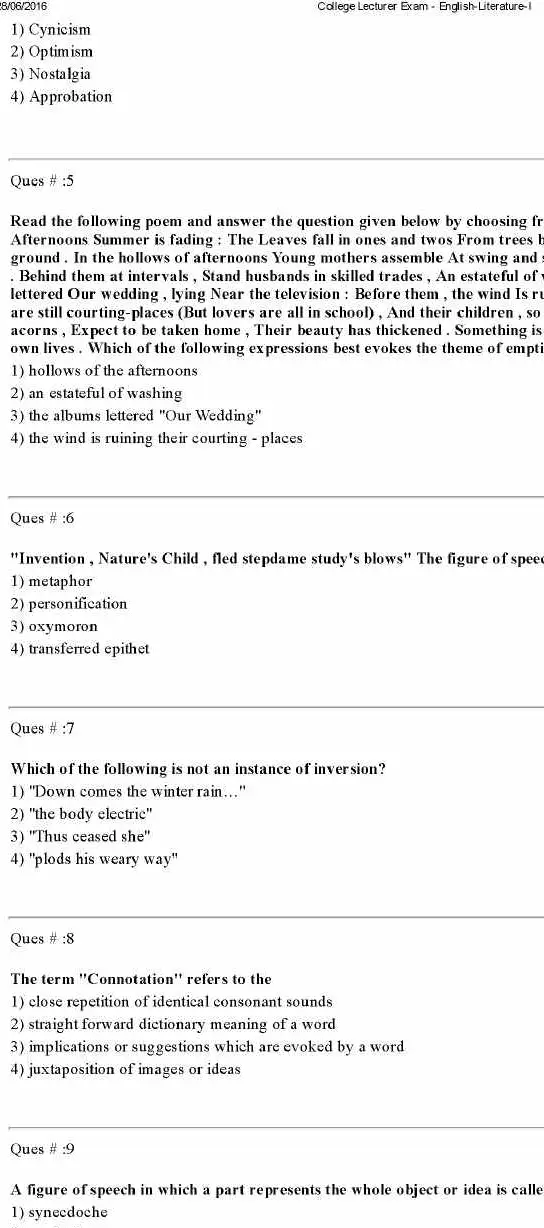
  • Mothers losing their identity 3) Enduring love
  • Poverty Ques # : 2 Read the following poem and answer the question given below by choosing from the given options : Afternoons Summer is fading : The Leaves fall in ones and twos From trees bordering The new recreation ground.
  • In the hollows of afternoons Young mothers assemble At swing and sandpit Setting free their children , Behind them at intervals , Stand husbands in skilled trades , An estateful of washing , And the albums . lettered Our wedding, lying Near the television: Before them, the wind Is ruining their courting-places That are still courting-places (But lovers are all in school) , And their children , so intent on Finding more unripe acorns , Expect to be taken home , Their beauty has thickened .
  • Something is pushing them To the side of their own lives .
  • From the following statements , pick out the one that is true with reference to the poem .
  • Young mothers enjoy their lives immensely.
  • Young mothers engage in interesting activities.
  • Young mothers are trapped in daily routines.
  • Love and romance are a part of the lives of young mothers.
  • In the hollows of afternoons Young mothers assemble At swing and sandpit Setting free their children .
  • Behind them at intervals, Stand husbands in skilled trades, An estateful of washing, And the albums, lettered Our wedding, lying Near the television: Before them, the wind Is ruining their courting-places That are still courting-places (But lovers are all in school) , And their children , so intent on Finding more unripe acorns , Expect to be taken home , Their beauty has thickened .
  • a testimony to the continuing romantic relationship.

Questions (page 2)

Q5. Read the following poem and answer the question given below by choosing from the given options : Afternoons
Summer is fading: The Leaves fall in ones and twos
From trees bordering The new recreation ground. In the hollows of afternoons
Young mothers assemble At swing and sandpit Setting free their children ,
Behind them at intervals , Stand husbands in skilled trades ,
An estateful of washing , And the albums . lettered Our wedding, lying
Near the television: Before them, the wind
Is ruining their courting-places
That are still courting-places (But lovers are all in school) ,
And their children , so intent on
Finding more unripe acorns,
Expect to be taken home,
Their beauty has thickened. Something is pushing them
To the side of their own lives . Which of the following expressions best evokes the theme of emptiness?

  • (1) hollows of the afternoons
  • (2) an estateful of washing
  • (3) the albums lettered "Our Wedding"
  • (4) the wind is ruining their courting - places
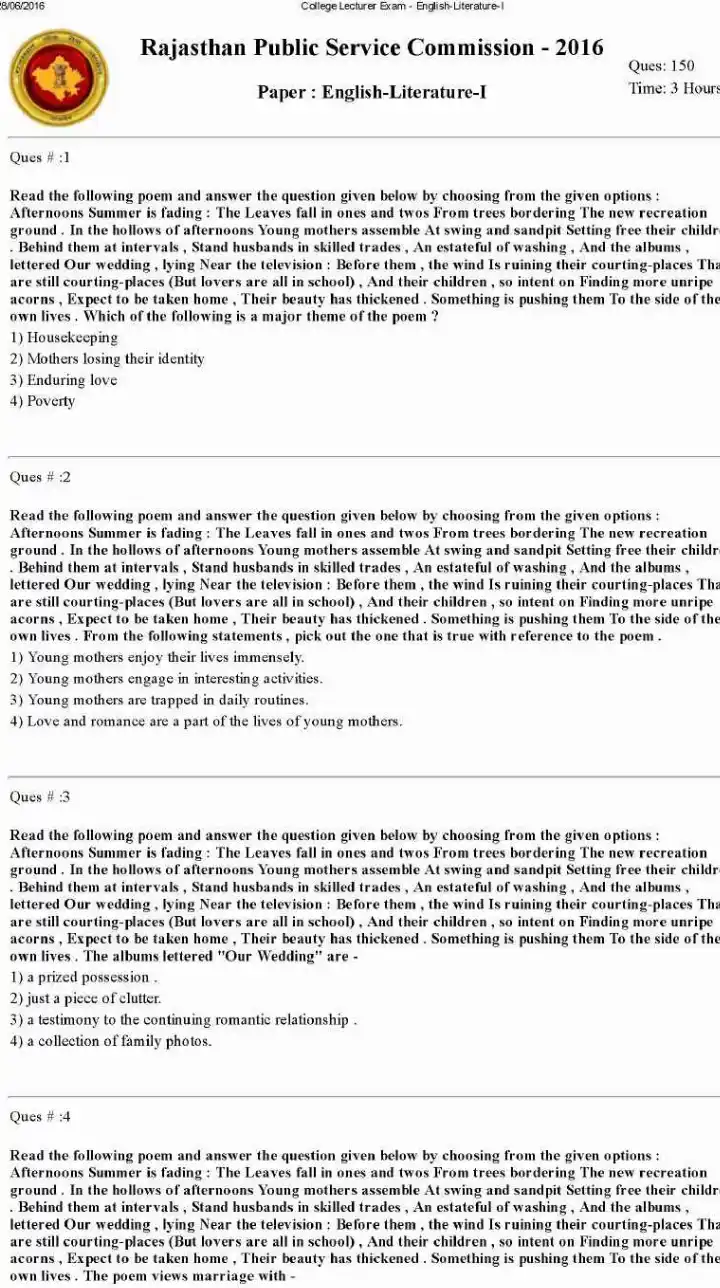
Q6. "Invention , Nature's Child , fled stepdame study's blows" The figure of speech used in the above line is

  • (1) metaphor
  • (2) personification
  • (3) oxymoron
  • (4) transferred epithet

Q7. Which of the following is not an instance of inversion?

  • (1) "Down comes the winter rain..."
  • (2) "the body electric"
  • (3) "Thus ceased she"
  • (4) "plods his weary way"

Q8. The term "Connotation" refers to the

  • (1) close repetition of identical consonant sounds
  • (2) straight forward dictionary meaning of a word
  • (3) implications or suggestions which are evoked by a word
  • (4) juxtaposition of images or ideas

Q9. A figure of speech in which a part represents the whole object or idea is called

  • (1) syneedoche
  • (2) symbol
  • (3) conceit
  • (4) metonymy

Question paper preview

Scanned pages 1–2 for reference. Download the official PDF for the full paper.

Page 1
RPSC College Lecturer 2014 English Literature Paper I question paper page 1 instructions scan PDF download
Page 2
RPSC College Lecturer 2014 English Literature Paper I question paper page 1 instructions scan PDF download

Free question paper download

Download question paper PDF

  • 381 KB
  • 26 pages
  • PDF format

Frequently asked questions

What is the name of the exam?

The exam is the College Lecturer Examination.

What year is this question paper from?

This question paper is from the year 2014.

Which subject does this paper cover?

This paper covers English Literature - Paper I.

Who conducted the College Lecturer Exam in 2014?

The exam was conducted by the Rajasthan Public Service Commission (RPSC).

What was the duration of the exam?

The exam duration was 3 Hours.

How many questions were there in the paper?

There were 150 questions in the paper.

← Back to Lecturer papers