Maharashtra MSS Physics Paper I 2025 Section A

Maharashtra Government Jobs Other Jobs 2025

  • Year 2025
  • Conducted By Maharashtra Government
  • Questions 8
  • Maximum Marks 250
  • Duration Three Hours
  • Languages English

Exam Details

Detail Information
Examination Maharashtra State Services Main Examination
Year 2025
Conducting Body Maharashtra Government
Paper Optional Subject - Physics Paper 1
Subject Physics
Duration Three Hours
Maximum Marks 250
Number of Questions 8
Question Type Descriptive / Subjective

This SEO content captures Maharashtra State Services Main Examination Physics Paper I (2025). Page 1 sets the exam context: 3-hour, 250 marks, English medium, with eight questions across two sections. Page 2 provides Section A with descriptive questions spanning classical mechanics, optics, and electromagnetism. Q1 covers Newton's laws, Fermat's principle, Poynting vector, central/non-central forces, chromatic aberration, and Kepler's laws. Q2 addresses Maxwell's equations, electromagnetic wave propagation, Newton's rings, and optical interference relations. Q3 explores gravitational potential for a thin spherical shell, achromatism of thin lenses, and reflection/transmission at a glass boundary with index 1.5. The content supports SEO themes around mechanics, optics, and EM foundations, suitable for exam prep and knowledge consolidation.

Major Topics Covered

  • Classical Mechanics
  • Newton's Laws
  • Fermat's Principle
  • Optics
  • Reflection and Refraction
  • Poynting Vector
  • Central and Non-Central Forces
  • Chromatic Aberration
  • Kepler's Laws
  • Maxwell's Equations
  • Electromagnetic Waves
  • Newton's Rings
  • Gravitation
  • Gravitational Potential
  • Thin Shell
  • Achromatism
  • Lenses
  • Dispersion
  • Refractive Index
  • Boundary Conditions

Why This Paper is Important

  • Useful for Maharashtra State Services Main Examinat preparation
  • Helps understand the latest exam pattern
  • Useful for practice and self-assessment
  • Covers frequently asked General Studies topics
  • Helpful for analysing question trends

Related Resources

Instructions

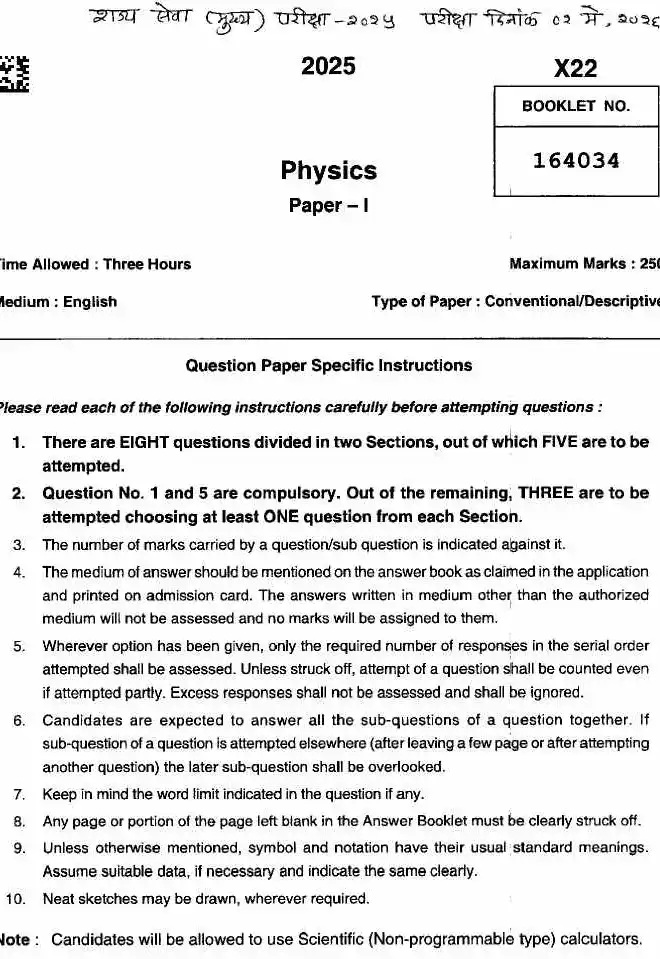
  • त्न्यात्र्य लेवा (प्रुम्बा) परीक्षा-२०१५ - परीक्षा निर्माठ ०१ में ,२०१९ - 2025 X22 BOOKLET NO. 164034 Physics Paper - I Time Allowed: Three Hours Maximum Marks: 250 Type of Paper : Conventional/Descriptive Medium : English

  • There are EIGHT questions divided in two Sections, out of which FIVE are to be attempted. * *
  • Question No. 1 and 5 are compulsory.
  • Out of the remaining, THREE are to be * SE. attempted choosing at least ONE question from each Section.
  • The number of marks carried by a question/sub question is indicated against it. з. * → The medium of answer should be mentioned on the answer book as claimed in the application
  • and printed on admission card.
  • The answers written in medium other than the authorized medium will not be assessed and no marks will be assigned to them.
  • Wherever option has been given, only the required number of responses in the serial order attempted shall be assessed.
  • Unless struck off, attempt of a question shall be counted even if attempted partly.
  • Excess responses shall not be assessed and shall be ignored.
  • Candidates are expected to answer all the sub-questions of a question together.
  • If sub-question of a question is attempted elsewhere (after leaving a few page or after attempting another question) the later sub-question shall be overlooked.
  • Keep in mind the word limit indicated in the question if any.
  • Any page or portion of the page left blank in the Answer Booklet must be clearly struck off.
  • Unless otherwise mentioned, symbol and notation have their usual standard meanings.
  • Assume suitable data, if necessary and indicate the same clearly.
  • Neat sketches may be drawn, wherever required.
  • Note : Candidates will be allowed to use Scientific (Non-programmable type) calculators.

Questions (page 2)

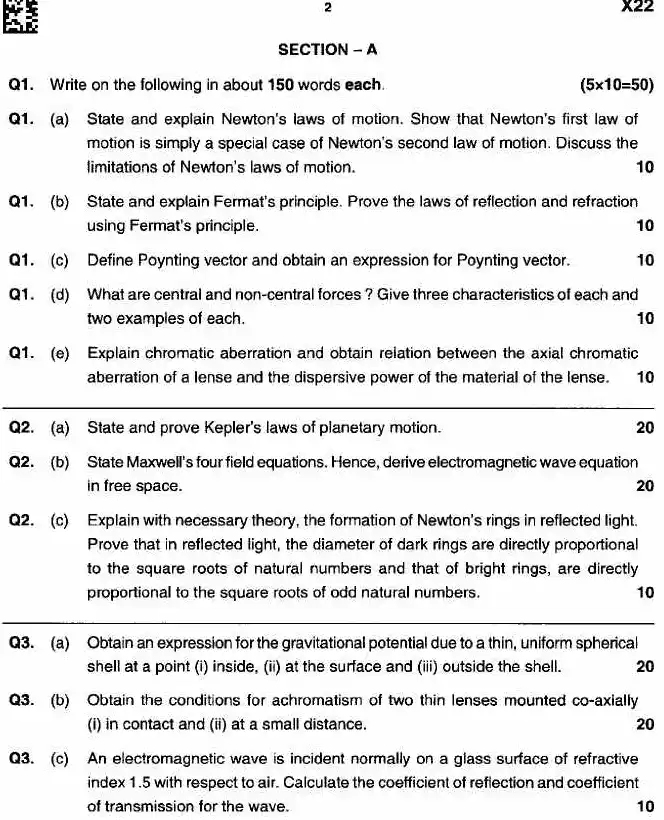
Q1. Q1: State and explain Newton's laws of motion. Show that Newton's first law of motion is simply a special case of Newton's second law of motion. Discuss the limitations of Newton's laws of motion.

() (a) State and explain Newton's laws of motion. Show that Newton's first law of motion is a special case of Newton's second law of motion. Discuss the limitations of Newton's laws of motion.

() (b) State and explain Fermat's principle. Prove the laws of reflection and refraction using Fermat's principle.

() (c) Define Poynting vector and obtain an expression for Poynting vector.

() (d) What are central and non-central forces? Give three characteristics of each and two examples of each.

() (e) Explain chromatic aberration and obtain relation between the axial chromatic aberration of a lens and the dispersive power of the material of the lens.

() (f) State and prove Kepler's laws of planetary motion.
  • (a) State and explain Newton's laws of motion. Show that Newton's first law of motion is a special case of Newton's second law of motion. Discuss the limitations of Newton's laws of motion.
  • (b) State and explain Fermat's principle. Prove the laws of reflection and refraction using Fermat's principle.
  • (c) Define Poynting vector and obtain an expression for Poynting vector.
  • (d) What are central and non-central forces? Give three characteristics of each and two examples of each.

Q2. Q2: (a) State Maxwell's four field equations. Hence, derive the electromagnetic wave equation in free space.

() (b) In free space.

() (c) Explain with necessary theory, the formation of Newton's rings in reflected light.

() (d) Prove that in reflected light, the diameter of dark rings are directly proportional to the square roots of natural numbers and that of bright rings, are directly proportional to the square roots of odd natural numbers.

  • (b) In free space.
  • (c) Explain with necessary theory, the formation of Newton's rings in reflected light.
  • (d) Prove that in reflected light, the diameter of dark rings are directly proportional to the square roots of natural numbers and that of bright rings, are directly proportional to the square roots of odd natural numbers.

Q3. Q3: Obtain an expression for the gravitational potential due to a thin, uniform spherical shell at a point
(i) inside,
(ii) at the surface and
(iii) outside the shell.

() (a) Obtain an expression for the gravitational potential due to a thin, uniform spherical shell at a point
(i) inside,
(ii) at the surface and
(iii) outside the shell.

() (b) Obtain the conditions for achromatism of two thin lenses mounted co-axially
(i) in contact and
(ii) at a small distance.

() (c) An electromagnetic wave is incident normally on a glass surface of refractive index 1.5 with respect to air. Calculate the coefficient of reflection and coefficient of transmission for the wave.

  • (a) Obtain an expression for the gravitational potential due to a thin, uniform spherical shell at a point
  • (b) Obtain the conditions for achromatism of two thin lenses mounted co-axially
  • (c) An electromagnetic wave is incident normally on a glass surface of refractive index 1.5 with respect to air. Calculate the coefficient of reflection and coefficient of transmission for the wave.

Question paper preview

Scanned pages 1–2 for reference. Download the official PDF for the full paper.

Page 1
Maharashtra MSS Physics Paper I 2025 Section A — page 1 instructions scan PDF download
Page 2
Maharashtra MSS Physics Paper I 2025 Section A — page 1 instructions scan PDF download

Free question paper download

Download question paper PDF

  • 168 KB
  • 4 pages
  • PDF format

Frequently asked questions

What is Newton's first law of motion?

An object at rest remains at rest and an object in motion continues in straight-line motion unless acted upon by an external force.

What is Fermat's principle?

Light follows the path that minimizes travel time between two points.

What is the Poynting vector?

Poynting vector represents the directional energy flux (the rate of energy transfer per unit area) of an electromagnetic field.

What are central and non-central forces?

Central forces act along the line joining two bodies; non-central forces do not. Characteristics include dependence on distance and direction.

What is chromatic aberration?

Chromatic aberration is the dispersion-related failure of a lens to focus all colors to the same point; it relates to the material's dispersive power.

State Kepler's laws of planetary motion.

1) Orbits are ellipses with the sun at one focus; 2) Equal areas are swept in equal times; 3) The square of orbital period is proportional to the cube of the semi-major axis.

← Back to Other Jobs papers