MPSC Chemical Engineering Optional 2007 Main Exam Paper | Chemical Engineering

Maharashtra Government Jobs Engineer 2007

  • Year 2007
  • Conducted By MPSC
  • Questions 6
  • Maximum Marks 200
  • Duration 3 Hours
  • Languages English & Hindi

Exam Details

Detail Information
Examination Maharashtra Forest Services Main Examination
Year 2007
Conducting Body MPSC
Paper Chemical Engineering (Optional)
Subject Chemical Engineering
Duration 3 Hours
Maximum Marks 200
Number of Questions 6
Question Type Descriptive / Subjective

This document contains the Chemical Engineering (Optional) paper for the Maharashtra Forest Services Main Examination conducted by MPSC in 2007. The paper consists of descriptive questions, with a total of 200 marks and a time limit of 3 hours. Question 1 is compulsory, and candidates must attempt any four questions from the remaining sections. The questions cover a wide range of topics within Chemical Engineering, including fluid mechanics (Ergun equation, flow patterns, pipe flow calculations), chemical reaction engineering (batch and plug flow reactors, CSTR design), thermodynamics and process design (sulfuric acid plants, heat exchangers), separation processes (solid-liquid separation, filtration), and process control. Specific questions delve into non-Newtonian flow behavior, catalytic converter gas composition, particle settling velocities, ammonia plant operations with recycle streams and purge calculations, and filter cake compressibility. This paper is a valuable resource for aspirants preparing for the Maharashtra Forest Services Main Examination, providing insights into the types of descriptive questions asked and the depth of knowledge required in Chemical Engineering.

Major Topics Covered

  • Chemical Engineering
  • Fluid Flow
  • Packed Beds
  • Ergun Equation
  • Reactor Design
  • Batch Reactors
  • Plug Flow Reactors (PFR)
  • Continuous Stirred Tank Reactors (CSTR)
  • Heat Exchangers
  • Process Design
  • Sulfuric Acid Plants
  • Pipe Flow
  • Reynolds Number
  • Shear Stress
  • Pump Power
  • Non-Newtonian Flow
  • Catalytic Converters
  • Gas Composition
  • Separation Processes
  • Solid-Liquid Separation
  • Particle Settling
  • Stokes Law
  • Ammonia Synthesis
  • Recycle Streams
  • Purge Streams
  • Inert Component Control
  • Filter Cakes
  • Compressible Filters
  • Non-compressible Filters
  • Maharashtra Forest Services
  • MPSC Exam
  • 2007 Exam Paper

Why This Paper is Important

  • Useful for Maharashtra Forest Services Main Examina preparation
  • Helps understand the latest exam pattern
  • Useful for practice and self-assessment
  • Covers frequently asked General Studies topics
  • Helpful for analysing question trends

Related Resources

Instructions

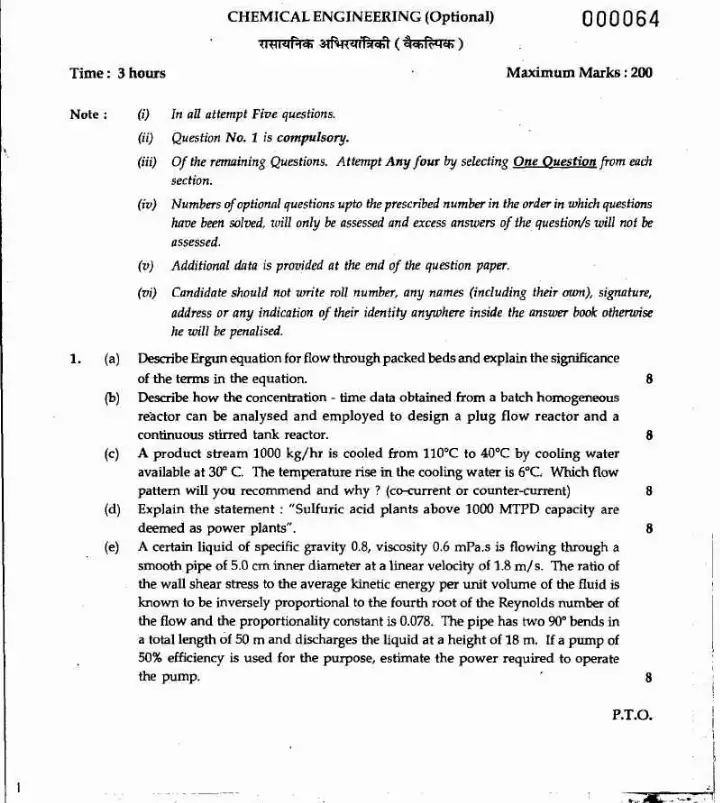
  • mPs ATi 2007 000064 CHEMICAL ENGINEERING (Optional) रासायनिक अभिरयांत्रिकी (वैकल्पिक) Maximum Marks: 200 Time : 3 hours In all attempt Five questions.
  • (ii) Question No. 1 is compulsory. Of the remaining Questions. Attempt Any four by selecting One Question from each
  • (iii) section. Numbers of optional questions upto the prescribed number in the order in which questions
  • (iv) have been solved, will only be assessed and excess answers of the question/s will not be assessed.
  • Additional data is provided at the end of the question paper.
  • (vi) Candidate should not write roll number, any names (including their own), signature, address or any indication of their identity anywhere inside the answer book otherwise he will be penalised.
  • Describe Ergun equation for flow through packed beds and explain the significance

Questions (page 2)

Q1.

(a) Describe Ergun equation for flow through packed beds and explain the significance of the terms in the equation.

(b) Describe how the concentration - time data obtained from a batch homogeneous reactor can be analysed and employed to design a plug flow reactor and a continuous stirred tank reactor.

(c) A product stream 1000 kg/hr is cooled from 110°C to 40°C by cooling water
(c) available at 30° C. The temperature rise in the cooling water is 6°C. Which flow pattern will you recommend and why ? (co-current or counter-current)

(d) Explain the statement : "Sulfuric acid plants above 1000 MTPD capacity are deemed as power plants".

(e) A certain liquid of specific gravity 0.8, viscosity 0.6 mPa.s is flowing through a smooth pipe of 5.0 cm inner diameter at a linear velocity of 1.8 m/s. The ratio of the wall shear stress to the average kinetic energy per unit volume of the fluid is known to be inversely proportional to the fourth root of the Reynolds number of the flow and the proportionality constant is 0.078. The pipe has two 90° bends in a total length of 50 m and discharges the liquid at a height of 18 m. If a pump of 50% efficiency is used for the purpose, estimate the power required to operate the pump.
Q2.

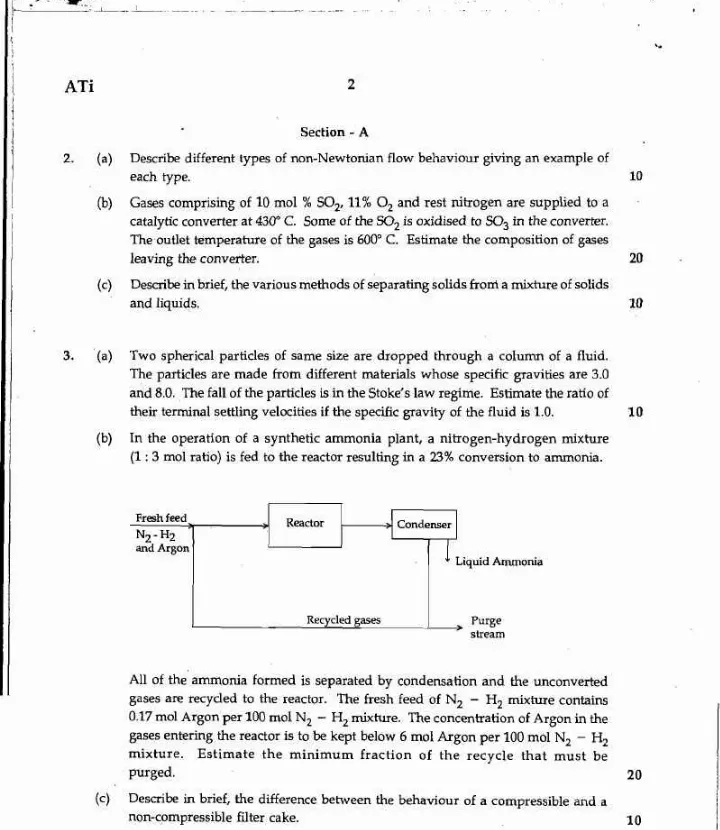
(a) each type. Gases comprising of mol % SO2, 11% O2 and rest nitrogen are supplied to a

(b) catalytic converter at 430° C. Some of the SO2 is oxidised to SO3 in the converter. The outlet temperature of the gases is 600\circ C. Estimate the composition of gases leaving the converter.

(c) Describe in brief, the various methods of separating solids from a mixture of solids and liquids.
3. Two spherical particles of same size are dropped through a column of a fluid. (a) The particles are made from different materials whose specific gravities are 3.0 and 8.0. The fall of the particles is in the Stoke's law regime. Estimate the ratio of their terminal settling velocities if the specific gravity of the fluid is 1.0. (b) In the operation of a synthetic ammonia plant, a nitrogen-hydrogen mixture (1:3 mol ratio) is fed to the reactor resulting in a 23% conversion to ammonia. Fresh feed Reactor Condenser N2 - H2 and Argon Liquid Ammonia Recycled gases Purge stream All of the ammonia formed is separated by condensation and the unconverted gases are recycled to the reactor. The fresh feed of N2 - H2 mixture contains 0.17 mol Argon per 100 mol N2 - H2 mixture. The concentration of Argon in the gases entering the reactor is to be kept below 6 mol Argon per 100 mol N2 - H2 mixture. Estimate the minimum fraction of the recycle that must be purged. Describe in brief, the difference between the behaviour of a compressible and a
(c) non-compressible filter cake.

Q3.

(a) Two spherical particles of same size are dropped through a column of a fluid. The particles are made from different materials whose specific gravities are 3.0 and 8.0. The fall of the particles is in the Stoke's law regime. Estimate the ratio of their terminal settling velocities if the specific gravity of the fluid is 1.0.

(b) In the operation of a synthetic ammonia plant, a nitrogen-hydrogen mixture (1:3 mol ratio) is fed to the reactor resulting in a 23% conversion to ammonia. Fresh feed Reactor Condenser N2 - H2 and Argon Liquid Ammonia Recycled gases Purge stream All of the ammonia formed is separated by condensation and the unconverted gases are recycled to the reactor. The fresh feed of N2 - H2 mixture contains 0.17 mol Argon per 100 mol N2 - H2 mixture. The concentration of Argon in the gases entering the reactor is to be kept below 6 mol Argon per 100 mol N2 - H2 mixture. Estimate the minimum fraction of the recycle that must be purged.

(c) Describe in brief, the difference between the behaviour of a compressible and a non-compressible filter cake.

Question paper preview

Scanned pages 1–2 for reference. Download the official PDF for the full paper.

Page 1
MPSC Chemical Engineering Optional 2007 Main Exam Paper | Chemical Engineering — page 1 instructions scan PDF download
Page 2
MPSC Chemical Engineering Optional 2007 Main Exam Paper | Chemical Engineering — page 1 instructions scan PDF download

Free question paper download

Download question paper PDF

  • 49 KB
  • 5 pages
  • PDF format

Frequently asked questions

What is the exam name and year for this Chemical Engineering paper?

The exam is the Maharashtra Forest Services Main Examination, held in 2007.

Who conducts the Maharashtra Forest Services Main Examination?

The examination is conducted by MPSC (Maharashtra Public Service Commission).

What is the subject and paper code?

The subject is Chemical Engineering (Optional), and the paper code is 000064.

What is the maximum marks and time duration for the paper?

The maximum marks are 200, and the time allowed is 3 hours.

What is the question pattern for this paper?

The paper consists of descriptive questions. Question 1 is compulsory, and candidates need to attempt any four questions from the remaining sections.

What topics are covered in Question 1?

Question 1 covers Ergun equation for packed beds, analysis of batch reactor data for PFR and CSTR design, heat exchanger flow patterns (co-current vs. counter-current), significance of sulfuric acid plants as power plants, and pipe flow calculations involving pump power estimation.

← Back to Engineer papers