
Maharashtra Forest Services 2012 Chemical Eng Optional
- Year 2012
- Conducted By Maharashtra Government
- Questions 8
- Maximum Marks 200
- Duration 3 Hours
- Languages Hindi & English
Exam Details
| Detail | Information |
|---|---|
| Examination | Maharashtra Forest Services Main Examination |
| Year | 2012 |
| Conducting Body | Maharashtra Government |
| Paper | Chemical Engineering (Optional) |
| Subject | Chemical Engineering |
| Duration | 3 Hours |
| Maximum Marks | 200 |
| Number of Questions | 8 |
| Question Type | Descriptive / sectioned |
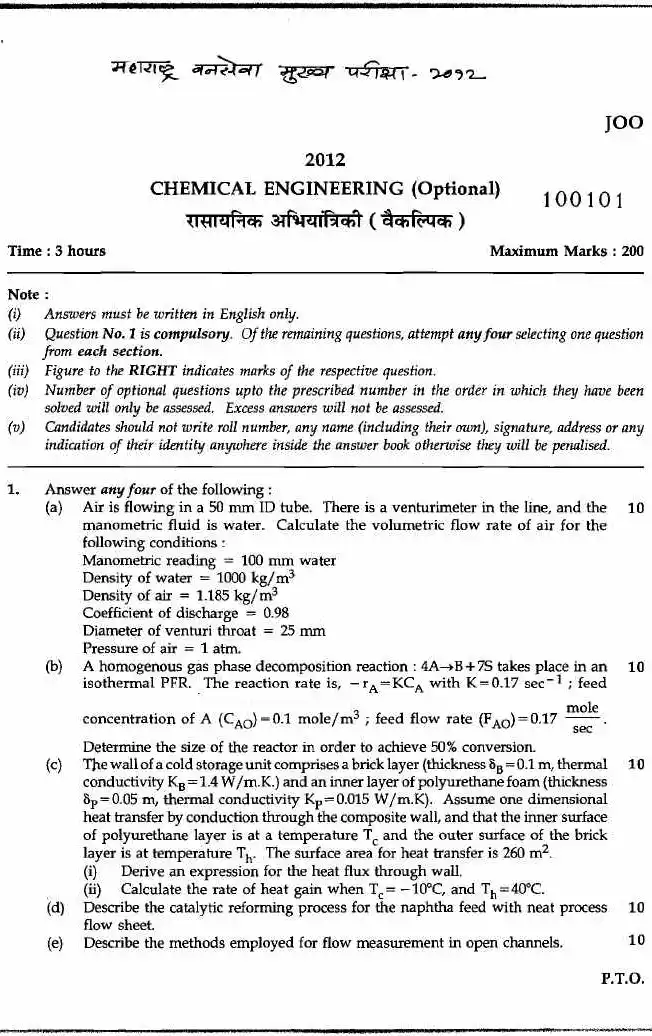
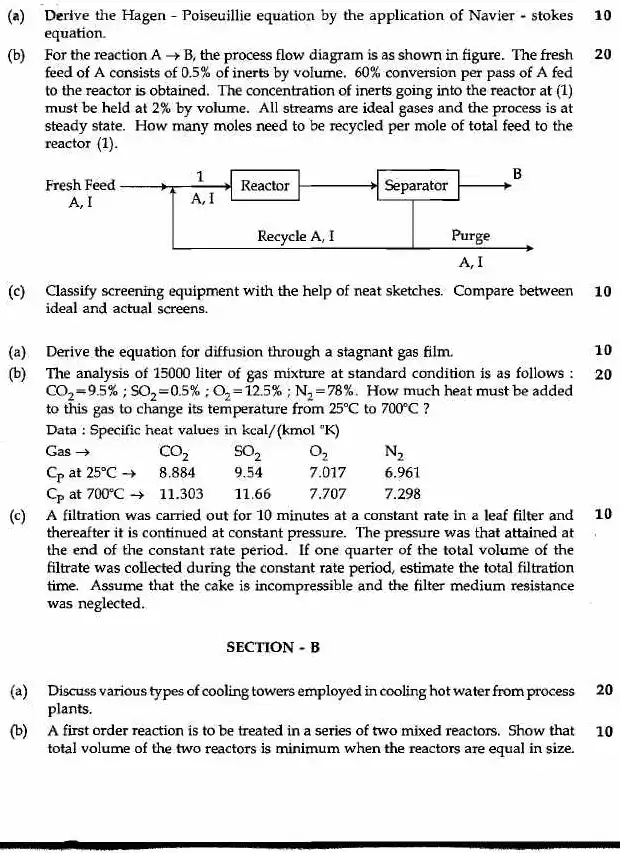
This dataset covers the Maharashtra Forest Services Main Examination 2012 for Chemical Engineering (Optional). Page 1 includes the compulsory Q1 with five sub-parts addressing venturi flow, gas-phase reaction in a PFR, composite wall heat transfer, catalytic reforming process, and open-channel flow measurement. Page 2 (Section A and B) expands with questions on Hagen-Poiseuille derivation, recycle calculations in a reactor system, diffusion through stagnant films, gas mixture heat addition data, leaf filtration, cooling towers, and optimal reactor sizing. The content is a mix of descriptive and calculation-based prompts intended to test reactor design, heat transfer, unit operations, and mass transfer concepts. This previous year Maharashtra Forest Services Main Examination question paper (2012) is useful for Engineer aspirants preparing for Maharashtra government recruitment. The paper was conducted by MPSC and reflects the official exam pattern, marking scheme and difficulty level seen in recent cycles. Use it for timed practice, topic-wise revision and understanding how questions are framed in the real examination. Download the free PDF on QuizCurrent to read instructions, attempt MCQs and compare your answers with the study notes provided on this page. Key syllabus areas include Venturi meter, Hagen-Poiseuille, Navier-Stokes, Reactor sizing, PFR (Plug Flow Reactor), Gas-phase reactions, Composite wall conduction, Heat flux. Useful for Maharashtra Forest Services Main Examina preparation. Helps understand the latest exam pattern. Useful for practice and self-assessment.
Major Topics Covered
- Venturi meter
- Hagen-Poiseuille
- Navier-Stokes
- Reactor sizing
- PFR (Plug Flow Reactor)
- Gas-phase reactions
- Composite wall conduction
- Heat flux
- Open-channel flow
- Flow measurement
- Catalytic reforming
- Naphtha processing
- Screening equipment
- Ideal vs actual screens
- Leaf filtration
- Cooling towers
- Water/air heat transfer
- Diffusion through stagnant gas film
- Recycle calculations
- Process diagrams
Why This Paper is Important
- Useful for Maharashtra Forest Services Main Examina preparation
- Helps understand the latest exam pattern
- Useful for practice and self-assessment
- Covers frequently asked General Studies topics
- Helpful for analysing question trends
Related Resources
Instructions
- मशराष्ट्रं बनलेखा मूख्य परीक्षा - 2092 JOO 2012 CHEMICAL ENGINEERING (Optional) 100101 रासायनिक अभियांत्रिकी ( वैकल्पिक ) Time: 3 hours Maximum Marks: 200
- Note: \left( i\right) Answers must be written in English only.
- (ii) Question No. 1 is compulsory.
- Of the remaining questions, attempt any four selecting one question from each section.
- (iii) Figure to the RIGHT indicates marks of the respective question.
- Number of optional questions upto the prescribed number in the order in which they have been
- (iv) solved will only be assessed. Excess answers will not be assessed.
- (v) Candidates should not write roll number, any name (including their own), signature, address or any indication of their identity anywhere inside the answer book otherwise they will be penalised.
Questions (page 2)
Q2. (a) Derive the Hagen - Poiseuillie equation by the application of Navier - stokes equation.
(a) Derive the Hagen - Poiseuillie equation by the application of Navier - stokes equation.
(b) For the reaction A → B, the process flow diagram is as shown in figure. The fresh feed of A consists of 0.5% of inerts by volume. 60% conversion per pass of A fed to the reactor is obtained. The concentration of inerts going into the reactor at
(1) must be held at 2% by volume. All streams are ideal gases and the process is at steady state. How many moles need to be recycled per mole of total feed to the reactor
(1) . в Fresh Feed — Separator Reactor A, I A, I Purge Recycle A, I A, I Classify screening equipment with the help of neat sketches. Compare between
Q3. (a) 3. Derive the equation for diffusion through a stagnant gas film.
(a) 3. Derive the equation for diffusion through a stagnant gas film.
(b) 3. (a) The analysis of 15000 liter of gas mixture at standard condition is as follows :
Q4. 4. SECTION - B
Question paper preview
Scanned pages 1–2 for reference. Download the official PDF for the full paper.
Free question paper download
Download question paper PDF
Your download starts in 10s
Preparing your question paper file…
Frequently asked questions
What is compulsory in the exam?
Question 1 is compulsory; candidates must answer it along with four other questions from Sections A and B.
What is the duration of the exam?
3 hours.
In which language should answers be written?
Answers must be written in English.
Which topics are covered in Section A?
Section A includes topics like Hagen-Poiseuille flow, recycle calculations, diffusion through stagnant gas films, and related process design problems.
Which topics are covered in Section B?
Section B covers cooling towers, screening equipment, leaf filtration, and reactor sizing in series.
What kind of questions are Q1 sub-parts?
Q1 contains multiple sub-parts (a) to (e) addressing fluid flow, reaction design, heat transfer, reforming, and open-channel flow measurement.