
Maharashtra Forest Services Chemistry Optional 2007
- Year 2007
- Conducted By Maharashtra Government
- Questions 5
- Maximum Marks 200
- Duration 3 Hours
- Languages Hindi & English
Exam Details
| Detail | Information |
|---|---|
| Examination | Maharashtra Forest Services Main Examination |
| Year | 2007 |
| Conducting Body | Maharashtra Government |
| Paper | Chemistry (Optional) |
| Subject | Chemistry |
| Duration | 3 Hours |
| Maximum Marks | 200 |
| Number of Questions | 5 |
| Question Type | Descriptive / Subjective |
This document contains the Chemistry (Optional) paper for the Maharashtra Forest Services Main Examination, 2007. Page 1 presents the exam header, language options (Hindi/English), time, and maximum marks, along with the general instructions. Page 2 includes the repaired set of questions and topics, spanning organic reaction intermediates, lattice energy and Born-Haber cycle, coordination chemistry, polymers and tacticity, acids and bases, selection rules in spectroscopy, rotational spectra, environmental pollution due to SO2, and industrial preparation of calcium super phosphate. The content bridges both pages to provide a complete SEO-ready overview and enables keyword-rich metadata suitable for web publication. This previous year Maharashtra Forest Services Main Examination question paper (2007) is useful for Administrative / Civil Services aspirants preparing for Maharashtra government recruitment. The paper was conducted by MPSC and reflects the official exam pattern, marking scheme and difficulty level seen in recent cycles. Use it for timed practice, topic-wise revision and understanding how questions are framed in the real examination. Download the free PDF on QuizCurrent to read instructions, attempt MCQs and compare your answers with the study notes provided on this page. Key syllabus areas include Chemistry, Inorganic Chemistry, Organic Chemistry, Physical Chemistry, Spectroscopy, Polymers, Environmental Chemistry, Industrial Chemistry. Useful for Maharashtra Forest Services Main Examina preparation. Helps understand the latest exam pattern. Useful for practice and self-assessment.
Major Topics Covered
- Chemistry
- Inorganic Chemistry
- Organic Chemistry
- Physical Chemistry
- Spectroscopy
- Polymers
- Environmental Chemistry
- Industrial Chemistry
- Coordination Chemistry
- Hybridization
- Reactive Intermediates
- Born-Haber Cycle
- Lattice Energy
- Colligative Properties
- Hydrogen Spectrum
- Heisenberg Principle
- Chemistry of Oxidation/Reduction
- Pollution Control
- Industrial Chemicals
- Calcium Phosphate Chemistry
Why This Paper is Important
- Useful for Maharashtra Forest Services Main Examina preparation
- Helps understand the latest exam pattern
- Useful for practice and self-assessment
- Covers frequently asked General Studies topics
- Helpful for analysing question trends
Related Resources
- MFS 2018: General Science & Nature Conservation
- MFS Main 2017: General Science & Nature Conservation Paper
- Maharashtra Forest Services Main Exam 2017 General Knowledge Paper-1
- Maharashtra Forest Services 2012 Agriculture Optional Paper
- MPSC Botany Optional Previous Year Paper 2012 - Maharashtra Forest Services Main Exam
Instructions
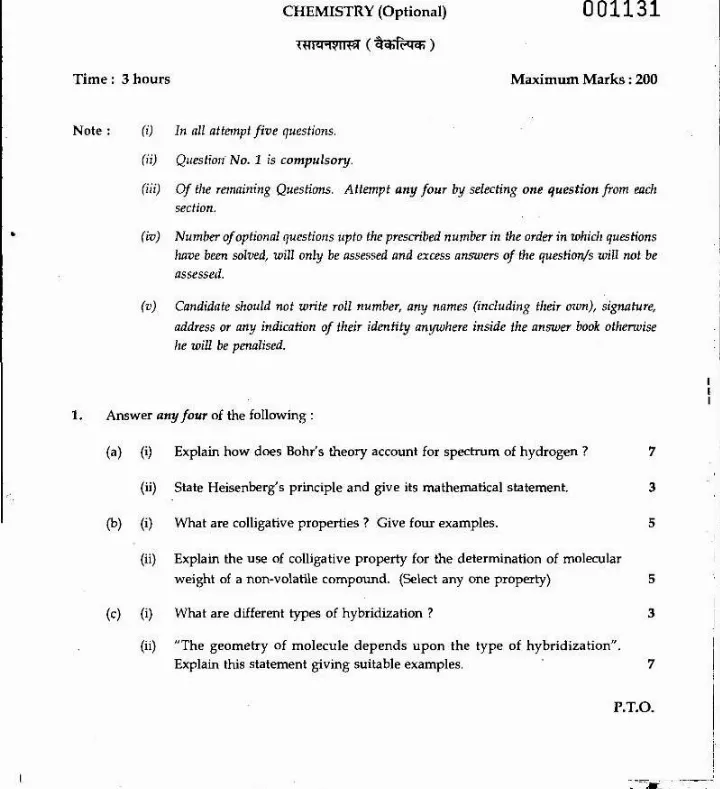
- r\gammaPs ATk 2007 001131 CHEMISTRY (Optional) रसायनशास्त्र ( वैकल्पिक ) Time: 3 hours Maximum Marks: 200 In all attempt five questions.
- Note: (i) Question No. 1 is compulsory.
- (i) Question No. 1 is compulsory.
- (iii) Of the remaining Questions.
- Attempt any four by selecting one question from each section.
- Number of optional questions upto the prescribed number in the order in which questions
- (iv) have been solved, will only be assessed and excess answers of the question/s will not be assessed.
- (v) Candidate should not write roll number, any names (including their own), signature, address or any indication of their identity anywhere inside the answer book otherwise he will be penalised.
Questions (page 2)
Q1. 1. Answer any four of the following : Explain how does Bohr's theory account for spectrum of hydrogen?
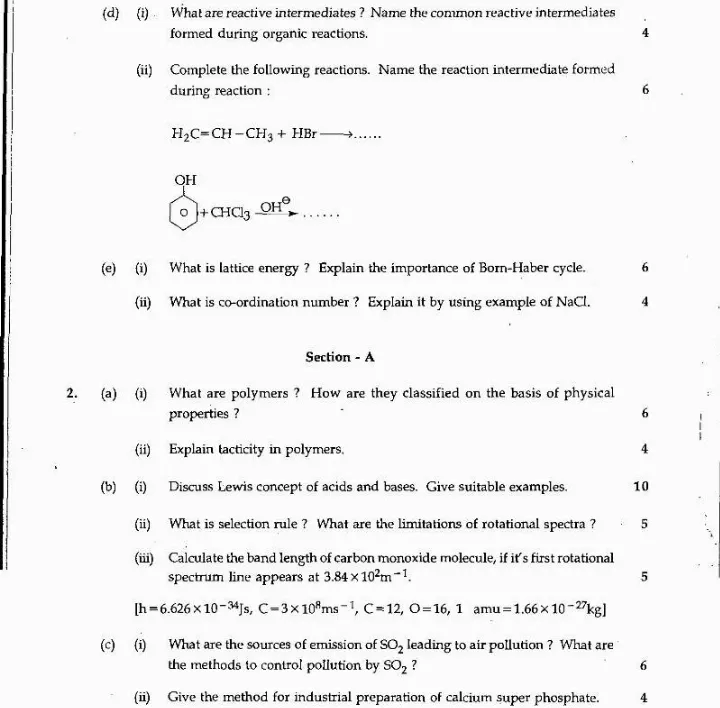
Q1. ATk \mathbf2 (d) What are reactive intermediates? Name the common reactive intermediates
(i) . formed during organic reactions. 4 Complete the following reactions. Name the reaction intermediate formed
(ii) during reaction : 6 H2C = CH-CH3 + HBr \longrightarrow \dots OН \circ + CHCl 3 (OH\Theta)/(H) ...... What is lattice energy ? Explain the importance of Born-Haber cycle. (e)
(i) 6 What is co-ordination number ? Explain it by using example of NaCl.
(ii) 4 Section - A
Q2.
(a) What are polymers? How are they classified on the basis of physical
(i) properties? 6 Explain tacticity in polymers.
(ii) 4
(b) (i) Discuss Lewis concept of acids and bases. Give suitable examples. What is selection rule ? What are the limitations of rotational spectra ?
(ii) Calculate the band length of carbon monoxide molecule, if it's first rotational
(iii) spectrum line appears at 3.84 × 10²m -1 . 5 [h = 6.626 × 10⁻³⁴]s, C = 3×10 ms -1 , C = 12, O = 16, 1 amu = 1.66×10 -27 kg] What are the sources of emission of SO2 leading to air pollution ? What are
(c) (i) the methods to control pollution by SO2? 6 Give the method for industrial preparation of calcium super phosphate.
(ii) 4
Q2. (a) What are polymers? How are they classified on the basis of physical
(i) properties? 6 Explain tacticity in polymers.
(ii) 4
(a) What are polymers? How are they classified on the basis of physical
(i) properties? 6 Explain tacticity in polymers.
(ii) 4
(b) (i) Discuss Lewis concept of acids and bases. Give suitable examples. What is selection rule ? What are the limitations of rotational spectra ?
(ii) Calculate the band length of carbon monoxide molecule, if it's first rotational
(iii) spectrum line appears at 3.84 × 10²m -1 . 5 [h = 6.626 × 10⁻³⁴]s, C = 3×10 ms -1 , C = 12, O = 16, 1 amu = 1.66×10 -27 kg] What are the sources of emission of SO2 leading to air pollution ? What are
(c) (i) the methods to control pollution by SO2? 6 Give the method for industrial preparation of calcium super phosphate.
(ii) 4
Q3. 3. What is lattice energy? Explain the importance of Born-Haber cycle.
Q4. 4. What is co-ordination number? Explain it by using the example of NaCl.
Q5. 5.
2. What are polymers? How are they classified on the basis of physical properties? (a)
(i) Explain tacticity in polymers.
(ii) Discuss Lewis concept of acids and bases. Give suitable examples.
Q6. 6. What is selection rule? What are the limitations of rotational spectra?
(i) 5
(ii) Calculate the band length of carbon monoxide molecule, if its first rotational spectrum line appears at 3.84 × 10² m^-1.
Q7. 7. What are the sources of emission of SO2 leading to air pollution? What are the methods to control pollution by SO2?
Q8. 8. Give the method for industrial preparation of calcium super phosphate.
Q9. 9. What are reactive intermediates? Name the common reactive intermediates formed during organic reactions.
Question paper preview
Scanned pages 1–2 for reference. Download the official PDF for the full paper.
Free question paper download
Download question paper PDF
Your download starts in 10s
Preparing your question paper file…
Frequently asked questions
What is Bohr's theory and how does it explain the hydrogen spectrum?
Bohr's theory proposes quantized orbits for electrons in hydrogen, with energy levels given by En = -RH/n^2. The spectral lines arise from transitions between these levels. The observed line wavelengths correspond to energy differences between allowed orbits.
What are colligative properties and give examples?
Colligative properties depend on the number of solute particles, not their identity: freezing point depression, boiling point elevation, osmotic pressure, and relative lowering of vapor pressure.
What is lattice energy and why is the Born-Haber cycle important?
Lattice energy is the energy released when gaseous ions form a solid ionic lattice. The Born-Haber cycle provides a thermochemical route to estimate lattice energy using measurable steps: atomization, ionization, electron affinity, and lattice formation.
What is a coordination number and how is NaCl a typical example?
Coordination number is the number of atoms/ions immediately surrounding a central atom/ion in a structure. In NaCl each Na+ is surrounded by 6 Cl- ions and vice versa, giving CN = 6 in the rock-salt structure.
What are polymers and how are they classified by physical properties?
Polymers are macromolecules formed by repeating units. Classification by physical properties includes amorphous vs. crystalline, thermoplastic vs. thermosetting, and tacticity (isotactic, syndiotactic, atactic).
What is a selection rule in spectroscopy and what are its limitations for rotational spectra?
Selection rules determine allowed transitions (e.g., ΔJ = ±1 for pure rotational). Limitations arise from molecular symmetry, centrifugal distortion, and dipole moment requirements which can suppress or modify transitions.
← Back to Administrative / Civil Services papers · Maharashtra Government Jobs