MPSC Botany Optional Previous Year Paper 2012 - Maharashtra Forest Services Main Exam

Maharashtra Government Jobs Administrative / Civil Services 2012

  • Year 2012
  • Conducted By Maharashtra Public Service Commission
  • Questions 9
  • Maximum Marks 200
  • Duration 3 Hours
  • Languages English

Exam Details

Detail Information
Examination Maharashtra Forest Services Main Examination
Year 2012
Conducting Body Maharashtra Public Service Commission
Paper Botany (Optional)
Subject Botany
Duration 3 Hours
Maximum Marks 200
Number of Questions 9
Question Type Descriptive / Subjective

This is the official question paper for the Maharashtra Forest Services Main Examination held in 2012, featuring the Botany (Optional) subject. The exam, conducted by the Maharashtra Public Service Commission (MPSC), allowed 3 hours to answer a maximum of 200 marks. The paper comprises descriptive questions divided into sections A, B, C, and D, with a compulsory question 1 and four other questions to be attempted from the remaining sections. Key topics covered include plant physiology, genetics, plant classification, ecology, and applied botany. The questions require detailed explanations, definitions, classifications, and discussions on various botanical concepts, such as secondary growth, cell cycle, plant nomenclature, endosperm development, photophosphorylation, enzymes, plant growth regulators, Calvin's cycle, somaclonal variation, energy flow in ecosystems, and human resources from plants. This paper is a valuable resource for aspirants preparing for the MPSC Botany Optional paper, offering insights into the exam pattern and the depth of knowledge required.

Major Topics Covered

  • Plant Physiology
  • Plant Anatomy
  • Plant Taxonomy
  • Genetics
  • Ecology
  • Plant Biotechnology
  • Crop Improvement
  • Photosynthesis
  • Cell Biology
  • Plant Pathology
  • Economic Botany
  • Secondary Growth
  • Cell Cycle
  • Botanical Nomenclature
  • Embryo Sac Development
  • Plant Classification
  • Endosperm
  • Photophosphorylation
  • Enzymes
  • Plant Growth Regulators
  • Calvin Cycle
  • Somaclonal Variation
  • Ecosystem
  • Pollution

Why This Paper is Important

  • Useful for Maharashtra Forest Services Main Examina preparation
  • Helps understand the latest exam pattern
  • Useful for practice and self-assessment
  • Covers frequently asked General Studies topics
  • Helpful for analysing question trends

Related Resources

Instructions

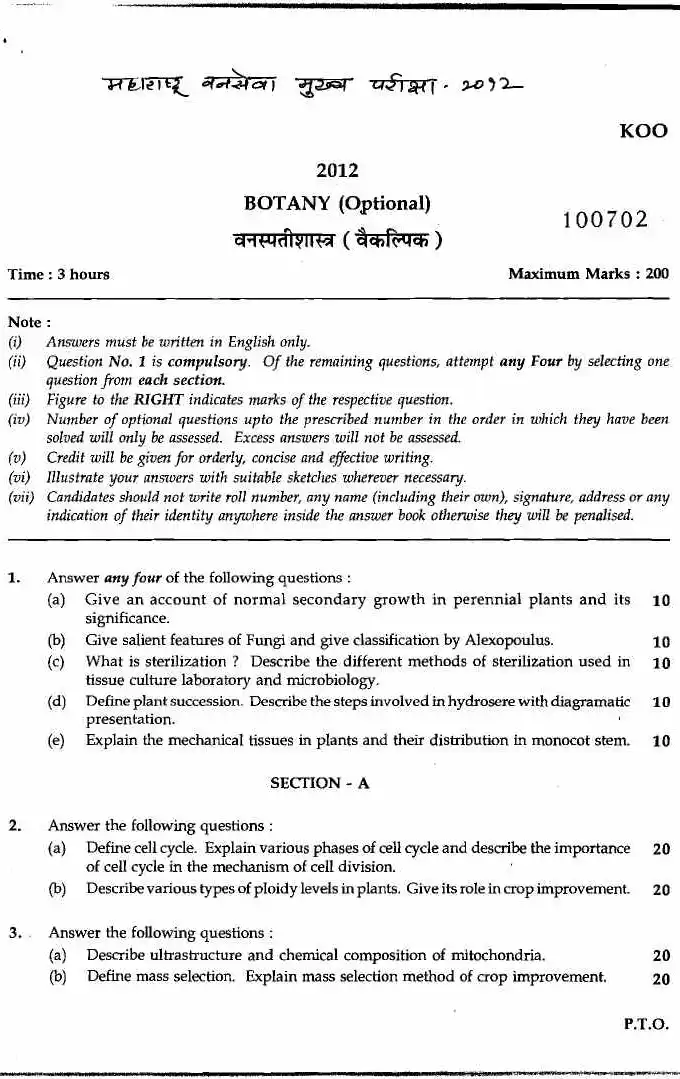
  • ामहाराष्ट्र् बनसेवा 'मुख्य' परीक्षा · 2092- KOO 2012 BOTANY (Optional) 100702 वनस्पतीशास्त्र ( वैकल्पिक ) Time: 3 hours Maximum Marks: 200
  • Note: (i) Answers must be written in English only.
  • Question No. 1 is compulsory.
  • Of the remaining questions, attempt any Four by selecting one
  • (i) Answers must be written in English only.
  • (ii) question from each section.
  • (iii) Figure to the RIGHT indicates marks of the respective question.
  • Number of optional questions upto the prescribed number in the order in which they have been
  • (iv) solved will only be assessed.
  • Excess answers will not be assessed.
  • Credit will be given for orderly, concise and effective writing.
  • (v) Illustrate your answers with suitable sketches wherever necessary.
  • (vii) Candidates should not write roll number, any name (including their own), signature, address or any indication of their identity anywhere inside the answer book otherwise they will be penalised.

Questions (page 2)

Q1.

() Answer any four of the following questions :
Give an account of normal secondary growth in perennial plants and its significance.
What is sterilization? Describe the different methods of sterilization used in tissue culture laboratory and microbiology.
Define plant succession. Describe the steps involved in hydrosere with diagramatic presentation.
Explain the mechanical tissues in plants and their distribution in monocot stem.

() Give salient features of Fungi and give classification by Alexopoulus.

() What is sterilization? Describe the different methods of sterilization used in tissue culture laboratory and microbiology.

() Define plant succession. Describe the steps involved in hydrosere with diagramatic presentation.

() Explain the mechanical tissues in plants and their distribution in monocot stem.

Q2.

() Define cell cycle. Explain various phases of cell cycle and describe the importance of cell cycle in the mechanism of cell division.

() Describe various types of ploidy levels in plants. Give its role in crop improvement.

Q3.

() Describe ultrastructure and chemical composition of mitochondria.
Define mass selection. Explain mass selection method of crop improvement.

() Define mass selection. Explain mass selection method of crop improvement.

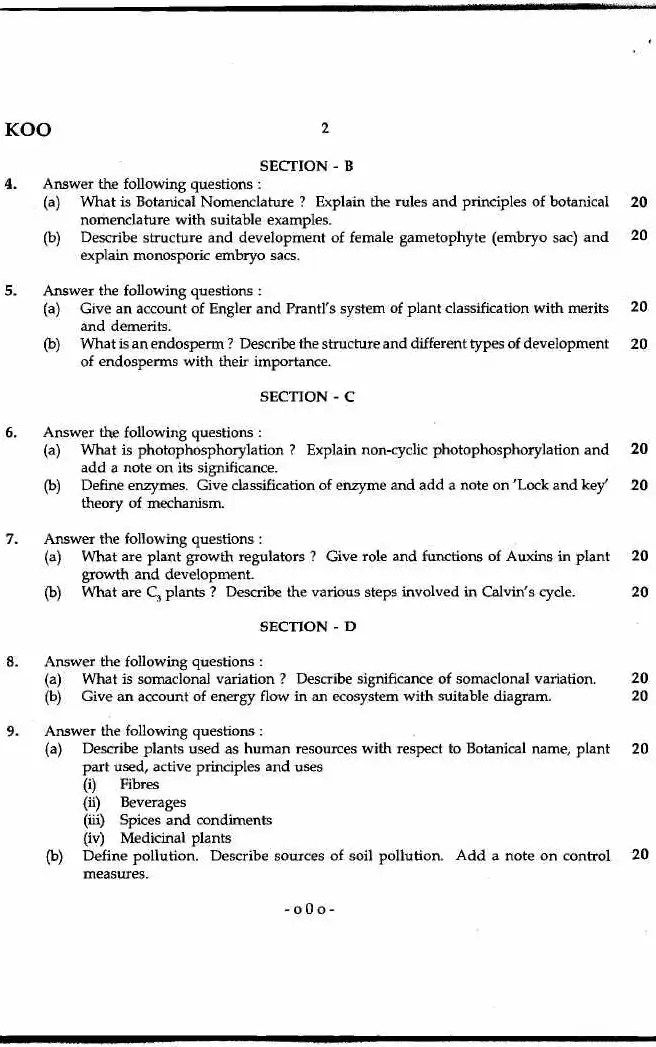
Q4.

() What is Botanical Nomenclature? Explain the rules and principles of botanical nomenclature with suitable examples.
Describe structure and development of female gametophyte (embryo sac) and explain monosporic embryo sacs.

() Describe structure and development of female gametophyte (embryo sac) and explain monosporic embryo sacs.

Q5.

() Give an account of Engler and Prantl's system of plant classification with merits and demerits.
What is an endosperm? Describe the structure and different types of development of endosperms with their importance.

() What is an endosperm? Describe the structure and different types of development of endosperms with their importance.

Q6.

() What is photophosphorylation? Explain non-cyclic photophosphorylation and add a note on its significance.
Define enzymes. Give classification of enzyme and add a note on 'Lock and key' theory of mechanism.

() Define enzymes. Give classification of enzyme and add a note on 'Lock and key' theory of mechanism.

Q7.

() What are plant growth regulators? Give role and functions of Auxins in plant growth and development.

() What are C3 plants ? Describe the various steps involved in Calvin's cycle.

Q8.

() What is somaclonal variation? Describe significance of somaclonal variation.
Give an account of energy flow in an ecosystem with suitable diagram.

() Give an account of energy flow in an ecosystem with suitable diagram.

Q9.

() Describe plants used as human resources with respect to Botanical name, plant part used, active principles and uses
Fibres
Beverages
Spices and condiments
Medicinal plants

() Define pollution. Describe sources of soil pollution. Add a note on control measures.

Question paper preview

Scanned pages 1–2 for reference. Download the official PDF for the full paper.

Page 1
MPSC Botany Optional Previous Year Paper 2012 - Maharashtra Forest Services Main Exam — page 1 instructions scan PDF download
Page 2
MPSC Botany Optional Previous Year Paper 2012 - Maharashtra Forest Services Main Exam — page 1 instructions scan PDF download

Free question paper download

Download question paper PDF

  • 32 KB
  • 2 pages
  • PDF format

Frequently asked questions

What is the exam name and year for this Botany Optional paper?

The exam is the Maharashtra Forest Services Main Examination, and the year is 2012.

What is the maximum marks and time duration for this paper?

The maximum marks are 200, and the time allowed is 3 hours.

What is the compulsory question in this paper?

Question number 1 is compulsory, requiring answers to any four of the listed sub-questions.

How many questions need to be attempted from the remaining sections?

Candidates need to attempt any four questions by selecting one from each of the remaining sections (A, B, C, D).

What are the main subjects covered in the Botany Optional paper?

The paper covers a wide range of botanical topics including plant physiology, genetics, plant classification, ecology, and applied botany.

Can you explain the importance of secondary growth in perennial plants as asked in Q1(a)?

Secondary growth in perennial plants refers to the increase in girth of stems and roots due to the activity of vascular cambium and cork cambium. Its significance lies in providing mechanical support, facilitating water and nutrient transport through secondary xylem and phloem, and forming protective tissues like bark.

← Back to Administrative / Civil Services papers