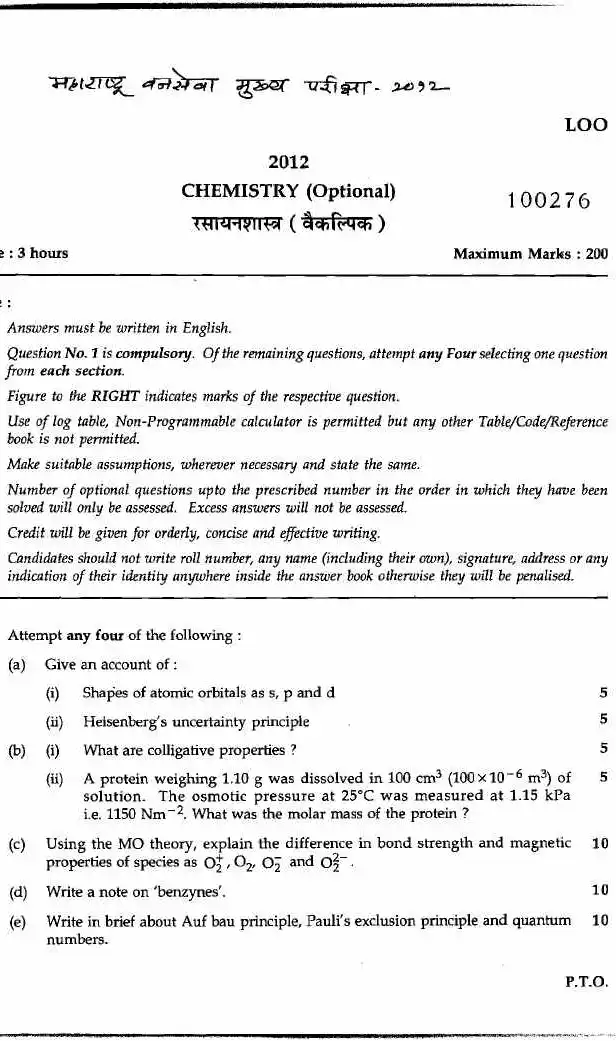
Q1. (a) 1. Attempt any four of the following : Give an account of: Shapes of atomic orbitals as s, p and d
(i) Heisenberg's uncertainty principle
(ii) ?
(a) 1. Attempt any four of the following : Give an account of: Shapes of atomic orbitals as s, p and d
(i) Heisenberg's uncertainty principle
(ii) ?
(b) (i) What are colligative properties?
A protein weighing 1.10 g was dissolved in 100 cm3 (100 × 10^{-6} m3) of solution. The osmotic pressure at 25°C was measured at 1.15 kPa i.e. 1150 Nm^{-2}. What was the molar mass of the protein?
Using the MO theory, explain the difference in bond strength and magnetic properties of species as O2^+, O2^-, and O2^{2-}. Write a note on 'benzynes'.
(d) Write in brief about Aufbau principle, Pauli's exclusion principle and quantum numbers.
(e) P.T.O.
- (a) 1. Attempt any four of the following : Give an account of: Shapes of atomic orbitals as s, p and d
- (b) (i) What are colligative properties?
A protein weighing 1.10 g was dissolved in 100 cm3 (100 × 10^{-6} m3) of solution. The osmotic pressure at 25°C was measured at 1.15 kPa i.e. 1150 Nm^{-2}. What was the molar mass of the protein?
Using the MO theory, explain the difference in bond strength and magnetic properties of species as O2^+, O2^-, and O2^{2-}. Write a note on 'benzynes'. - (d) Write in brief about Aufbau principle, Pauli's exclusion principle and quantum numbers.
Q2.
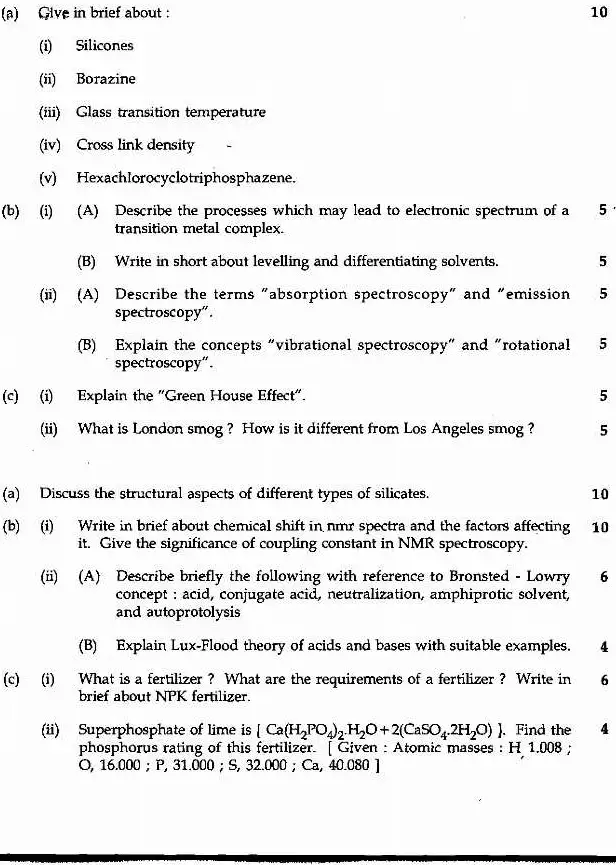
(a) Silicones i) Borazine
(iii) (iii) Glass transition temperature Cross link density
(iv) Hexachlorocyclotriphosphazene.
(v) 5 ·
(b) (i) (A) Describe the processes which may lead to electronic spectrum of a transition metal complex. Write in short about levelling and differentiating solvents. (B)
5. Describe the terms "absorption spectroscopy" and "emission
(ii) (A) spectroscopy".
(c) Explain the concepts "vibrational spectroscopy" and "rotational (B) spectroscopy". Explain the "Green House Effect".
(i) What is London smog? How is it different from Los Angeles smog?
(ii) Discuss the structural aspects of different types of silicates. з. (a) (b)
(i) Write in brief about chemical shift in nmr spectra and the factors affecting it. Give the significance of coupling constant in NMR spectroscopy.
(ii) Describe briefly the following with reference to Bronsted - Lowry 6 (A) concept : acid, conjugate acid, neutralization, amphiprotic solvent, and autoprotolysis (B) Explain Lux-Flood theory of acids and bases with suitable examples. 4
(c) What is a fertilizer? What are the requirements of a fertilizer? Write in i) 6 brief about NPK fertilizer. Superphosphate of lime is [Ca(H2PO4)_2.H2O + 2(CaSO4.2H2O)]. Find the 4
(ii) phosphorus rating of this fertilizer. [Given : Atomic masses : H 1.008 ; O, 16.000; P, 31.000; S, 32.000; Ca, 40.080]
Q2. (a) Silicones i) Borazine
(iii) (iii) Glass transition temperature Cross link density
(iv) Hexachlorocyclotriphosphazene.
(v) 5 ·
(a) Silicones i) Borazine
(iii) (iii) Glass transition temperature Cross link density
(iv) Hexachlorocyclotriphosphazene.
(v) 5 ·
(b) (i) (A) Describe the processes which may lead to electronic spectrum of a transition metal complex. Write in short about levelling and differentiating solvents. (B)
5. Describe the terms "absorption spectroscopy" and "emission
(ii) (A) spectroscopy".
(c) Explain the concepts "vibrational spectroscopy" and "rotational (B) spectroscopy". Explain the "Green House Effect".
(i) What is London smog? How is it different from Los Angeles smog?
(ii) Discuss the structural aspects of different types of silicates. з. (a) (b)
(i) Write in brief about chemical shift in nmr spectra and the factors affecting it. Give the significance of coupling constant in NMR spectroscopy.
(ii) Describe briefly the following with reference to Bronsted - Lowry 6 (A) concept : acid, conjugate acid, neutralization, amphiprotic solvent, and autoprotolysis (B) Explain Lux-Flood theory of acids and bases with suitable examples. 4
(c) What is a fertilizer? What are the requirements of a fertilizer? Write in i) 6 brief about NPK fertilizer. Superphosphate of lime is [Ca(H2PO4)_2.H2O + 2(CaSO4.2H2O)]. Find the 4
(ii) phosphorus rating of this fertilizer. [Given : Atomic masses : H 1.008 ; O, 16.000; P, 31.000; S, 32.000; Ca, 40.080]
- (a) Silicones i) Borazine
- (b) (i) (A) Describe the processes which may lead to electronic spectrum of a transition metal complex. Write in short about levelling and differentiating solvents. (B)
Q3. (a) 2.
(a) 2. (b)
(i) Describe the processes which may lead to electronic spectrum of a transition metal complex.
(b) Write in short about levelling and differentiating solvents.
- (a) 2. (b)
- (b) Write in short about levelling and differentiating solvents.
Q4. 2.
(ii) (A) Describe the terms "absorption spectroscopy" and "emission spectroscopy".
Q5. 2.
(ii) (B) Explain the concepts "vibrational spectroscopy" and "rotational spectroscopy". Explain the "Green House Effect".
- (c) Explain the concepts "vibrational spectroscopy" and "rotational (B) spectroscopy". Explain the "Green House Effect".
- (c) What is a fertilizer? What are the requirements of a fertilizer? Write in i) 6 brief about NPK fertilizer. Superphosphate of lime is [Ca(H2PO4)_2.H2O + 2(CaSO4.2H2O)]. Find the 4
Q6. 2.
(c)
(i) What is London smog? How is it different from Los Angeles smog?
Q7. 2.
(c)
(ii) Discuss the structural aspects of different types of silicates.
Q8. 2. (a) (d) (a) Write in brief about chemical shift in NMR spectra and the factors affecting it. Give the significance of coupling constant in NMR spectroscopy.
Q9. 2.
(ii) (A) Describe briefly the Bronsted-Lowry concept: acid, conjugate acid, neutralization, amphiprotic solvent, and autoprotolysis.
Q10. 2.
(ii) (B) Explain Lux-Flood theory of acids and bases with suitable examples.
Q11. 2.
(c) What is a fertilizer? What are the requirements of a fertilizer? Write in
(i) brief about NPK fertilizer. Superphosphate of lime is [Ca(H2PO4)2.H2O+2(CaSO4.2H2O)]. Find the phosphorus rating of this fertilizer. [Given : Atomic masses : H 1.008 ; O 16.000; P 31.000; S 32.000; Ca 40.080]