MPSC Geology Optional Previous Year Paper 2007 - Maharashtra Forest Services Main Exam
Maharashtra Government Jobs·Administrative / Civil Services·2007
📅Year2007
🏛Conducted ByMaharashtra Public Service Commission
📝Questions7
🎯Maximum Marks200
⏱Duration3 Hours
🌐LanguagesEnglish & Hindi
Exam Details
Detail
Information
Examination
Maharashtra Forest Services Main Examination
Year
2007
Conducting Body
Maharashtra Public Service Commission
Paper
Geology (Optional)
Subject
Geology
Duration
3 Hours
Maximum Marks
200
Number of Questions
7
Question Type
Descriptive / Subjective
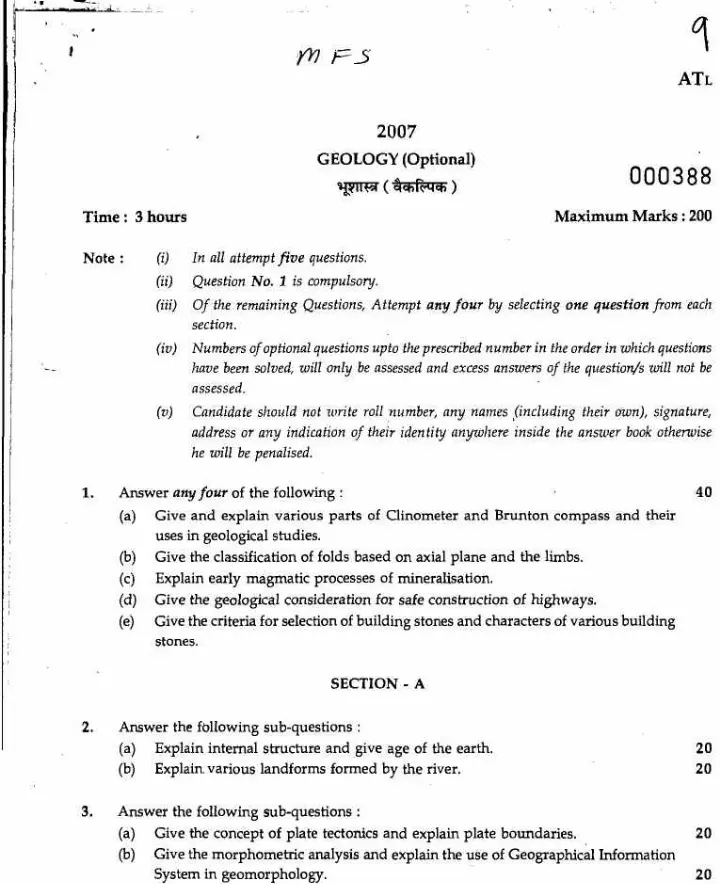
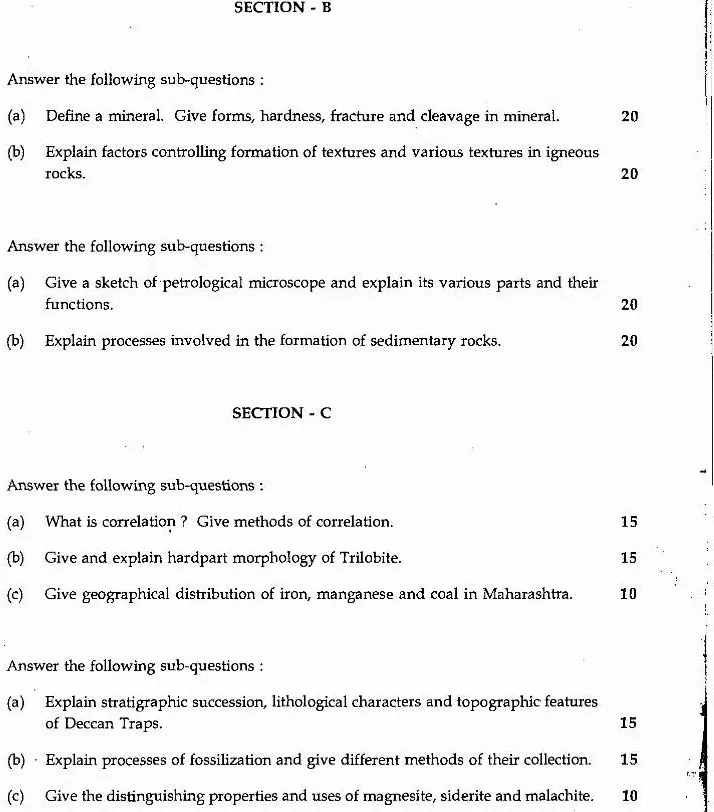
This is the official question paper for the Maharashtra Forest Services Main Examination held in 2007, featuring the Geology (Optional) paper. The exam, conducted by the Maharashtra Public Service Commission (MPSC), allowed candidates 3 hours to answer a maximum of 200 marks. The paper consists of descriptive questions divided into three sections (A, B, and C), with compulsory question 1 and four other questions to be attempted from the remaining sections. Key topics covered include geological instruments (Clinometer, Brunton compass), structural geology (folds), mineralisation, civil engineering geology, building stones, Earth's internal structure, geomorphology (landforms, plate tectonics, GIS), mineralogy (definition, properties, textures of igneous rocks), petrology (microscope, sedimentary rocks), stratigraphy, paleontology (Trilobite, fossilization), economic geology (iron, manganese, coal), and regional geology (Deccan Traps). The paper tests in-depth knowledge and application of geological principles relevant to forest services. This previous year Maharashtra Forest Services Main Examination question paper (2007) is useful for Administrative / Civil Services aspirants preparing for Maharashtra government recruitment. The paper was conducted by MPSC and reflects the official exam pattern, marking scheme and difficulty level seen in recent cycles. Use it for timed practice, topic-wise revision and understanding how questions are framed in the real examination. Download the free PDF on QuizCurrent to read instructions, attempt MCQs and compare your answers with the study notes provided on this page. Key syllabus areas include Geology, Optional Subjects, Maharashtra Forest Services, MPSC Exams, Civil Services, Earth Science, Geomorphology, Mineralogy. Useful for Maharashtra Forest Services Main Examina preparation. Helps understand the latest exam pattern. Useful for practice and self-assessment.
Major Topics Covered
Geology
Optional Subjects
Maharashtra Forest Services
MPSC Exams
Civil Services
Earth Science
Geomorphology
Mineralogy
Petrology
Structural Geology
Stratigraphy
Paleontology
Economic Geology
Engineering Geology
Plate Tectonics
GIS in Geomorphology
Fossilization
Deccan Traps
Indian Geology
Maharashtra Geology
Why This Paper is Important
Useful for Maharashtra Forest Services Main Examina preparation
(ii) Question No. 1 is compulsory. Of the remaining Questions, Attempt any four by selecting one question from each
(iii) section. Numbers of optional questions upto the prescribed number in the order in which questions
(iv) have been solved, will only be assessed and excess answers of the question/s will not be assessed.
Candidate should not write roll number, any names (including their own), signature,
(v) address or any indication of their identity anywhere inside the answer book otherwise he will be penalised.
Answer any four of the following : 40
Questions (page 2)
Q1.(a) Give and explain various parts of Clinometer and Brunton compass and their uses in geological studies. Give the classification of folds based on axial plane and the limbs. Explain early magmatic processes of mineralisation. Give the geological consideration for safe construction of highways. Give the criteria for selection of building stones and characters of various building stones.
(a)Give and explain various parts of Clinometer and Brunton compass and their uses in geological studies. Give the classification of folds based on axial plane and the limbs. Explain early magmatic processes of mineralisation. Give the geological consideration for safe construction of highways. Give the criteria for selection of building stones and characters of various building stones.
(b)Give the classification of folds based on axial plane and the limbs.
(c)Explain early magmatic processes of mineralisation.
(d)Give the geological consideration for safe construction of highways.
(e)Give the criteria for selection of building stones and characters of various building stones.
(a)Give and explain various parts of Clinometer and Brunton compass and their uses in geological studies. Give the classification of folds based on axial plane and the limbs. Explain early magmatic processes of mineralisation. Give the geological consideration for safe construction of highways. Give the criteria for selection of building stones and characters of various building stones.
(b)Give the classification of folds based on axial plane and the limbs.
(c)Explain early magmatic processes of mineralisation.
(d)Give the geological consideration for safe construction of highways.
Q2.Explain internal structure and give age of the earth.
(a)Explain various landforms formed by the river.
Q3.Give the concept of plate tectonics and explain plate boundaries.
(a)Give the morphometric analysis and explain the use of Geographical Information System in geomorphology.
Q4.(a) Define a mineral. Give forms, hardness, fracture and cleavage in mineral. Explain factors controlling formation of textures and various textures in igneous rocks.
(a)Define a mineral. Give forms, hardness, fracture and cleavage in mineral. Explain factors controlling formation of textures and various textures in igneous rocks.
(b)Explain factors controlling formation of textures and various textures in igneous rocks.
(a)Define a mineral. Give forms, hardness, fracture and cleavage in mineral. Explain factors controlling formation of textures and various textures in igneous rocks.
(b)Explain factors controlling formation of textures and various textures in igneous rocks.
Q5.(a) Give a sketch of petrological microscope and explain its various parts and their functions.
(a)Give a sketch of petrological microscope and explain its various parts and their functions.
(b)Explain processes involved in the formation of sedimentary rocks.
(a)Give a sketch of petrological microscope and explain its various parts and their functions.
(b)Explain processes involved in the formation of sedimentary rocks.
Q6.(a) What is correlation? Give methods of correlation. Give and explain hardpart morphology of Trilobite. Give geographical distribution of iron, manganese and coal in Maharashtra.
(a)What is correlation? Give methods of correlation. Give and explain hardpart morphology of Trilobite. Give geographical distribution of iron, manganese and coal in Maharashtra.
(b)Give and explain hardpart morphology of Trilobite.
(c)Give geographical distribution of iron, manganese and coal in Maharashtra.
(a)What is correlation? Give methods of correlation. Give and explain hardpart morphology of Trilobite. Give geographical distribution of iron, manganese and coal in Maharashtra.
(b)Give and explain hardpart morphology of Trilobite.
(c)Give geographical distribution of iron, manganese and coal in Maharashtra.
Q7.(a) Explain stratigraphic succession, lithological characters and topographic features of Deccan Traps. Explain processes of fossilization and give different methods of their collection. Give the distinguishing properties and uses of magnesite, siderite and malachite.
(a)Explain stratigraphic succession, lithological characters and topographic features of Deccan Traps. Explain processes of fossilization and give different methods of their collection. Give the distinguishing properties and uses of magnesite, siderite and malachite.
(b)Explain processes of fossilization and give different methods of their collection.
(c)Give the distinguishing properties and uses of magnesite, siderite and malachite.
(a)Explain stratigraphic succession, lithological characters and topographic features of Deccan Traps. Explain processes of fossilization and give different methods of their collection. Give the distinguishing properties and uses of magnesite, siderite and malachite.
(b)Explain processes of fossilization and give different methods of their collection.
(c)Give the distinguishing properties and uses of magnesite, siderite and malachite.
Question paper preview
Scanned pages 1–2 for reference. Download the official PDF for the full paper.
Page 1Page 2
PDF
Free question paper download
Download question paper PDF
27 KB
3 pages
PDF format
10
PDF
Your download starts in 10s
Preparing your question paper file…
Frequently asked questions
What is the exam name and year for this Geology Optional paper?
The exam name is Maharashtra Forest Services Main Examination, and the year is 2007.
What is the maximum marks and time duration for the Geology Optional paper?
The maximum marks are 200, and the time allowed is 3 hours.
What is the conducting body for the Maharashtra Forest Services Main Examination?
The conducting body is the Maharashtra Public Service Commission (MPSC).
How many questions are compulsory in the 2007 Geology Optional paper?
Question No. 1 is compulsory.
What is the structure of the Geology Optional paper?
The paper has descriptive questions divided into three sections. Candidates must attempt question 1 and any four from the remaining questions, selecting one from each section.
What are some of the key topics covered in Section A of the Geology Optional paper?
Section A covers topics like geological instruments, folds, mineralisation, highway construction geology, and building stones.