MFS Forestry 2008 Optional Main Exam

Maharashtra Government Jobs Administrative / Civil Services 2008

  • Year 2008
  • Conducted By FNS
  • Questions 9
  • Maximum Marks 200
  • Duration 3 Hours
  • Languages English & Hindi

Exam Details

Detail Information
Examination Forestry (Optional)
Year 2008
Conducting Body FNS
Paper Forestry (Optional)
Subject Forestry
Duration 3 Hours
Maximum Marks 200
Number of Questions 9

This dataset compiles the 2008 Maharashtra Forest Services Main Examination Forestry (Optional) paper. Page 1 presents header information, instructions, and Question 1–3 with parts addressing neem seed problems, seedling types, and plantation methods. Page 2 contains Section B–D style prompts (4–9) covering agroforestry, JFM, rotations, social forestry, terraces, ecosystem structure, katha extraction, forest industries, wildlife, and climate-plant distribution. The OCR was repaired to preserve question numbering, sub-parts, and approximate marks, enabling an organized set of 9 descriptive questions across sections. The content is used for SEO-rich metadata, structured data, and comprehensive FAQ development.

Major Topics Covered

  • Forestry
  • Maharashtra Forest Services
  • Main Examination
  • Seed provenance
  • Seed source
  • Sustained yield
  • Forest working plans
  • WTO in forestry
  • Bare rooted seedlings
  • Containerized seedlings
  • Shelterwood system
  • Eucalyptus seedling methods
  • Alkaline soil plantations
  • Selection system
  • Teak regeneration
  • Agroforestry
  • Global warming effects on forests
  • Joint Forest Management (JFM)
  • Micro-nutrients in soils
  • Soil pollutants and remedies
  • Rotations in forestry
  • Increment types
  • Terraces in forestry
  • Remote sensing
  • GSI techniques
  • Social forestry
  • Types of increments
  • Katha extraction
  • Forest-based industries
  • Wildlife conservation
  • Succession

Why This Paper is Important

  • Useful for Forestry (Optional) preparation
  • Helps understand the latest exam pattern
  • Useful for practice and self-assessment
  • Covers frequently asked General Studies topics
  • Helpful for analysing question trends

Related Resources

Instructions

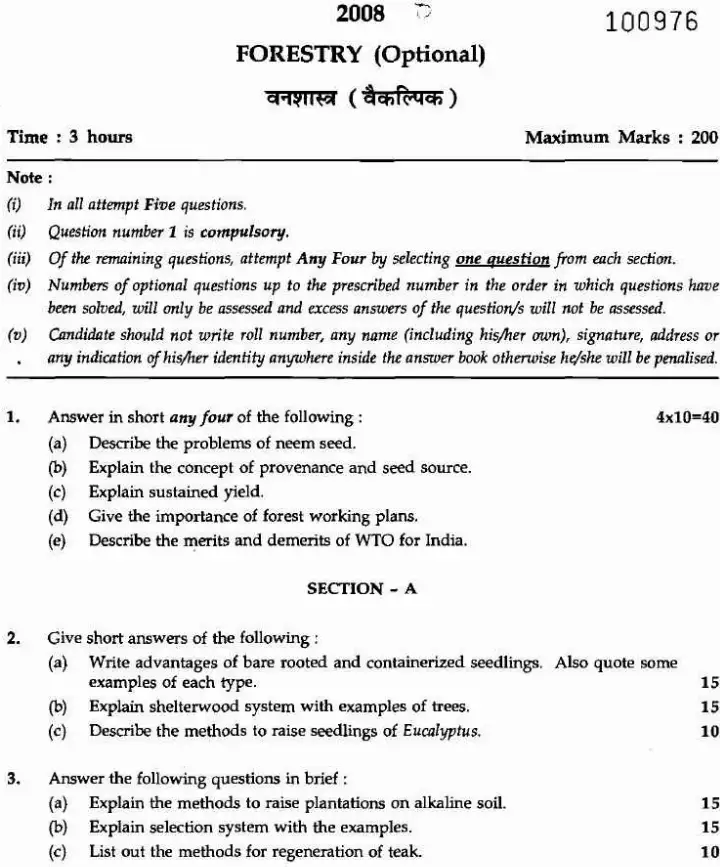
  • FNS 2008 ▽ 100976 FORESTRY (Optional) वनशास्त्र (वैकल्पिक) Time: 3 hours Maximum Marks: 200
  • Note: (i) In all attempt Five questions.
  • (i) In all attempt Five questions.
  • (ii) Question number 1 is compulsory.
  • (iii) Of the remaining questions, attempt Any Four by selecting one question from each section.
  • Numbers of optional questions up to the prescribed number in the order in which questions have
  • (vv) been solved, will only be assessed and excess answers of the question/s will not be assessed.
  • Candidate should not write roll number, any name (including his/her own), signature, address or
  • (v) any indication of his/her identity anywhere inside the answer book otherwise he/she will be penalised. \bullet Answer in short any four of the following :

Questions (page 2)

Q1. Describe the problems of neem seed.

() Describe the problems of neem seed.
(a) Explain the concept of provenance and seed source.
(b) Explain sustained yield.
(e) Describe the merits and demerits of WTO for India.

() (b) Explain sustained yield.

() (e) Describe the merits and demerits of WTO for India.

  • (a) Explain the concept of provenance and seed source.
  • (b) Explain sustained yield.
  • (b) Explain sustained yield.

Q2.

() (a) Write advantages of bare rooted and containerized seedlings. Also quote some 15 examples of each type. Explain shelterwood system with examples of trees.

() 2. Give short answers of the following : Write advantages of bare rooted and containerized seedlings. Also quote some 15 examples of each type. Explain shelterwood system with examples of trees.
(b) Describe the methods to raise seedlings of Eucalyptus.

Q3. Explain the methods to raise plantations on alkaline soil.

() 3. Explain the methods to raise plantations on alkaline soil.
(a) Explain selection system with the examples.
(b) List out the methods for regeneration of teak.

() (b) List out the methods for regeneration of teak.

  • (a) Explain selection system with the examples.
  • (b) List out the methods for regeneration of teak.
  • (b) List out the methods for regeneration of teak.

Q4. Define agroforestry. What are its advantages?

() 4. Define agroforestry. What are its advantages?
(a) Explain nutrient cycling in forest ecosystems.
(b) List out the effects of global warming on forests.
(c) Give answers of the following questions in short:

() (b) List out the effects of global warming on forests.

() (c) Give answers of the following questions in short:

  • (a) Explain nutrient cycling in forest ecosystems.
  • (b) List out the effects of global warming on forests.
  • (c) Give answers of the following questions in short:
  • (b) List out the effects of global warming on forests.
  • (c) Give answers of the following questions in short:

Q5. Explain JFM particularly its impact.

() 5. Explain JFM particularly its impact.
(a) Describe the symptoms of micro-nutrients and their remedies.
(b) Name the pollutants affecting the soil. Explain remedial measures for them.
(c)

() (b) Name the pollutants affecting the soil. Explain remedial measures for them.

  • (a) Describe the symptoms of micro-nutrients and their remedies.
  • (b) Name the pollutants affecting the soil. Explain remedial measures for them.
  • (b) Name the pollutants affecting the soil. Explain remedial measures for them.

Q6. Explain the types of rotations. What is their effect on yield?

() (a) Describe the types of increments. How these are related with productivity.

() 6. Explain the types of rotations. What is their effect on yield?
(a) Describe the types of increments. How these are related with productivity?
(b) Describe the methods to develop trenches.
(c)

  • (a) Describe the types of increments. How these are related with productivity?
  • (b) Describe the methods to develop trenches.

Q7. 7. Answer in brief: Define social forestry. Name important species and give its impact on Indian society. Explain the advantages of Remote Sensing and GSI techniques. What are their shortcomings?
(a) 20

() (a) Define social forestry.

() (b) Name important species and give its impact on Indian society.

() (c) Explain the advantages of Remote Sensing and GSI techniques. What are their shortcomings?

  • (a) 20
  • (a) Define social forestry.
  • (b) Name important species and give its impact on Indian society.
  • (c) Explain the advantages of Remote Sensing and GSI techniques. What are their shortcomings?

Q8.

() 8. Answer in short: Describe the structural aspects of an ecosystem.
(a) Explain the methods for extraction of katha.
(b) 10
(c) Define succession. Explain this process on sand dune areas with examples of 20 plants. Explain the role of climate in the distribution of plants.

() (c) Define succession. Explain this process on sand dune areas with examples of 20 plants. Explain the role of climate in the distribution of plants.

Q9. (a) Describe forest based industries in brief.

() (a) Describe forest based industries in brief.
() (b) Define wildlife. What are the methods for conservation of wildlife?

(a) 9.

(b) Describe forest based industries in brief.
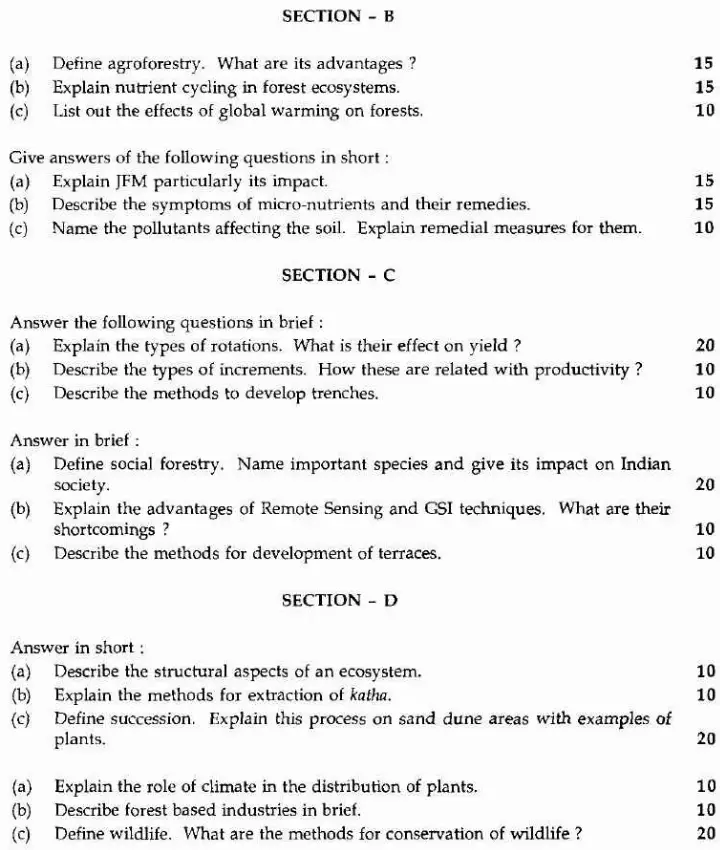
(c) Define wildlife. What are the methods for conservation of wildlife? - o O o \mathcalL = \{ \mathcalL1, \ldots, \mathcalLn \}

  • (a) Describe forest based industries in brief.
  • (b) Define wildlife. What are the methods for conservation of wildlife?
  • (a) 9.
  • (b) Describe forest based industries in brief.
  • (c) Define wildlife. What are the methods for conservation of wildlife? - o O o \mathcalL = \{ \mathcalL1, \ldots, \mathcalLn \}

Question paper preview

Scanned pages 1–2 for reference. Download the official PDF for the full paper.

Page 1
MFS Forestry 2008 Optional Main Exam — page 1 instructions scan PDF download
Page 2
MFS Forestry 2008 Optional Main Exam — page 1 instructions scan PDF download

Free question paper download

Download question paper PDF

  • 19 KB
  • 2 pages
  • PDF format

Frequently asked questions

What is the exam name and year?

Maharashtra Forest Services Main Examination, Forestry (Optional), 2008.

How many questions are compulsory and which section is compulsory?

Question 1 is compulsory; five questions in total are to be answered, selecting from sections.

What is the duration and maximum marks?

3 hours; maximum 200 marks.

From which pages are the questions taken?

Page 1 and Page 2 of the Forestry (Optional) paper.

Which topics are covered in Section B–D on Page 2?

Agroforestry, JFM, rotations, social forestry, terrace development, ecosystem structure, katha extraction, forest industries, wildlife, and climate-related plant distribution.

Are bilingual (Hindi/English) question texts present?

Yes; Hindi instructions appear in the questions, while FAQ answers are in English.

← Back to Administrative / Civil Services papers