Section A
Q1.
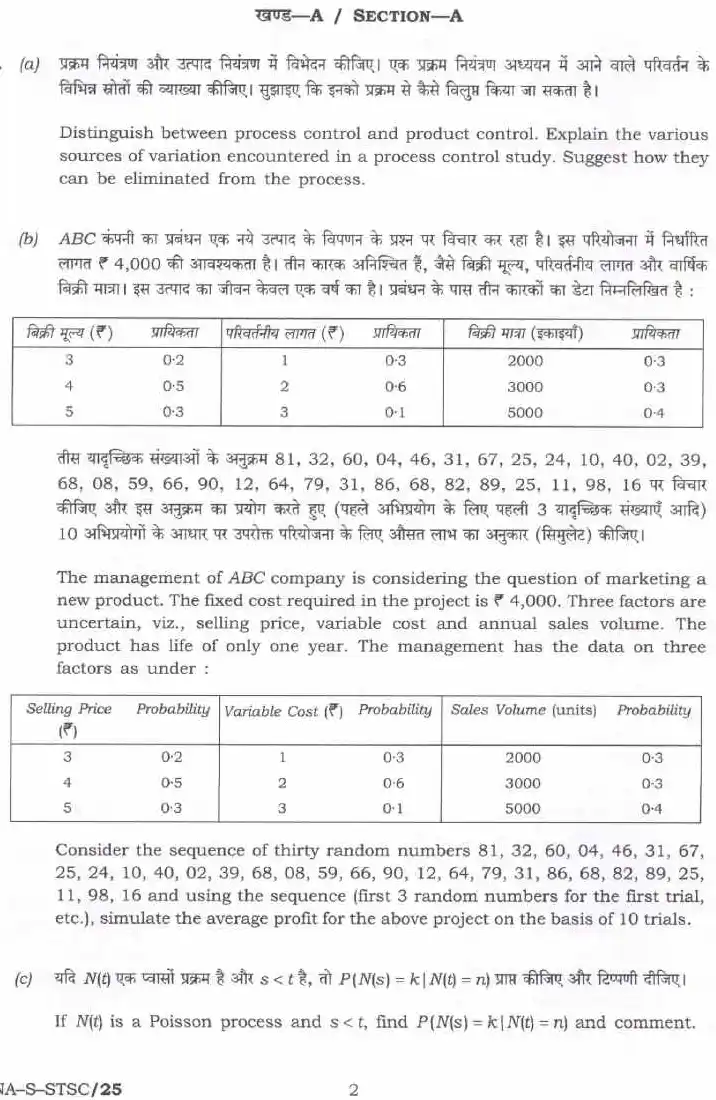
(a) प्रक्रम नियंत्रण और उत्पाद नियंत्रण में विभेदन कीजिए। एक प्रक्रम नियंत्रण अध्ययन में आने वाले परिवर्तन के विभिन्न स्रोतों की व्याख्या कीजिए। सुझाइए कि इनको प्रक्रम से कैसे विलुप्त किया जा सकता है।
Distinguish between process control and product control. Explain the various sources of variation encountered in a process control study. Suggest how they can be eliminated from the process.
(b) ABC कंपनी का प्रबंधन एक नये उत्पाद के विपणन के प्रश्न पर विचार कर रहा है। इस परियोजना में निर्धारित लागत ₹ 4,000 की आवश्यकता है। तीन कारक अनिश्चित हैं, जैसे बिक्री मूल्य, परिवर्तनीय लागत और वार्षिक बिक्री मात्रा। इस उत्पाद का जीवन केवल एक वर्ष का है। प्रबंधन के पास तीन कारकों का डेटा निम्नलिखित है:
बिक्री मूल्य (₹)
प्रायिकता
परिवर्तनीय लागत (₹)
प्रायिकता
बिक्री मात्रा (इकाइयाँ)
प्रायिकता
3
0.2
1
0.3
2000
0.3
4
0.5
2
0.6
3000
0.3
5
0.3
3
0.1
5000
0.4
तीस यादृच्छिक संख्याओं के अनुक्रम 81, 32, 60, 04, 46, 31, 67, 25, 24, 10, 40, 02, 39, 68, 08, 59, 66, 90, 12, 64, 79, 31, 86, 68, 82, 89, 25, 11, 98, 16 पर विचार कीजिए और इस अनुक्रम का प्रयोग करते हुए (पहले अभिप्रयोग के लिए पहली 3 यादृच्छिक संख्याएँ आदि) 10 अभिप्रयोगों के आधार पर उपरोक्त परियोजना के लिए औसत लाभ का अनुकार (सिमुलेट) कीजिए।
The management of ABC company is considering the question of marketing a new product. The fixed cost required in the project is ₹ 4,000. Three factors are uncertain, viz., selling price, variable cost and annual sales volume. The product has life of only one year. The management has the data on three factors as under :
Selling Price
Probability
Variable Cost (₹)
Probability
Sales Volume (units)
Probability
3
0.2
1
0.3
2000
0.3
4
0.5
2
0.6
3000
0.3
5
0.3
3
0.1
5000
0.4
Consider the sequence of thirty random numbers 81, 32, 60, 04, 46, 31, 67, 25, 24, 10, 40, 02, 39, 68, 08, 59, 66, 90, 12, 64, 79, 31, 86, 68, 82, 89, 25, 11, 98, 16 and using the sequence (first 3 random numbers for the first trial, etc.), simulate the average profit for the above project on the basis of 10 trials.
(c) यदि N(t) एक प्वासों प्रक्रम है और s < t है, तो P(N(s) = k | N(t) = n) प्राप्त कीजिए और टिप्पणी दीजिए।
If N(t) is a Poisson process and s < t, find P(N(s) = k | N(t) = n) and comment.