Section A
Q1.
(a) Describe two most commonly used point-electrode systems - the Wenner and Schlumberger Arrays. Derive apparent resistivity equation for Wenner and Schlumberger Array.
(b) (i) Cement Bond Logging (CBL) of production logging, works on which physical principle?
(ii) Give the reason for using CBL tool before and during hydrocarbon production.
(iii) Given for flushed zone, the fluid resistivity (Rxw) is 0.15 \Omegam, and the rock matrix resistivity for the flushed zone (Rxo) is 15 \Omegam. Consider 100% water saturated, constants a = 0.64, m = 2. Find the porosity in % for the flushed zone.
(c) What is Sampling theorem in data processing? Compute the sampling and Nyquist interval for analogue waveforms having maximum frequencies 250 Hz, 500 Hz and 1000 Hz respectively. Give answer in milliseconds.
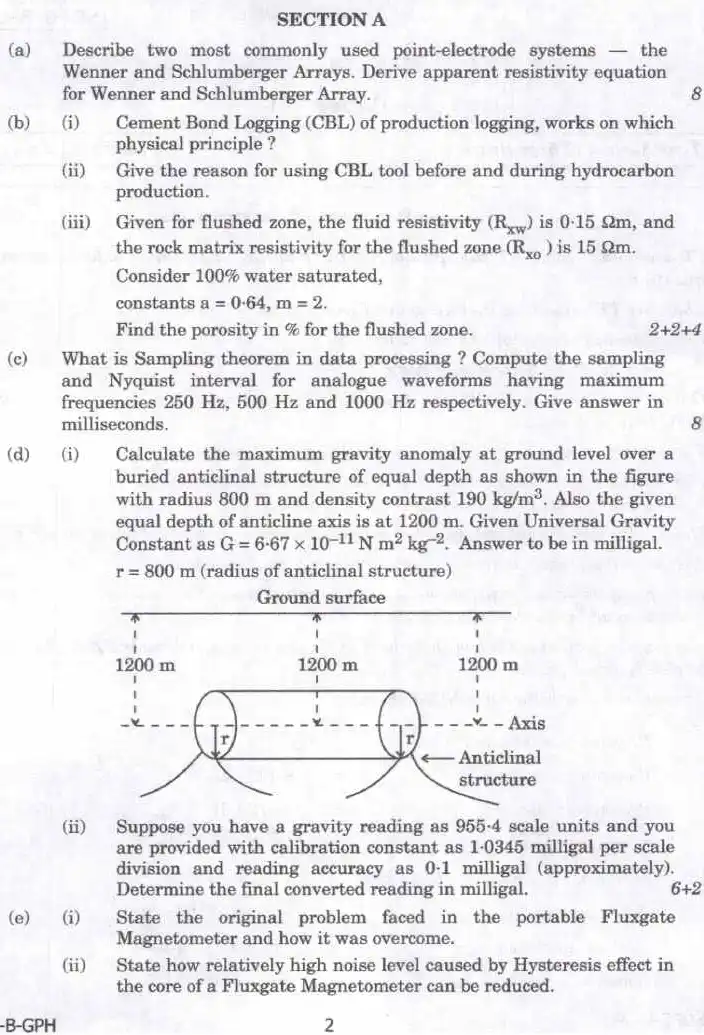
(d) (i) Calculate the maximum gravity anomaly at ground level over a buried anticlinal structure of equal depth as shown in the figure with radius 800 m and density contrast 190 kg/m3. Also the given equal depth of anticline axis is at 1200 m. Given Universal Gravity Constant as G = 6.67 × 10⁻¹¹ N \text m2 \text kg-2. Answer to be in milligal.
(ii) Suppose you have a gravity reading as 955.4 scale units and you are provided with calibration constant as 1.0345 milligal per scale division and reading accuracy as 0.1 milligal (approximately). Determine the final converted reading in milligal.
(e) (i) State the original problem faced in the portable Fluxgate Magnetometer and how it was overcome.
(ii) State how relatively high noise level caused by Hysteresis effect in the core of a Fluxgate Magnetometer can be reduced.