
Q1.
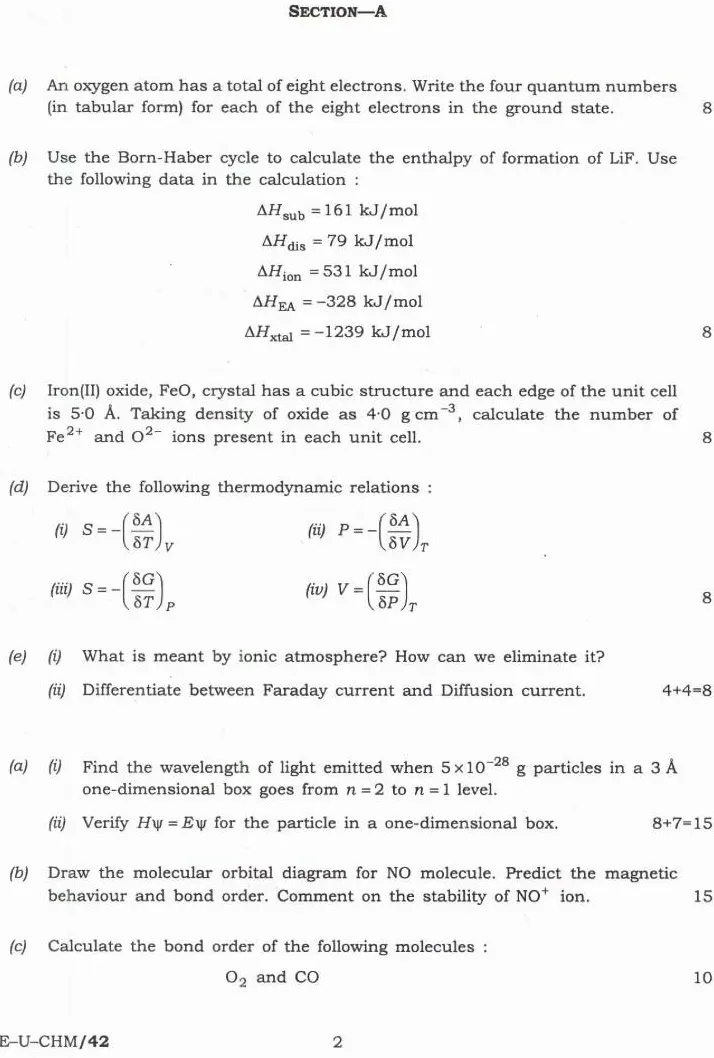
(a) SECTION-A 1. An oxygen atom has a total of eight electrons.
| Detail | Information |
|---|---|
| Examination | Indian Forest Service (Main) Examination |
| Year | 2023 |
| Conducting Body | Not specified in OCR |
| Paper | Chemistry Paper-I |
| Subject | Chemistry |
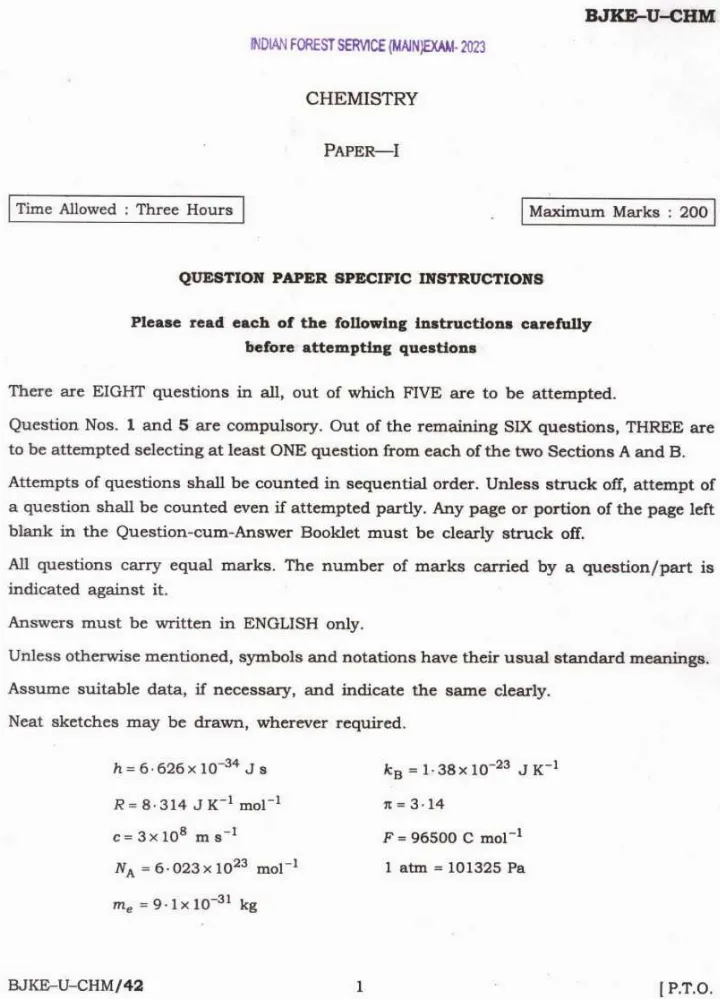
| Duration | Three Hours Maximum Marks: 200 Question Paper Specific Instructions Please Read Each Of The Following Instructions Carefully Before Attempting Questions There Are Eight Questions In All, Out Of Which Five Are To Be Attempted. Question Nos. 1 And 5 Are Compulsory. Out Of The Remaining Six Questions, Three Are To Be Attempted Selecting At Least One Question From Each Of The Two Sections A And B. Attempts Of Questions Shall Be Counted In Sequential Order. Unless Struck Off, Attempt Of A Question Shall Be Counted Even If Attempted Partly. Any Page Or Portion Of The Page Left Blank In The Question-cum-answer Booklet Must Be Clearly Struck Off. All Questions Carry Equal Marks. The Number Of Marks Carried By A Question/part Is Indicated Against It. Answers Must Be Written In English Only. Unless Otherwise Mentioned, Symbols And Notations Have Their Usual Standard Meanings. Assume Suitable Data, If Necessary, And Indicate The Same Clearly. Neat Sketches May Be Drawn, Wherever Required. |
| Maximum Marks | 200 |
| Number of Questions | 8 |
| Question Type | Descriptive/mixed |
This SEO dataset combines Page 1 metadata and Page 2 repaired OCR content for Chemistry Paper I (IFoS Main 2023). Page 1 provides exam metadata, instructions, constants, and paper identifiers. Page 2 (Section A) presents several long-answer prompts spanning quantum numbers, Born-Haber cycle calculations, unit cell ion counts in FeO, thermodynamic relations, ionic atmosphere, and electrochemical vs diffusion currents, plus a wavelength problem. The repair reconstructs numbered questions across potential two-column layouts, preserves sub-parts, and ensures one numbered item per line in text, with descriptive parts for non-MCQ items. The SEO output combines metadata, an objective_questions_preview array, and extensive FAQ, topics, tags, and image SEO to optimize discovery. This previous year Indian Forest Service (Main) Examination question paper (2023) is useful for Other Jobs aspirants preparing for Central government recruitment. The paper was conducted by UPSC and reflects the official exam pattern, marking scheme and difficulty level seen in recent cycles. Use it for timed practice, topic-wise revision and understanding how questions are framed in the real examination. Download the free PDF on QuizCurrent to read instructions, attempt MCQs and compare your answers with the study notes provided on this page. Key syllabus areas include Quantum numbers, Electron configuration, Atomic structure, Born– Haber cycle, Enthalpy of formation, Lattice energy, Unit cell and FeO structure, Density and unit cell calculation. Useful for Indian Forest Service (Main) Examination preparation. Helps understand the latest exam pattern. Useful for practice and self-assessment.
(a) SECTION-A 1. An oxygen atom has a total of eight electrons.
(a) SECTION-A 1. An oxygen atom has a total of eight electrons.
(a) (i) one-dimensional box goes from n = 2 to n = 1 level. Verify H\psi = E\psi for the particle in a one-dimensional box.
(ii) 8 + 7 = 15
Scanned pages 1–2 for reference. Download the official PDF for the full paper.
Free question paper download
Your download starts in 10s
Preparing your question paper file…
Use the Download PDF button on this page to save the official Indian Forest Service (Main) Examination (2023) Chemistry Paper-I paper hosted on QuizCurrent.
The Indian Forest Service (Main) Examination is conducted by Not specified in OCR. This portal reproduces the scanned question paper for practice and revision.
Yes. Page 1 instructions and page 2 questions are extracted from the official PDF OCR so you can read them without downloading.
The paper lists 8 questions as per the official booklet.
This is a previous year question paper for Indian Forest Service (Main) Examination (2023).