Indian Forest Service Physics Paper I 2025 Question Paper PDF

Central Government Jobs Other Jobs 2025

  • Year 2025
  • Conducted By UPSC
  • Questions 8
  • Maximum Marks 200
  • Duration Three Hours
  • Languages English

Exam Details

Detail Information
Examination Indian Forest Service (Main) Examination
Year 2025
Conducting Body UPSC
Paper Physics Paper - I
Subject Physics
Duration Three Hours
Maximum Marks 200
Number of Questions 8
Question Type Mixed

This is the Physics Paper I from the Indian Forest Service (Main) Examination 2025, conducted by UPSC. The paper contains a total of eight questions, with candidates required to attempt five. Questions 1 and 5 are compulsory, and at least one question must be selected from each of the two sections (A and B) from the remaining six questions. All questions carry equal marks, and answers must be written in English. This paper is crucial for aspirants preparing for the Indian Forest Service examination, offering insights into the exam pattern and difficulty level.

Major Topics Covered

  • Physics
  • Mechanics
  • Gravitation
  • Waves
  • Optics
  • Diffraction
  • Oscillations
  • Central Force Motion
  • Polarization

Why This Paper is Important

  • Useful for Indian Forest Service (Main) Examination preparation
  • Helps understand the latest exam pattern
  • Useful for practice and self-assessment
  • Covers frequently asked General Studies topics
  • Helpful for analysing question trends

Related Resources

  • Indian Forest Service (Main) Examination 2024 Physics Paper I
  • Indian Forest Service (Main) Examination 2025 Physics Paper II
  • UPSC Engineering Services Exam Physics Papers
  • Indian Forest Service (Main) Examination 2025 Physics Paper I Answer Key
  • UPSC IFS Main 2025 Physics Paper I Solutions
  • Indian Forest Service (Main) Examination Physics Syllabus
  • UPSC IFS Main Physics Subject Details
  • Indian Forest Service (Main) Examination Pattern

Instructions

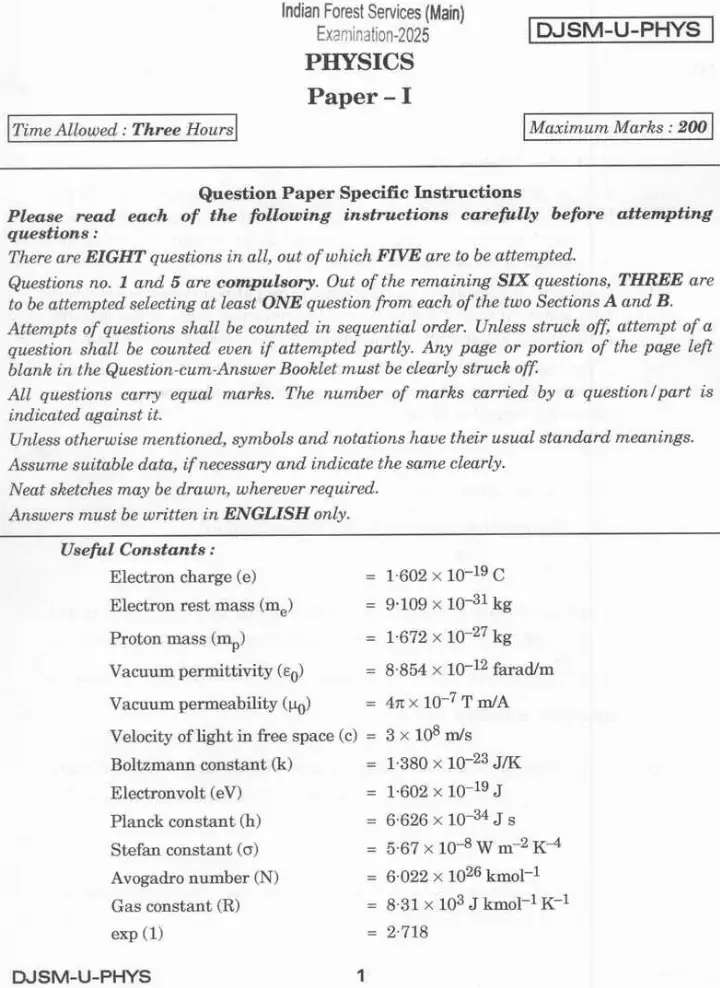
  • There are EIGHT questions in all, out of which FIVE are to be attempted.
  • Out of the remaining SIX questions, THREE are to be attempted selecting at least \overline{ONE} question from each of the two Sections A and B.
  • Attempts of questions shall be counted in sequential order.
  • Unless struck off, attempt of a question shall be counted even if attempted partly.
  • Any page or portion of the page left blank in the Question-cum-Answer Booklet must be clearly struck off.
  • The number of marks carried by a question/part is indicated against it.
  • Unless otherwise mentioned, symbols and notations have their usual standard meanings.
  • Assume suitable data, if necessary and indicate the same clearly.
  • Neat sketches may be drawn, wherever required.
  • Answers must be written in ENGLISH only.
  • Useful Constants: = 1.602 \times 10^{-19} C Electron charge (e) = 9.109 \times 10^{-31} kg Electron rest mass (m_{\rm e}) = 1.672 \times 10^{-27} kg Proton mass (m_p) = 8.854 \times 10^{-12} farad/m Vacuum permittivity (\epsilon_0) = 4\pi \times 10^{-7} T m/A Vacuum permeability (\mu_0) Velocity of light in free space (c) = 3 \times 10^8 m/s = 1.380 \times 10^{-23} J/K Boltzmann constant (k) = 1.602 \times 10^{-19} J Electronvolt (eV) = 6.626 \times 10^{-34} J s Planck constant (h) = 5.67 \times 10^{-8} \,\mathrm{W} \,\mathrm{m}^{-2} \,\mathrm{K}^{-4} Stefan constant (\sigma) = 6.022 \times 10^{26} kmol-1 Avogadro number (N) = 8.31 \times 10^3 J kmol-1 K-1 Gas constant (R) = 2.718 exp(1)

Questions (page 2)

Section A

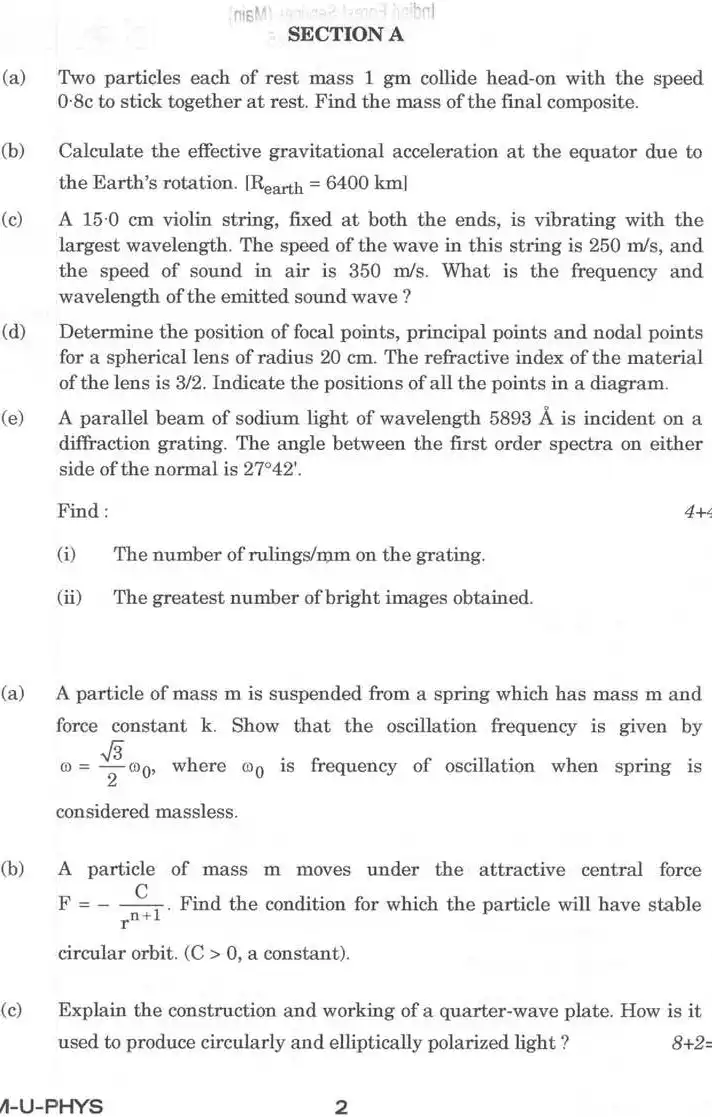
Q1. Two particles each of rest mass 1 gm collide head-on with the speed 0.8c to stick together at rest. Find the mass of the final composite. Calculate the effective gravitational acceleration at the equator due to the Earth's rotation. [R_earth = 6400 km] A 15.0 cm violin string, fixed at both the ends, is vibrating with the largest wavelength. The speed of the wave in this string is 250 m/s, and the speed of sound in air is 350 m/s. What is the frequency and wavelength of the emitted sound wave? Determine the position of focal points, principal points and nodal points for a spherical lens of radius 20 cm. The refractive index of the material of the lens is 3/2. Indicate the positions of all the points in a diagram. A parallel beam of sodium light of wavelength 5893 Å is incident on a diffraction grating. The angle between the first order spectra on either side of the normal is 27^{circ}42'. Find :

(i) The number of rulings/mm on the grating.

(ii) The greatest number of bright images obtained.
Section A

Q2. A particle of mass m is suspended from a spring which has mass m and force constant k. Show that the oscillation frequency is given by ω = (√(3))/(2) ω_0, where ω_0 is frequency of oscillation when spring is considered massless. A particle of mass m moves under the attractive central force F = -(C)/(rn+1). Find the condition for which the particle will have stable circular orbit. (C > 0, a constant). Explain the construction and working of a quarter-wave plate. How is it used to produce circularly and elliptically polarized light?

Question paper preview

Scanned pages 1–2 for reference. Download the official PDF for the full paper.

Page 1
Indian Forest Service Main 2025 Physics Paper I question paper page 1 scan showing exam instructions, compulsory questions, and useful physical constants. UPSC IFS exam PDF.
Page 2
Indian Forest Service Main 2025 Physics Paper I question paper page 1 scan showing exam instructions, compulsory questions, and useful physical constants. UPSC IFS exam PDF.

Free question paper download

Download question paper PDF

  • 2.2 MB
  • 8 pages
  • PDF format

Frequently asked questions

What is the name of the examination?

The examination is the Indian Forest Service (Main) Examination.

Which paper is this question set for?

This is for Physics Paper I.

What is the conducting body for this exam?

The Union Public Service Commission (UPSC) conducts this examination.

What is the year of this question paper?

The year is 2025.

How many questions are there in total?

There are a total of eight questions.

How many questions need to be attempted?

Candidates need to attempt five questions.

← Back to Other Jobs papers