Q1.
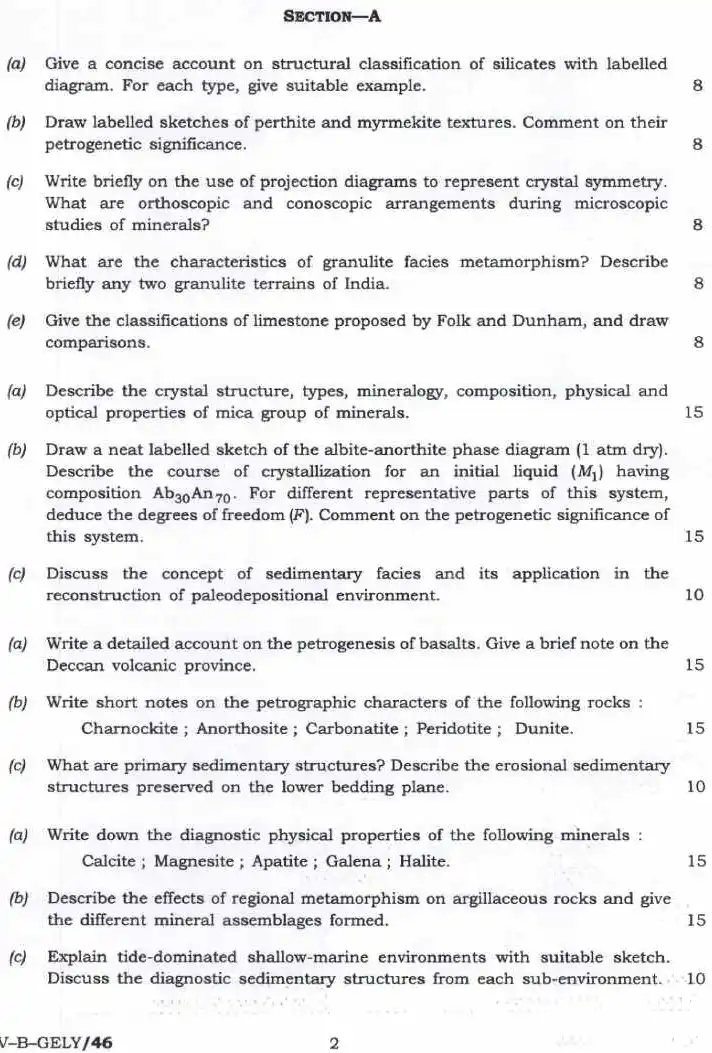
(a) 1. Give a concise account on structural classification of silicates with labelled diagram. For each type, give suitable example.
(b) Draw labelled sketches of perthite and myrmekite textures. Comment on their petrogenetic significance.
(c) Write briefly on the use of projection diagrams to represent crystal symmetry. What are orthoscopic and conoscopic arrangements during microscopic studies of minerals?
(d) What are the characteristics of granulite facies metamorphism? Describe briefly any two granulite terrains of India. Give the classifications of limestone proposed by Folk and Dunham, and draw
(e) comparisons.
Q1.
(a) SECTION-A 1. Give a concise account on structural classification of silicates with labelled diagram. For each type, give suitable example.
(b) Draw labelled sketches of perthite and myrmekite textures. Comment on their petrogenetic significance.
(c) Write briefly on the use of projection diagrams to represent crystal symmetry. What are orthoscopic and conoscopic arrangements during microscopic studies of minerals?
(d) What are the characteristics of granulite facies metamorphism? Describe briefly any two granulite terrains of India. Give the classifications of limestone proposed by Folk and Dunham, and draw
(e) comparisons.
Q2.
(a) Describe the crystal structure, types, mineralogy, composition, physical and optical properties of mica group of minerals.
(b) Draw a neat labelled sketch of the albite-anorthite phase diagram (1 atm dry). Describe the course of crystallization for an initial liquid (M1) having composition Ab 30 An 70 . For different representative parts of this system, deduce the degrees of freedom (F). Comment on the petrogenetic significance of this system.
(c) Discuss the concept of sedimentary facies and its application in the reconstruction of paleodepositional environment. Write a detailed account on the petrogenesis of basalts. Give a brief note on the
3. (a) Deccan volcanic province. (b) Write short notes on the petrographic characters of the following rocks : Charnockite; Anorthosite; Carbonatite; Peridotite; Dunite.
(c) What are primary sedimentary structures? Describe the erosional sedimentary structures preserved on the lower bedding plane. (a) Write down the diagnostic physical properties of the following minerals : Calcite; Magnesite; Apatite; Galena; Halite. (b) Describe the effects of regional metamorphism on argillaceous rocks and give the different mineral assemblages formed. Explain tide-dominated shallow-marine environments with suitable sketch. c ) Discuss the diagnostic sedimentary structures from each sub-environment. 10 ? JBNV-B-GELY/46 2
Q2.
(a) Describe the crystal structure, types, mineralogy, composition, physical and optical properties of mica group of minerals.
(b) Draw a neat labelled sketch of the albite-anorthite phase diagram (1 atm dry). Describe the course of crystallization for an initial liquid (M1) having composition Ab 30 An 70 . For different representative parts of this system, deduce the degrees of freedom (F). Comment on the petrogenetic significance of this system.
(c) Discuss the concept of sedimentary facies and its application in the reconstruction of paleodepositional environment. Write a detailed account on the petrogenesis of basalts. Give a brief note on the
3. (a) Deccan volcanic province. (b) Write short notes on the petrographic characters of the following rocks : Charnockite; Anorthosite; Carbonatite; Peridotite; Dunite.
(c) What are primary sedimentary structures? Describe the erosional sedimentary structures preserved on the lower bedding plane. (a) Write down the diagnostic physical properties of the following minerals : Calcite; Magnesite; Apatite; Galena; Halite. (b) Describe the effects of regional metamorphism on argillaceous rocks and give the different mineral assemblages formed. Explain tide-dominated shallow-marine environments with suitable sketch. c ) Discuss the diagnostic sedimentary structures from each sub-environment. 10 ? JBNV-B-GELY/46 2
Q3. 3. Deccan volcanic province. 15 (b) Short notes on petrographic characters of rocks: Charnockite; Anorthosite; Carbonatite; Peridotite; Dunite. 15
(c) Primary sedimentary structures? Describe the erosional sedimentary structures preserved on the lower bedding plane. 10