UPSC Geologist Exam 2017 Chemistry Paper I PDF

Central Government Jobs Other Jobs 2017

  • Year 2017
  • Conducted By UPSC
  • Questions 11
  • Maximum Marks 200
  • Duration Three Hours
  • Languages English

Exam Details

Detail Information
Examination Geologist Examination
Year 2017
Conducting Body UPSC
Paper CHEMISTRY Paper - I
Subject Chemistry
Duration Three Hours
Maximum Marks 200
Number of Questions 11
Question Type Mixed

This is the official Chemistry Paper I for the UPSC Geologist Examination held in 2017. The paper carries a maximum of 200 marks and candidates are allowed three hours to complete it. It consists of eleven questions divided into six sections, with Section A being compulsory. Aspirants must attempt six questions in total, choosing one from each of the remaining sections (B, C, D, E, and F). The paper is designed to test the in-depth knowledge of chemistry relevant to the role of a geologist. This question paper is a valuable resource for candidates preparing for the Geologist Examination, providing insights into the exam pattern, question types, and difficulty level.

Major Topics Covered

  • Redox Reactions
  • Organometallic Compounds
  • Magnetic Moment
  • 18 Electron Rule
  • Magic Number Nucleons
  • Organometallic Bonding
  • Chlorofluorocarbons (CFCs)
  • Actinides
  • Oxidation States
  • Lanthanide Contraction

Why This Paper is Important

  • Useful for Geologist Examination preparation
  • Helps understand the latest exam pattern
  • Useful for practice and self-assessment
  • Covers frequently asked General Studies topics
  • Helpful for analysing question trends

Related Resources

  • Geologist Examination 2016 Chemistry Paper I
  • Geologist Examination 2017 General Studies Paper
  • UPSC IES 2017 Mechanical Engineering Paper I
  • Geologist Examination 2017 Chemistry Paper I Answer Key
  • UPSC Geologist Exam 2017 Solutions
  • Geologist Examination Chemistry Syllabus
  • UPSC Geologist Exam Detailed Syllabus
  • Geologist Examination Exam Pattern

Instructions

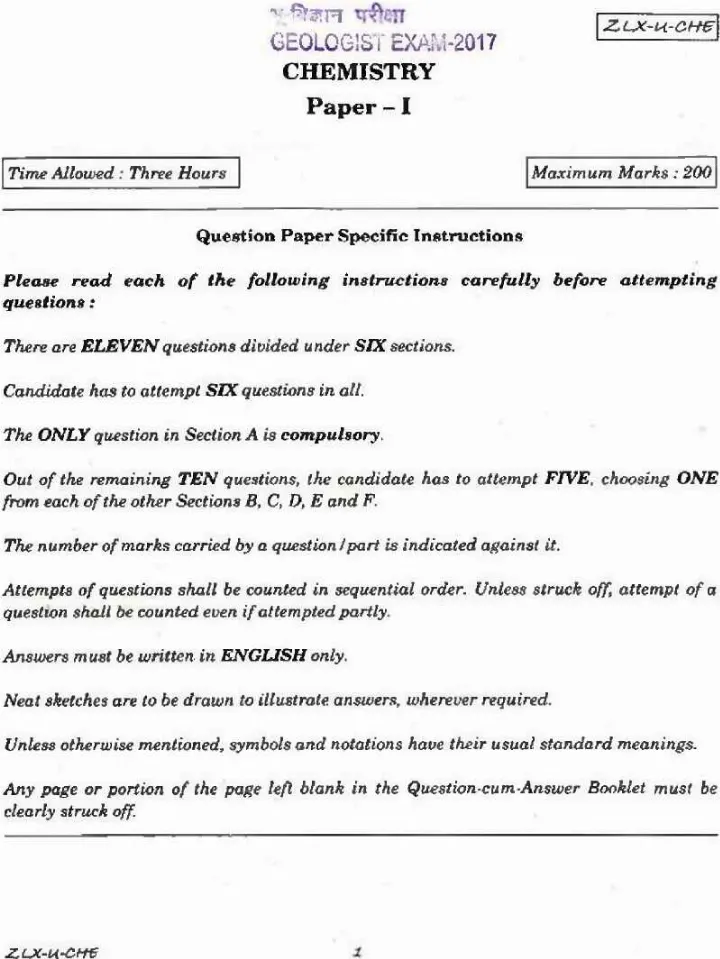
  • There are ELEVEN questions divided under SIX sections.
  • Candidate has to attempt SIX questions in all.
  • The ONLY question in Section A is compulsory.
  • Out of the remaining TEN questions, the candidate has to attempt FIVE, choosing ONE from each of the other Sections B, C, D, E and F.
  • The number of marks carried by a question / part is indicated against it.
  • Attempts of questions shall be counted in sequential order.
  • Unless struck off, attempt of a question shall be counted even if attempted partly.
  • Answers must be written in ENGLISH only.
  • Neat sketches are to be drawn to illustrate answers, wherever required.
  • Unless otherwise mentioned, symbols and notations have their usual standard meanings.
  • Any page or portion of the page left blank in the Question-cum-Answer Booklet must be clearly struck off.

Questions (page 2)

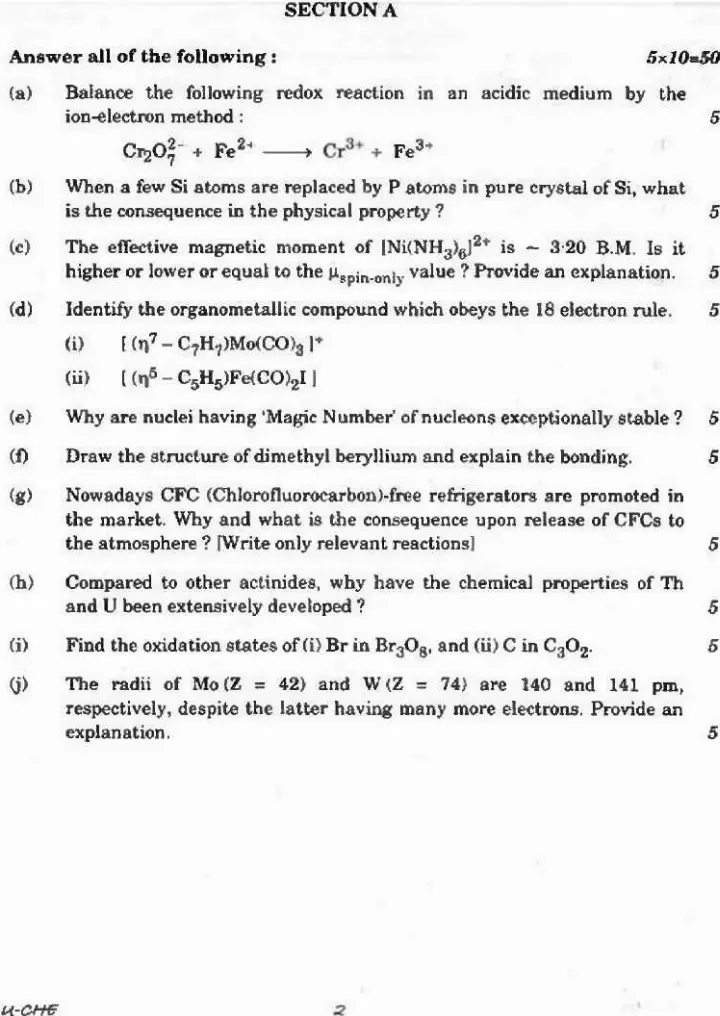
Section A

Q1. Answer all of the following:

(a) Balance the following redox reaction in an acidic medium by the ion-electron method:
Cr2O7^{2-} + Fe^{2+} longrightarrow Cr^{3+} + Fe^{3+}

(b) When a few Si atoms are replaced by P atoms in pure crystal of Si, what is the consequence in the physical property?

(c) The effective magnetic moment of [Ni(NH3)_6]^{2*} is sim 3.20 B.M. Is it higher or lower or equal to the mu_{ ext{spin-only}} value ? Provide an explanation.

(d) Identify the organometallic compound which obeys the 18 electron rule.
(i) [(eta7 - C7H7)Mo(CO)_3]^+
(ii) [(eta5 - C5H5)Fe(CO)_2]I

(e) Why are nuclei having 'Magic Number' of nucleons exceptionally stable ?

(f) Draw the structure of dimethyl beryllium and explain the bonding.

(g) Nowadays CFC (Chlorofluorocarbon)-free refrigerators are promoted in the market. Why and what is the consequence upon release of CFCs to the atmosphere? [Write only relevant reactions]

(h) Compared to other actinides, why have the chemical properties of Th and U been extensively developed?

(i) Find the oxidation states of (i) Br in Br3O8, and (ii) C in C3O2.

(j) The radii of Mo(Z = 42) and W(Z = 74) are 140 and 141 pm, respectively, despite the latter having many more electrons. Provide an explanation.
Question paper preview

Scanned pages 1–2 for reference. Download the official PDF for the full paper.

Page 1
UPSC Geologist Examination 2017 Chemistry Paper I page 1 instructions scan PDF download
Page 2
UPSC Geologist Examination 2017 Chemistry Paper I page 1 instructions scan PDF download

Free question paper download

Download question paper PDF

  • 156 KB
  • 8 pages
  • PDF format

Frequently asked questions

What is the name of the examination?

The examination is the Geologist Examination.

Which year is this question paper from?

This question paper is from the year 2017.

Who conducts the Geologist Examination?

The Geologist Examination is conducted by UPSC (Union Public Service Commission).

What is the subject of this paper?

This is Chemistry Paper - I.

What is the maximum marks for this paper?

The maximum marks for this paper are 200.

What is the time allowed to complete the paper?

The time allowed to complete the paper is Three Hours.

← Back to Other Jobs papers