UPSC Civil Services Mains 2017 Economics Paper I PDF

Central Government Jobs Other Jobs 2017

  • Year 2017
  • Conducted By UPSC
  • Questions 8
  • Maximum Marks 250
  • Duration Three Hours
  • Languages English & Hindi

Exam Details

Detail Information
Examination UPSC Civil Services Main Examination
Year 2017
Conducting Body UPSC
Paper Economics Paper - I
Subject Economics
Duration Three Hours
Maximum Marks 250
Number of Questions 8
Question Type Mixed

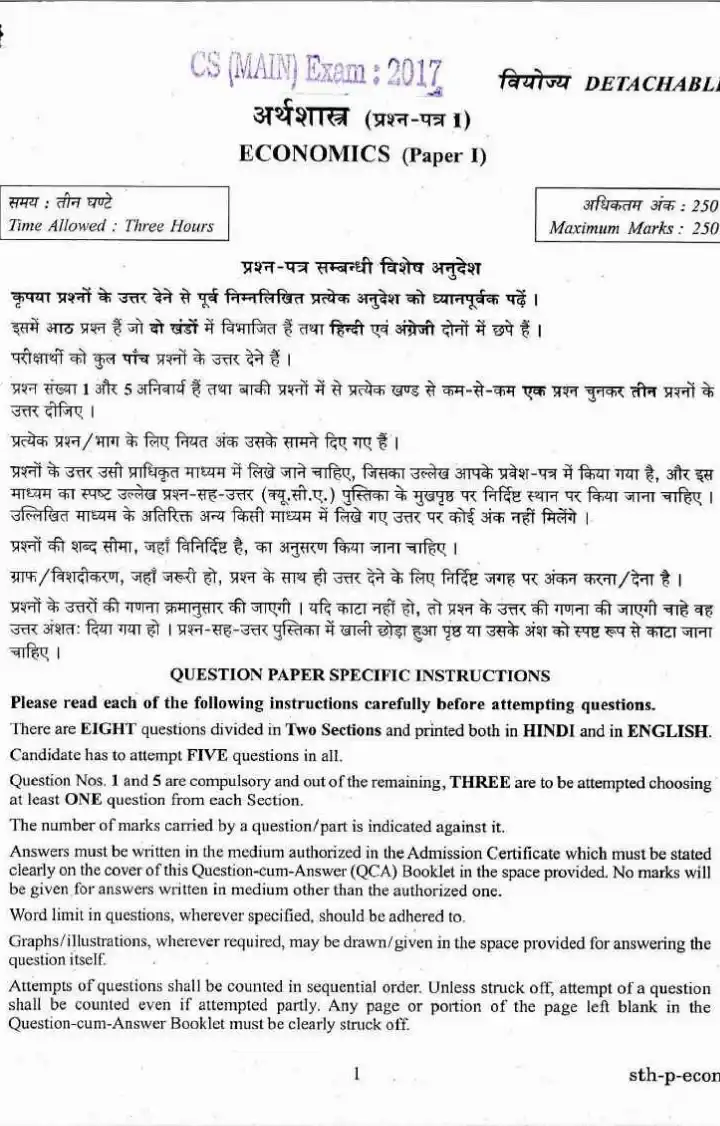
This is the Economics Paper I from the UPSC Civil Services Main Examination held in 2017. The paper is designed to test candidates' in-depth understanding of economic principles, theories, and their application. It consists of a total of 8 questions divided into two sections, with candidates required to answer five questions in total. Questions 1 and 5 are compulsory, and at least one question must be attempted from each section. The paper allows for answers in both Hindi and English, with a time limit of three hours and a maximum of 250 marks. This paper is crucial for aspirants aiming to secure a position in the Civil Services.

Major Topics Covered

  • Cobb-Douglas Production Function
  • Monopolistic Competition
  • Monopoly Power
  • Keynesian Model
  • Fiscal Policy
  • New Classical Economics
  • New Keynesian Economics
  • Classical Macro Model
  • Full Employment
  • Pareto Optimality
  • Social Welfare Maximisation
  • Fiscal Expansion
  • Crowding Out
  • Labor Supply
  • Money Wage Rigidity
  • Equilibrium Employment
  • Real Wage
  • Chamberlin's Theory
  • Planned Sales Curve
  • Firm and Group Equilibrium

Why This Paper is Important

  • Useful for UPSC Civil Services Main Examination preparation
  • Helps understand the latest exam pattern
  • Useful for practice and self-assessment
  • Covers frequently asked General Studies topics
  • Helpful for analysing question trends

Related Resources

  • UPSC Civil Services Main Examination 2016 Economics Paper I
  • UPSC Civil Services Main Examination 2018 Economics Paper I
  • UPSC Civil Services Main Examination 2017 General Studies Paper I
  • UPSC Civil Services Mains 2017 Economics Paper I Answer Key
  • UPSC Civil Services Mains Economics Syllabus
  • UPSC Mains Paper I Syllabus
  • UPSC Civil Services Mains Exam Pattern
  • UPSC Mains Paper I Exam Structure

Instructions

  • पुस्तिका के मुखपृष्ठ पर निर्दिष्ट स्थान पर किया जाना चाहिए।
  • उल्लिखित माध्यम के अतिरिक्त अन्य किसी माध्यम में लिखे गए उत्तर पर कोई अंक नहीं मिलेंगे ।
  • प्रश्नों की शब्द सीमा, जहाँ विनिर्दिष्ट है, का अनुसरण किया जाना चाहिए ।
  • ग्राफ/विशदीकरण, जहाँ जरूरी हो, प्रश्न के साथ ही उत्तर देने के लिए निर्दिष्ट जगह पर अंकन करना/देना है।
  • प्रश्नों के उत्तरों की गणना क्रमानुसार की जाएगी ।
  • यदि काटा नहीं हो, तो प्रश्न के उत्तर की गणना की जाएगी चाहे वह उत्तर अंशतः दिया गया हो ।
  • प्रश्न-सह-उत्तर पुस्तिका में खाली छोड़ा हुआ पृष्ठ या उसके अंश को स्पष्ट रूप से काटा जाना चाहिए ।

  • There are EIGHT questions divided in Two Sections and printed both in HINDI and in ENGLISH.
  • Candidate has to attempt FIVE questions in all.
  • Question Nos. 1 and 5 are compulsory and out of the remaining, THREE are to be attempted choosing at least ONE question from each Section.
  • The number of marks carried by a question/part is indicated against it.
  • Answers must be written in the medium authorized in the Admission Certificate which must be stated clearly on the cover of this Question-cum-Answer (QCA) Booklet in the space provided.
  • No marks will be given for answers written in medium other than the authorized one.
  • Word limit in questions, wherever specified, should be adhered to.
  • Graphs/illustrations, wherever required, may be drawn/given in the space provided for answering the question itself.
  • Attempts of questions shall be counted in sequential order.
  • Unless struck off, attempt of a question shall be counted even if attempted partly.
  • Any page or portion of the page left blank in the Question-cum-Answer Booklet must be clearly struck off.

Questions (page 2)

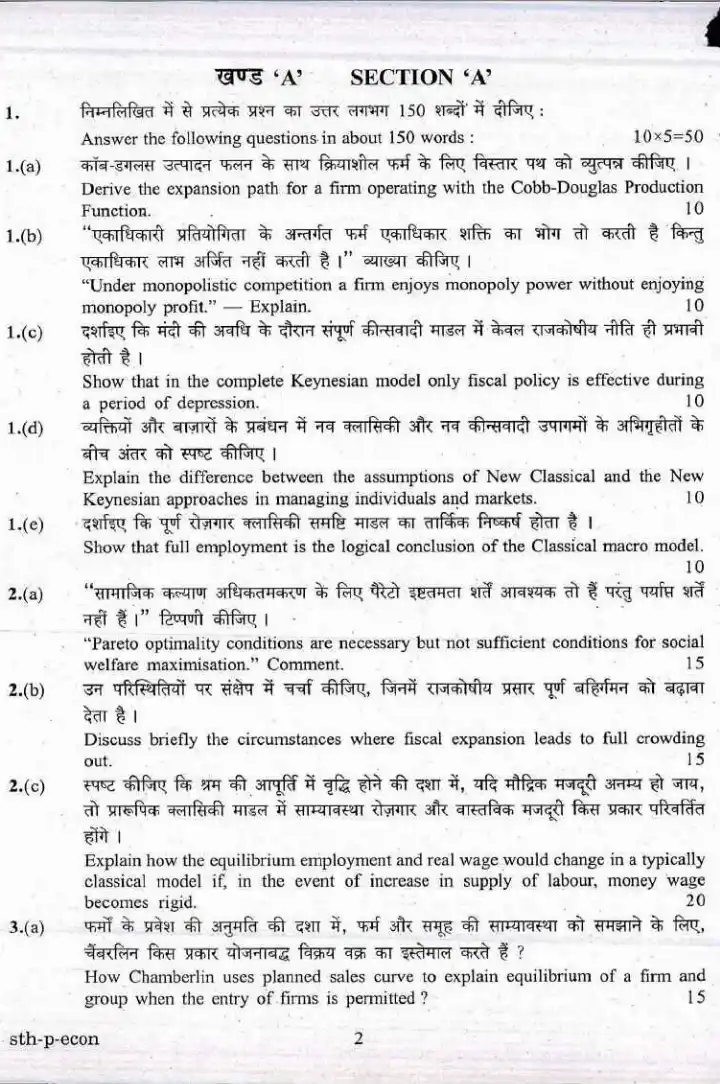
Section A

Q1. Answer the following questions in about 150 words :
निम्नलिखित में से प्रत्येक प्रश्न का उत्तर लगभग 150 शब्दों में दीजिए :

(a) कॉब-डगलस उत्पादन फलन के साथ क्रियाशील फर्म के लिए विस्तार पथ को व्युत्पन्न कीजिए ।
Derive the expansion path for a firm operating with the Cobb-Douglas Production Function.

(b) “एकाधिकारी प्रतियोगिता के अन्तर्गत फर्म एकाधिकार शक्ति का भोग तो करती है किन्तु एकाधिकार लाभ अर्जित नहीं करती है।” व्याख्या कीजिए।
"Under monopolistic competition a firm enjoys monopoly power without enjoying monopoly profit." - Explain.

(c) दर्शाइए कि मंदी की अवधि के दौरान संपूर्ण कीन्सवादी माडल में केवल राजकोषीय नीति ही प्रभावी होती है ।
Show that in the complete Keynesian model only fiscal policy is effective during a period of depression.

(d) व्यक्तियों और बाज़ारों के प्रबंधन में नव क्लासिकी और नव कीन्सवादी उपागमों के अभिगृहीतों के बीच अंतर को स्पष्ट कीजिए।
Explain the difference between the assumptions of New Classical and the New Keynesian approaches in managing individuals and markets.

(e) दर्शाइए कि पूर्ण रोज़गार क्लासिकी समष्टि माडल का तार्किक निष्कर्ष होता है ।
Show that full employment is the logical conclusion of the Classical macro model.
Section A

Q2.

(a) “सामाजिक कल्याण अधिकतमीकरण के लिए पैरेटो इष्टतमता शर्तें आवश्यक तो हैं परंतु पर्याप्त शर्तें नहीं हैं।” टिप्पणी कीजिए ।
"Pareto optimality conditions are necessary but not sufficient conditions for social welfare maximisation." Comment.

(b) उन परिस्थितियों पर संक्षेप में चर्चा कीजिए, जिनमें राजकोषीय प्रसार पूर्ण बहिर्गमन को बढ़ावा देता है।
Discuss briefly the circumstances where fiscal expansion leads to full crowding out.

(c) स्पष्ट कीजिए कि श्रम की आपूर्ति में वृद्धि होने की दशा में, यदि मौद्रिक मजदूरी अनम्य हो जाय, तो प्रारूपिक क्लासिकी माडल में साम्यावस्था रोज़गार और वास्तविक मजदूरी किस प्रकार परिवर्तित होंगे ।
Explain how the equilibrium employment and real wage would change in a typically classical model if, in the event of increase in supply of labour, money wage becomes rigid.

Section A

Q3.

(a) फर्मों के प्रवेश की अनुमति की दशा में, फर्म और समूह की साम्यावस्था को समझाने के लिए, चैंबरलिन किस प्रकार योजनाबद्ध विक्रय वक्र का इस्तेमाल करते हैं ?
How Chamberlin uses planned sales curve to explain equilibrium of a firm and group when the entry of firms is permitted?

Question paper preview

Scanned pages 1–2 for reference. Download the official PDF for the full paper.

Page 1
UPSC Civil Services Mains 2017 Economics Paper I question paper page 1 instructions scan PDF download
Page 2
UPSC Civil Services Mains 2017 Economics Paper I question paper page 1 instructions scan PDF download

Free question paper download

Download question paper PDF

  • 2.9 MB
  • 4 pages
  • PDF format

Frequently asked questions

What is the name of the exam?

The exam is the UPSC Civil Services Main Examination.

What is the year of this question paper?

This question paper is from the year 2017.

Which paper is this?

This is Economics Paper I.

Who conducts the Civil Services Examination?

The examination is conducted by the Union Public Service Commission (UPSC).

What is the maximum marks for this paper?

The maximum marks for Economics Paper I is 250.

What is the time allowed to complete the paper?

The time allowed to complete the paper is Three Hours.

← Back to Other Jobs papers