UPSC CS Main 2020 Management Paper I Question Paper PDF

Central Government Jobs Other Jobs 2020

  • Year 2020
  • Conducted By UPSC
  • Questions 8
  • Maximum Marks 250
  • Duration Three Hours
  • Languages English & Hindi

Exam Details

Detail Information
Examination UPSC CS (Main) Exam
Year 2020
Conducting Body UPSC
Paper Management Paper - I
Subject Management
Duration Three Hours
Maximum Marks 250
Number of Questions 8
Question Type Descriptive / Subjective

This is the Management Paper-I from the UPSC Civil Services (Main) Examination held in 2020. The paper is designed to assess candidates' understanding of core management principles through descriptive questions. It allows a time of three hours to answer a maximum of 250 marks. The paper is divided into two sections, with eight questions in total. Candidates are required to answer five questions, including compulsory questions from each section, demonstrating their analytical and writing skills on topics such as decision-making techniques, organizational structures, ethical considerations, employee motivation, and economic theories related to business.

Major Topics Covered

  • Decision Making
  • Delphi Technique
  • Organizational Design
  • Ethics in Business
  • Legal vs Ethical
  • Distributive Justice
  • Procedural Justice
  • Interactional Justice
  • Industrial Relations
  • Human Relations
  • Goals and Objectives
  • Management by Objectives (MBO)
  • Self-Interest in Business
  • Profit Motive
  • Adam Smith
  • Milton Friedman
  • Psychology of Personality
  • Id, Ego, Super-ego
  • Employee Motivation
  • Knowledge Workers
  • Manual Workers

Why This Paper is Important

  • Useful for UPSC CS (Main) Exam preparation
  • Helps understand the latest exam pattern
  • Useful for practice and self-assessment
  • Covers frequently asked General Studies topics
  • Helpful for analysing question trends

Related Resources

  • UPSC CS (Main) Exam 2021 Management Paper I
  • UPSC CS (Main) Exam 2019 Management Paper I
  • UPSC CS (Main) Exam 2020 General Studies Paper I
  • UPSC CS (Main) Exam 2020 Management Paper I Answer Key
  • UPSC CS (Main) Exam Management Syllabus
  • UPSC CS (Main) Exam General Studies Syllabus
  • UPSC CS (Main) Exam Pattern
  • UPSC Exam Calendar

Instructions

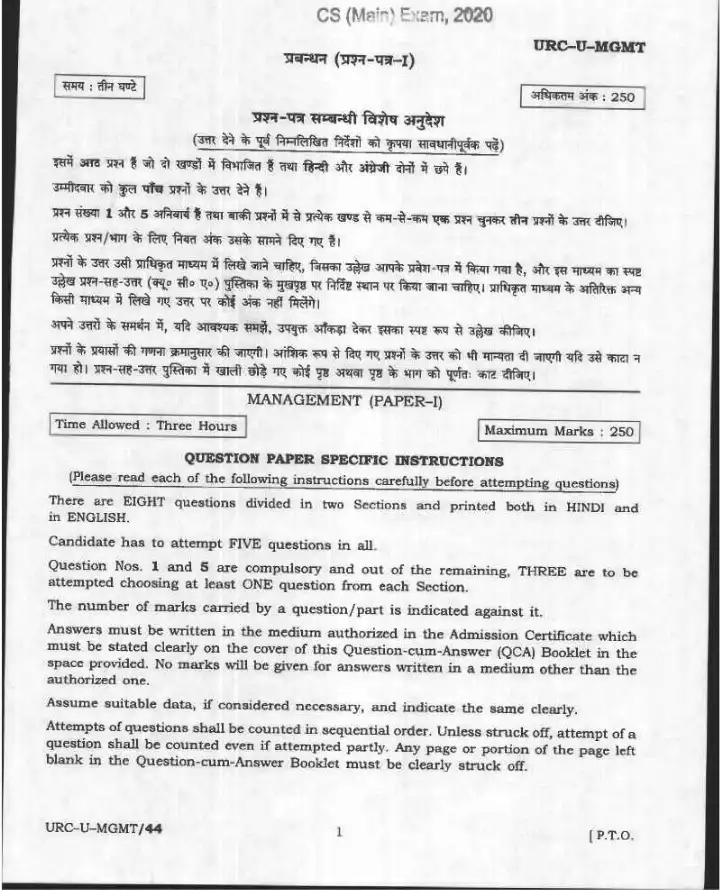
  • इसमें आठ प्रश्न हैं जो दो खण्डों में विभाजित हैं तथा हिन्दी और अंग्रेजी दोनों में छपे हैं।
  • उम्मीदवार को कुल पाँच प्रश्नों के उत्तर देने हैं।
  • प्रश्न संख्या 1 और 5 अनिवार्य हैं तथा बाकी प्रश्नों में से प्रत्येक खण्ड से कम-से-कम एक प्रश्न चुनकर तीन प्रश्नों के उत्तर दीजिए।
  • प्रत्येक प्रश्न/भाग के लिए नियत अंक उसके सामने दिए गए हैं।
  • प्रश्नों के उत्तर उसी प्राधिकृत माध्यम में लिखे जाने चाहिए, जिसका उल्लेख आपके प्रवेश-पत्र में किया गया है, और इस माध्यम का स्पष्ट उल्लेख प्रश्न-सह-उत्तर (क्यू॰ सी॰ ए॰) पुस्तिका के मुखपृष्ठ पर निर्दिष्ट स्थान पर किया जाना चाहिए।
  • प्राधिकृत माध्यम के अतिरिक्त अन्य किसी माध्यम में लिखे गए उत्तर पर कोई अंक नहीं मिलेंगे।
  • अपने उत्तरों के समर्थन में, यदि आवश्यक समझें, उपयुक्त आँकड़ा देकर इसका स्पष्ट रूप से उल्लेख कीजिए।
  • प्रश्नों के प्रयासों की गणना क्रमानुसार की जाएगी।
  • आंशिक रूप से दिए गए प्रश्नों के उत्तर को भी मान्यता दी जाएगी यदि उसे काटा न गया हो।
  • प्रश्न-सह-उत्तर पुस्तिका में खाली छोड़े गए कोई पृष्ठ अथवा पृष्ठ के भाग को पूर्णतः काट दीजिए।

  • There are EIGHT questions divided in two Sections and printed both in HINDI and in ENGLISH.
  • Candidate has to attempt FIVE questions in all.
  • Question Nos. 1 and 5 are compulsory and out of the remaining, THREE are to be attempted choosing at least ONE question from each Section.
  • The number of marks carried by a question/part is indicated against it.
  • Answers must be written in the medium authorized in the Admission Certificate which must be stated clearly on the cover of this Question-cum-Answer (QCA) Booklet in the space provided.
  • No marks will be given for answers written in a medium other than the authorized one.
  • Assume suitable data, if considered necessary, and indicate the same clearly.
  • Attempts of questions shall be counted in sequential order.
  • Unless struck off, attempt of a question shall be counted even if attempted partly.
  • Any page or portion of the page left blank in the Question-cum-Answer Booklet must be clearly struck off.

Questions (page 2)

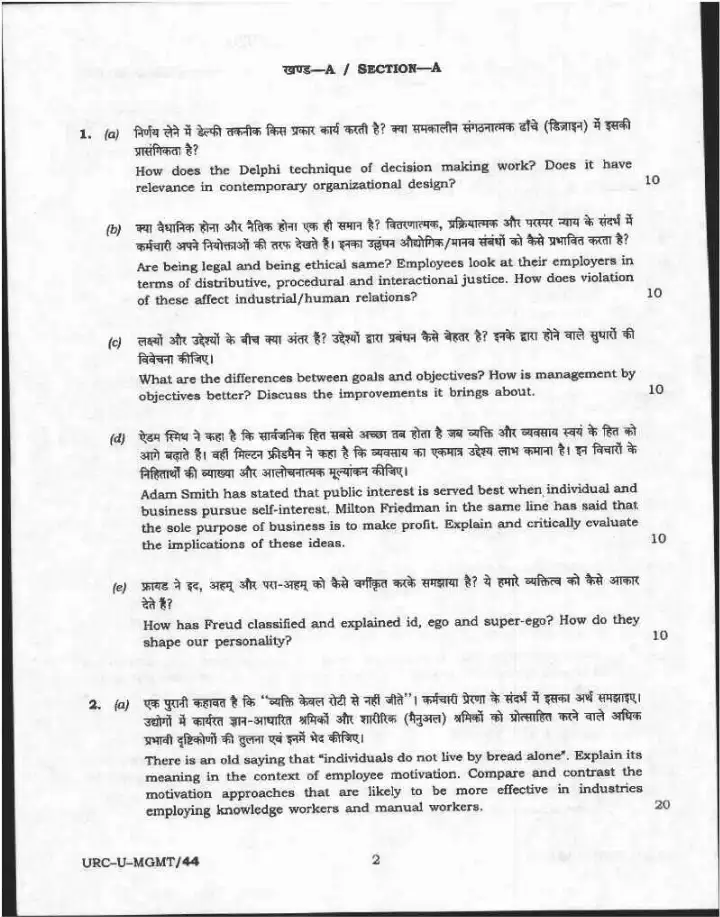
Section A

Q1.

(a) निर्णय लेने में डेल्फी तकनीक किस प्रकार कार्य करती है? क्या समकालीन संगठनात्मक ढाँचे (डिज़ाइन) में इसकी प्रासंगिकता है?
How does the Delphi technique of decision making work? Does it have relevance in contemporary organizational design?

(b) क्या वैधानिक होना और नैतिक होना एक ही समान है? वितरणात्मक, प्रक्रियात्मक और परस्पर न्याय के संदर्भ में कर्मचारी अपने नियोक्ताओं की तरफ देखते हैं। इनका उल्लंघन औद्योगिक/मानव संबंधों को कैसे प्रभावित करता है?
Are being legal and being ethical same? Employees look at their employers in terms of distributive, procedural and interactional justice. How does violation of these affect industrial/human relations?

(c) लक्ष्यों और उद्देश्यों के बीच क्या अंतर हैं? उद्देश्यों द्वारा प्रबंधन कैसे बेहतर है? इनके द्वारा होने वाले सुधारों की विवेचना कीजिए।
What are the differences between goals and objectives? How is management by objectives better? Discuss the improvements it brings about.

(d) ऐडम स्मिथ ने कहा है कि सार्वजनिक हित सबसे अच्छा तब होता है जब व्यक्ति और व्यवसाय स्वयं के हित को आगे बढ़ाते हैं। वहीं मिल्टन फ्रीडमैन ने कहा है कि व्यवसाय का एकमात्र उद्देश्य लाभ कमाना है। इन विचारों के निहितार्थों की व्याख्या और आलोचनात्मक मूल्यांकन कीजिए।
Adam Smith has stated that public interest is served best when individual and business pursue self-interest. Milton Friedman in the same line has said that the sole purpose of business is to make profit. Explain and critically evaluate the implications of these ideas.

(e) फ्रायड ने इद, अहम् और परा-अहम् को कैसे वर्गीकृत करके समझाया है? ये हमारे व्यक्तित्व को कैसे आकार रेते हैं?
How has Freud classified and explained id, ego and super-ego? How do they shape our personality?
Section A

Q2.

(a) एक पुरानी कहावत है कि ‘‘व्यक्ति केवल रोटी से नहीं जीते''। कर्मचारी प्रेरणा के संदर्भ में इसका अर्थ समझाइए। उद्योगों में कार्यरत ज्ञान-आधारित श्रमिकों और शारीरिक (मैनुअल) श्रमिकों को प्रोत्साहित करने वाले अधिक प्रभावी दृष्टिकोणों की तुलना एवं इनमें भेद कीजिए।
There is an old saying that "individuals do not live by bread alone". Explain its meaning in the context of employee motivation. Compare and contrast the motivation approaches that are likely to be more effective in industries employing knowledge workers and manual workers.

Question paper preview

Scanned pages 1–2 for reference. Download the official PDF for the full paper.

Page 1
UPSC CS (Main) Exam 2020 Management Paper-I question paper page 1 instructions scan PDF download
Page 2
UPSC CS (Main) Exam 2020 Management Paper-I question paper page 1 instructions scan PDF download

Free question paper download

Download question paper PDF

  • 718 KB
  • 8 pages
  • PDF format

Frequently asked questions

What is the name of the exam for which this paper was conducted?

This paper is from the UPSC CS (Main) Exam.

What is the subject of this question paper?

The subject is Management, specifically Paper-I.

What is the year of this UPSC CS (Main) exam paper?

The exam was conducted in the year 2020.

Who is the conducting body for this examination?

The examination is conducted by UPSC (Union Public Service Commission).

What is the maximum marks for this paper?

The maximum marks for Management Paper-I is 250.

What is the time duration allowed for this paper?

Candidates are allowed three hours to complete the paper.

← Back to Other Jobs papers