UPSC CS Main 2020 Chemistry Paper I PDF | Question Paper

Central Government Jobs Other Jobs 2020

  • Year 2020
  • Conducted By UPSC
  • Questions 8
  • Maximum Marks 250
  • Duration Three Hours
  • Languages Hindi & English

Exam Details

Detail Information
Examination UPSC CS (Main) Exam
Year 2020
Conducting Body UPSC
Paper Chemistry Paper - I
Subject Chemistry
Duration Three Hours
Maximum Marks 250
Number of Questions 8
Question Type Mixed

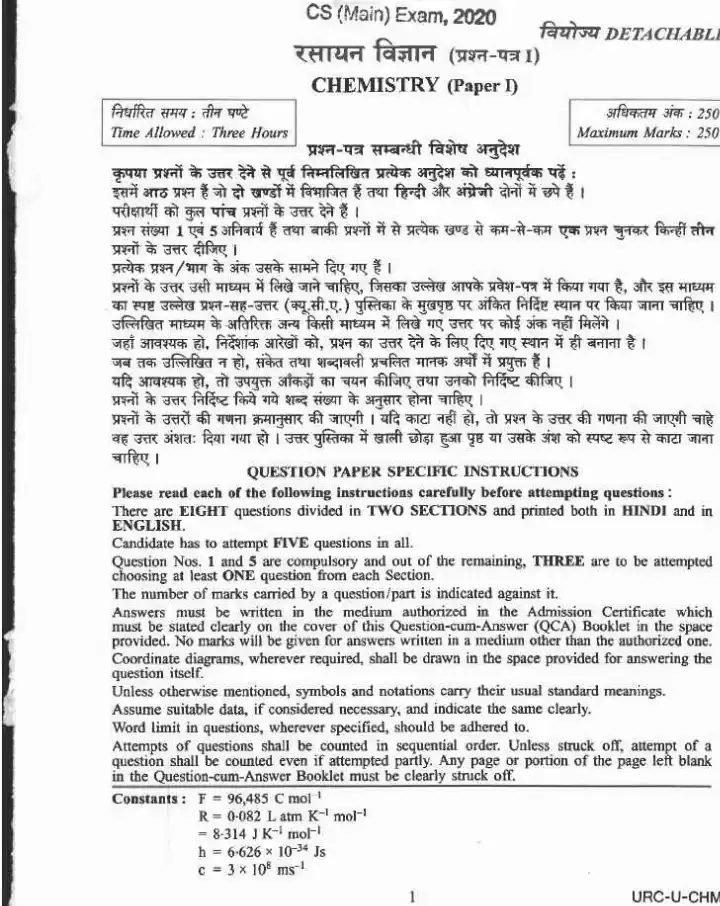
This is the Chemistry Paper I for the UPSC CS (Main) Exam held in 2020. Conducted by UPSC, this paper carries a maximum of 250 marks and is allocated a time of three hours. It is designed to assess candidates' in-depth knowledge of Chemistry. The paper is divided into two sections, with a total of eight questions, and candidates are required to answer five questions in total, including compulsory questions from each section. This paper is crucial for aspirants aiming for success in the Civil Services examination, providing a clear understanding of the exam's scope and difficulty level.

Major Topics Covered

  • Chemistry
  • Physical Chemistry
  • Chemical Kinetics
  • Thermodynamics
  • Solid State Chemistry
  • Equilibrium

Why This Paper is Important

  • Useful for UPSC CS (Main) Exam preparation
  • Helps understand the latest exam pattern
  • Useful for practice and self-assessment
  • Covers frequently asked General Studies topics
  • Helpful for analysing question trends

Related Resources

  • UPSC CS (Main) Exam 2020 Chemistry Paper II
  • UPSC CS (Main) Exam 2019 Chemistry Paper I
  • UPSC CS (Main) Exam 2020 General Studies Paper I
  • UPSC CS (Main) Exam 2020 Chemistry Paper I Answer Key
  • UPSC CS (Main) Exam Chemistry Syllabus
  • UPSC CS (Main) Exam Optional Subject Syllabus
  • UPSC CS (Main) Exam Pattern
  • UPSC Civil Services Exam Structure

Instructions

  • पुस्तिका के मुखपृष्ठ पर अंकित निर्दिष्ट स्थान पर किया जाना चाहिए ।
  • उल्लिखित माध्यम के अतिरिक्त अन्य किसी माध्यम में लिखे गए उत्तर पर कोई अंक नहीं मिलेंगे। , जहाँ आवश्यक हो, निर्देशांक आरेखों को, प्रश्न का उत्तर देने के लिए दिए गए स्थान में ही बनाना है ।
  • जब तक उल्लिखित न हो, संकेत तथा शब्दावली प्रचलित मानक अर्थों में प्रयुक्त हैं।
  • यदि आवश्यक हो, तो उपयुक्त आँकड़ों का चयन कीजिए तथा उनको निर्दिष्ट कीजिए ।
  • प्रश्नों के उत्तर निर्दिष्ट किये गये शब्द संख्या के अनुसार होना चाहिए ।
  • प्रश्नों के उत्तरों की गणना क्रमानुसार की जाएगी ।
  • यदि काटा नहीं हो, तो प्रश्न के उत्तर की गणना की जाएगी चाहे वह उत्तर अंशतः दिया गया हो ।
  • उत्तर पुस्तिका में खाली छोड़ा हुआ पृष्ठ या उसके अंश को स्पष्ट रूप से काटा जाना चाहिए ।

  • There are EIGHT questions divided in TWO SECTIONS and printed both in HINDI and in ENGLISH.
  • Candidate has to attempt FIVE questions in all.
  • Question Nos. 1 and 5 are compulsory and out of the remaining, THREE are to be attempted choosing at least ONE question from each Section.
  • The number of marks carried by a question/part is indicated against it.
  • Answers must be written in the medium authorized in the Admission Certificate which must be stated clearly on the cover of this Question-cum-Answer (QCA) Booklet in the space provided.
  • No marks will be given for answers written in a medium other than the authorized one.
  • Coordinate diagrams, wherever required, shall be drawn in the space provided for answering the question itself.
  • Unless otherwise mentioned, symbols and notations carry their usual standard meanings.
  • Assume suitable data, if considered necessary, and indicate the same clearly.
  • Word limit in questions, wherever specified, should be adhered to.
  • Attempts of questions shall be counted in sequential order.
  • Unless struck off, attempt of a question shall be counted even if attempted partly.
  • Any page or portion of the page left blank in the Question-cum-Answer Booklet must be clearly struck off.
  • Constants: F = 96,485 C mol-1 R = 0.082 L atm K^{-1} mol-1 = 8.314 J K-1 mol-1 h = 6.626 \times 10^{-34} Js c = 3 \times 10^8 ms-1

Questions (page 2)

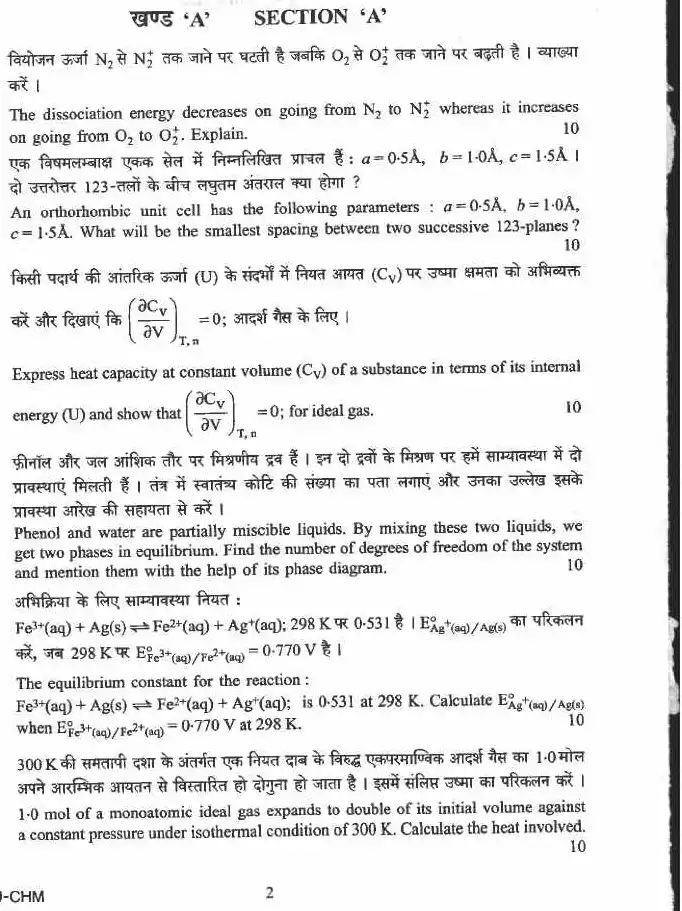
Section A

Q1.

(a) वियोजन ऊर्जा N2 से N2^ + तक जाने पर घटती है जबकि O2 से O2^ + तक जाने पर बढ़ती है। व्याख्या करें ।
The dissociation energy decreases on going from N2 to N2^ + whereas it increases on going from O2 to O2^ +. Explain.

(b) एक विषमलम्बाक्ष एकक सेल में निम्नलिखित प्राचल हैं: a = 0. 5Å, b = 1. 0Å, c = 1. 5Å । दो उत्तरोत्तर 123-तलों के बीच लघुतम अंतराल क्या होगा ? An orthorhombic unit cell has the following parameters : a = 0. 5Å. What will be the smallest spacing between two successive 123-planes?

(c) किसी पदार्थ की आंतरिक ऊर्जा (U) के संदर्भों में नियत आयतन (CV) पर उष्मा क्षमता को अभिव्यक्त करें और दिखाएं कि left(dfrac{partial C_{mathbfV}}{partial mathbfV}
ight)_{mathbfT} = 0; आदर्श गैस के लिए ।
Express heat capacity at constant volume (Cv) of a substance in terms of its internal energy (U) and show that left(racpartial CVpartial V
ight)T = 0; for ideal gas.

(d) फ़ीनॉल और जल आंशिक तौर पर मिश्रणीय द्रव हैं । इन दो द्रवों के मिश्रण पर हमें साम्यावस्था में दो प्रावस्थाएं मिलती हैं। तंत्र में स्वातंत्र्य कोटि की संख्या का पता लगाएं और उनका उल्लेख इसके प्रावस्था आरेख की सहायता से करें।
Phenol and water are partially miscible liquids. By mixing these two liquids, we get two phases in equilibrium. Find the number of degrees of freedom of the system and mention them with the help of its phase diagram.

(e) अभिक्रिया के लिए साम्यावस्था नियत :
Fe3+(aq) + Ag(s) ightleftharpoons Fe2+(aq) + Ag+(aq); 298 K 0.531 है । Eo_Ag+(aq)/Ag(s) का परिकलन करें, जब 298 K पर Eo_Fe3+(aq)/Fe2+(aq) = 0.770 V है ।
The equilibrium constant for the reaction:
Fe3+(aq) + Ag(s) ightleftharpoons Fe2+(aq) + Ag+(aq); is 0.531 at 298 K. Calculate Eo_Ag+(aq) / Ag(s) when Eo_Fe3+(aq)/Fe2+(aq) = 0.770 V at 298 K.
Section A

Q2.

(a) 300 K की समतापी दशा के अंतर्गत एक नियत दाब के विरुद्ध एकपरमाण्विक आदर्श गैस का 1. 0 मोल अपने आरम्भिक आयतन से विस्तारित हो दोगुना हो जाता है। इसमें संलिप्त उष्मा का परिकलन करें। 0 mol of a monoatomic ideal gas expands to double of its initial volume against a constant pressure under isothermal condition of 300 K. Calculate the heat involved.

Question paper preview

Scanned pages 1–2 for reference. Download the official PDF for the full paper.

Page 1
UPSC CS Main 2020 Chemistry Paper I question paper page 1 instructions and exam header scan PDF download
Page 2
UPSC CS Main 2020 Chemistry Paper I question paper page 1 instructions and exam header scan PDF download

Free question paper download

Download question paper PDF

  • 594 KB
  • 8 pages
  • PDF format

Frequently asked questions

What is the name of the exam for which this paper was conducted?

This paper is from the UPSC CS (Main) Exam.

What is the subject of this question paper?

The subject is Chemistry, specifically Paper I.

What is the conducting body for this examination?

The examination is conducted by UPSC (Union Public Service Commission).

In which year was this Chemistry Paper I conducted?

This paper was conducted in the year 2020.

What is the maximum marks for the Chemistry Paper I?

The maximum marks for this paper are 250.

What is the time duration allowed for the Chemistry Paper I?

The time allowed for this paper is three hours.

← Back to Other Jobs papers