UPSC CMS 2023 General Medicine & Pediatrics Paper-I PDF

Central Government Jobs Medical 2023

  • Year 2023
  • Conducted By UPSC
  • Questions 120
  • Maximum Marks 250
  • Duration Two Hours
  • Languages English

Exam Details

Detail Information
Examination Combined Medical Services Examination
Year 2023
Conducting Body UPSC
Paper General Medicine and Pediatrics Paper-I
Subject General Medicine and Pediatrics
Duration Two Hours
Maximum Marks 250
Number of Questions 120
Question Type Objective (MCQ)

This document contains the question paper for the UPSC Combined Medical Services Examination 2023, Paper-I, focusing on General Medicine and Pediatrics. The exam, conducted by UPSC, allows two hours to answer 120 objective-type questions for a maximum of 250 marks. Aspirants can use this paper to understand the exam's difficulty level, question patterns, and key topics covered in General Medicine and Pediatrics, crucial for their preparation.

Major Topics Covered

  • General Medicine
  • Pediatrics
  • Cardiology
  • Valvular Abnormalities
  • Infective Endocarditis
  • Arterial Diseases

Why This Paper is Important

  • Useful for Combined Medical Services Examination preparation
  • Helps understand the latest exam pattern
  • Useful for practice and self-assessment
  • Covers frequently asked General Studies topics
  • Helpful for analysing question trends

Related Resources

  • UPSC CMS 2022 General Medicine and Pediatrics Paper-I
  • UPSC CMS 2021 General Medicine and Pediatrics Paper-I
  • UPSC CMS 2023 General Medicine and Pediatrics Paper-II
  • UPSC CMS 2023 English Paper
  • UPSC CMS 2023 General Medicine and Pediatrics Paper-I Answer Key
  • UPSC CMS Syllabus
  • General Medicine Syllabus
  • Pediatrics Syllabus

Instructions

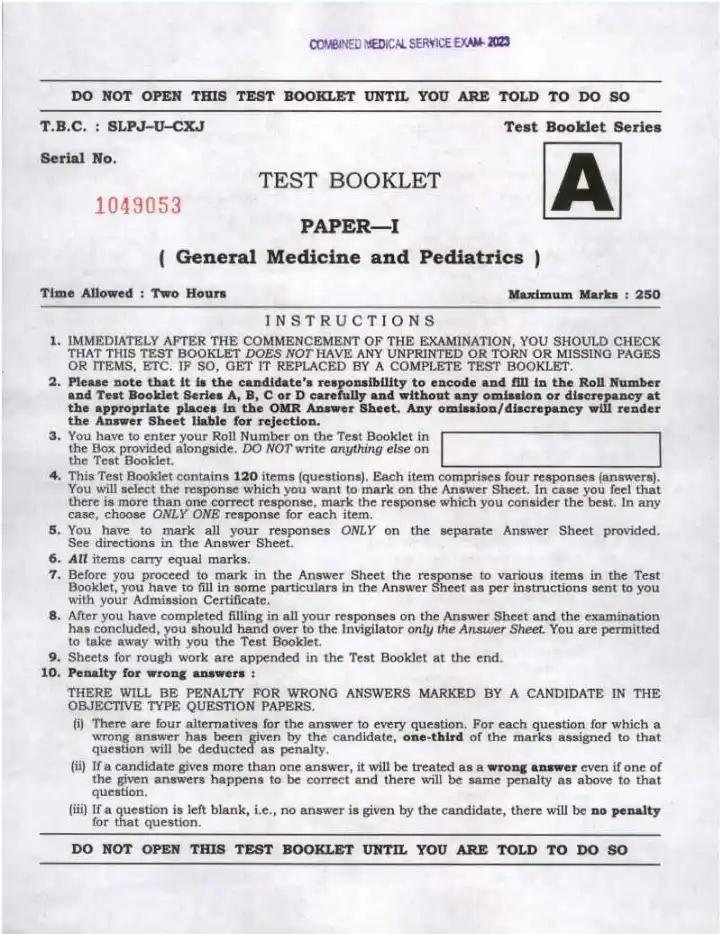
  • IMMEDIATELY AFTER THE COMMENCEMENT OF THE EXAMINATION, YOU SHOULD CHECK THAT THIS TEST BOOKLET DOES NOT HAVE ANY UNPRINTED OR TORN OR MISSING PAGES OR ITEMS, ETC.
  • IF SO, GET IT REPLACED BY A COMPLETE TEST BOOKLET.
  • Please note that it is the candidate's responsibility to encode and fill in the Roll Number and Test Booklet Series A, B, C or D carefully and without any omission or discrepancy at the appropriate places in the OMR Answer Sheet.
  • Any omission/discrepancy will render the Answer Sheet liable for rejection.
  • You have to enter your Roll Number on the Test Booklet in the Box provided alongside.
  • DO NOT write anything else on the Test Booklet.
  • This Test Booklet contains 120 items (questions).
  • Each item comprises four responses (answers).
  • You will select the response which you want to mark on the Answer Sheet.
  • In case you feel that there is more than one correct response, mark the response which you consider the best.
  • In any case, choose ONLY ONE response for each item.
  • You have to mark all your responses ONLY on the separate Answer Sheet provided. See directions in the Answer Sheet.
  • Before you proceed to mark in the Answer Sheet the response to various items in the Test Booklet, you have to fill in some particulars in the Answer Sheet as per instructions sent to you with your Admission Certificate.
  • After you have completed filling in all your responses on the Answer Sheet and the examination has concluded, you should hand over to the Invigilator only the Answer Sheet.
  • You are permitted to take away with you the Test Booklet.
  • Sheets for rough work are appended in the Test Booklet at the end.
  • Penalty for wrong answers : THERE WILL BE PENALTY FOR WRONG ANSWERS MARKED BY A CANDIDATE IN THE OBJECTIVE TYPE OUESTION PAPERS.

Questions (page 2)

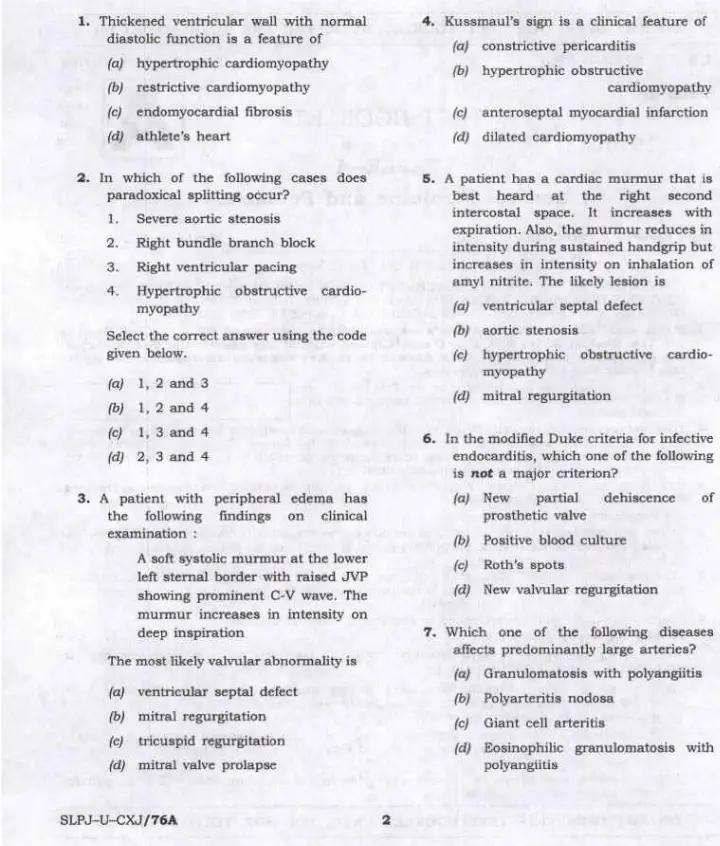
Q1. Thickened ventricular wall with normal diastolic function is a feature of

  • (a) hypertrophic cardiomyopathy
  • (b) restrictive cardiomyopathy
  • (c) endomyocardial fibrosis
  • (d) athlete's heart

Q2. In which of the following cases does paradoxical splitting occur?

  • (1) Severe aortic stenosis
  • (2) Right bundle branch block
  • (3) Right ventricular pacing
  • (4) Hypertrophic obstructive cardiomyopathy
  • (a) 1, 2 and 3
  • (b) 1, 2 and 4
  • (c) 1, 3 and 4
  • (d) 2, 3 and 4

Q3. A patient with peripheral edema has the following findings on clinical examination :
A soft systolic murmur at the lower left sternal border with raised JVP showing prominent C-V wave. The murmur increases in intensity on deep inspiration

  • (a) ventricular septal defect
  • (b) mitral regurgitation
  • (c) tricuspid regurgitation
  • (d) mitral valve prolapse

Q4. Kussmaul's sign is a clinical feature of

  • (a) constrictive pericarditis
  • (b) hypertrophic obstructive cardiomyopathy
  • (c) anteroseptal myocardial infarction
  • (d) dilated cardiomyopathy

Q5. A patient has a cardiac murmur that is best heard at the right second intercostal space. It increases with expiration. Also, the murmur reduces in intensity during sustained handgrip but increases in intensity on inhalation of amyl nitrite. The likely lesion is

  • (a) ventricular septal defect
  • (b) aortic stenosis
  • (c) hypertrophic obstructive cardiomyopathy
  • (d) mitral regurgitation

Q6. In the modified Duke criteria for infective endocarditis, which one of the following is not a major criterion?

  • (a) New partial dehiscence of prosthetic valve
  • (b) Positive blood culture
  • (c) Roth's spots
  • (d) New valvular regurgitation

Q7. Which one of the following diseases affects predominantly large arteries?

  • (a) Granulomatosis with polyangiitis
  • (b) Polyarteritis nodosa
  • (c) Giant cell arteritis
  • (d) Eosinophilic granulomatosis with polyangiitis

Question paper preview

Scanned pages 1–2 for reference. Download the official PDF for the full paper.
Page 1
UPSC CMS 2023 General Medicine and Pediatrics Paper-I question paper page 1 instructions scan PDF download
Page 2
UPSC CMS 2023 General Medicine and Pediatrics Paper-I question paper page 1 instructions scan PDF download

Free question paper download

Download question paper PDF

  • 15.1 MB
  • 24 pages
  • PDF format

Frequently asked questions

What is the name of the exam?

The exam is the Combined Medical Services Examination.

Which year is this question paper for?

This question paper is for the 2023 examination.

Who conducts the Combined Medical Services Examination?

The examination is conducted by the Union Public Service Commission (UPSC).

What is the subject of Paper-I?

Paper-I covers General Medicine and Pediatrics.

What is the total time allowed for the exam?

The time allowed for the exam is Two Hours.

What are the maximum marks for this paper?

The maximum marks for Paper-I are 250.

← Back to Medical papers