UPSC CMS 2021 General Medicine & Pediatrics Paper I Question Paper PDF

Central Government Jobs Medical 2021

  • Year 2021
  • Conducted By UPSC
  • Questions 120
  • Maximum Marks 250
  • Duration Two Hours

Exam Details

Detail Information
Examination Combined Medical Services Examination
Year 2021
Conducting Body UPSC
Paper General Medicine and Pediatrics Paper I
Subject General Medicine and Pediatrics
Duration Two Hours
Maximum Marks 250
Number of Questions 120
Question Type Objective (MCQ)

This is the question paper for the Combined Medical Services Examination (CMS) 2021, specifically Paper I focusing on General Medicine and Pediatrics. Conducted by UPSC, this exam tests candidates' knowledge in specialized medical fields. The paper consists of 120 objective-type questions, with a maximum of 250 marks and a time limit of two hours. It is a crucial resource for aspirants preparing for the CMS exam, offering insights into the types of questions asked, difficulty level, and important topics covered in General Medicine and Pediatrics.

Major Topics Covered

  • General Medicine
  • Pediatrics
  • Cardiology
  • Resuscitation
  • ECG Interpretation
  • Cardiac Biomarkers
  • Cardiac Diseases in Pregnancy

Why This Paper is Important

  • Useful for Combined Medical Services Examination preparation
  • Helps understand the latest exam pattern
  • Useful for practice and self-assessment
  • Covers frequently asked General Studies topics
  • Helpful for analysing question trends

Related Resources

  • UPSC CMS 2020 General Medicine and Pediatrics Paper I
  • UPSC CMS 2021 General Medicine and Pediatrics Paper II
  • UPSC CMS 2021 General Knowledge and Current Affairs Paper
  • UPSC CMS 2019 General Medicine and Pediatrics Paper I
  • UPSC CMS 2021 General Medicine and Pediatrics Paper I Answer Key
  • UPSC CMS 2021 Official Answer Key
  • UPSC CMS Syllabus
  • General Medicine Syllabus

Instructions

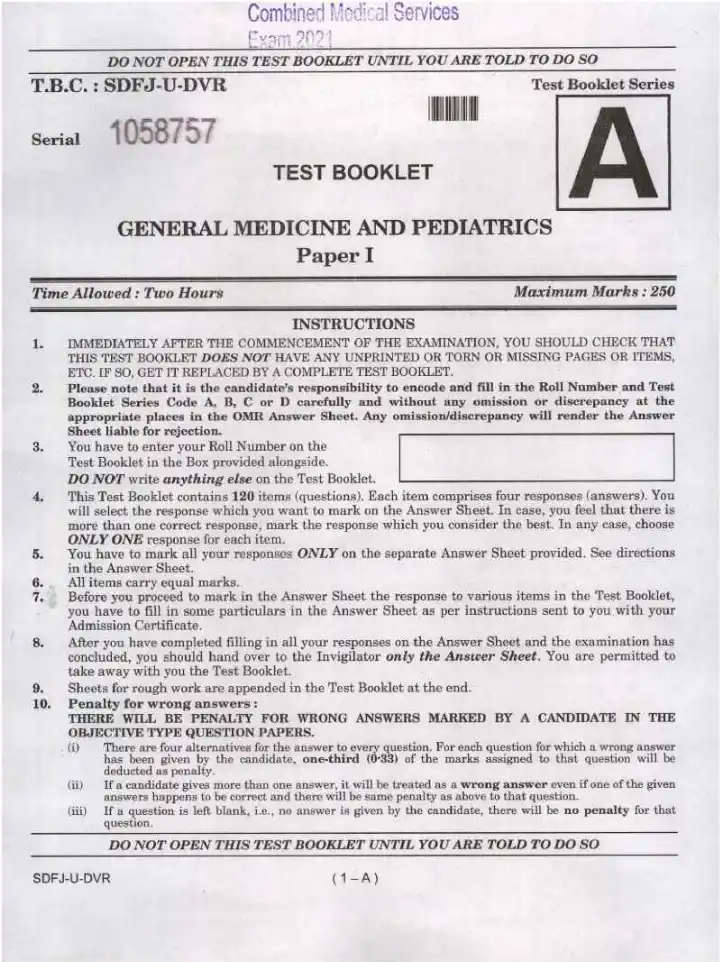
  • THIS TEST BOOKLET DOES NOT HAVE ANY UNPRINTED OR TORN OR MISSING PAGES OR ITEMS, ETC.
  • IF SO, GET IT REPLACED BY A COMPLETE TEST BOOKLET.
  • Please note that it is the candidate's responsibility to encode and fill in the Roll Number and Test
  • Booklet Series Code A, B, C or D carefully and without any omission or discrepancy at the appropriate places in the OMR Answer Sheet.
  • Any omission/discrepancy will render the Answer Sheet liable for rejection.
  • You have to enter your Roll Number on the
  • Test Booklet in the Box provided alongside.
  • DO NOT write anything else on the Test Booklet.
  • This Test Booklet contains 120 items (questions).
  • Each item comprises four responses (answers).
  • will select the response which you want to mark on the Answer Sheet.
  • In case, you feel that there is more than one correct response, mark the response which you consider the best.
  • In any case, choose ONLY ONE response for each item.
  • You have to mark all your responses ONLY on the separate Answer Sheet provided.
  • Before you proceed to mark in the Answer Sheet the response to various items in the Test Booklet,
  • you have to fill in some particulars in the Answer Sheet as per instructions sent to you with your Admission Certificate.
  • After you have completed filling in all your responses on the Answer Sheet and the examination has concluded, you should hand over to the Invigilator only the Answer Sheet.
  • You are permitted to take away with you the Test Booklet.
  • Sheets for rough work are appended in the Test Booklet at the end.
  • THERE WILL BE PENALTY FOR WRONG ANSWERS MARKED BY A CANDIDATE IN THE OBJECTIVE TYPE QUESTION PAPERS.
  • There are four alternatives for the answer to every question.
  • For each question for which a wrong answer (i) has been given by the candidate, one-third (0.33) of the marks assigned to that question will be deducted as penalty.
  • If a candidate gives more than one answer, it will be treated as a wrong answer even if one of the given (ii) answers happens to be correct and there will be same penalty as above to that question.
  • If a question is left blank, i.e., no answer is given by the candidate, there will be no penalty for that (iii) question.
  • DO NOT OPEN THIS TEST BOOKLET UNTIL YOU ARE TOLD TO DO SO (1-A)

Questions (page 2)

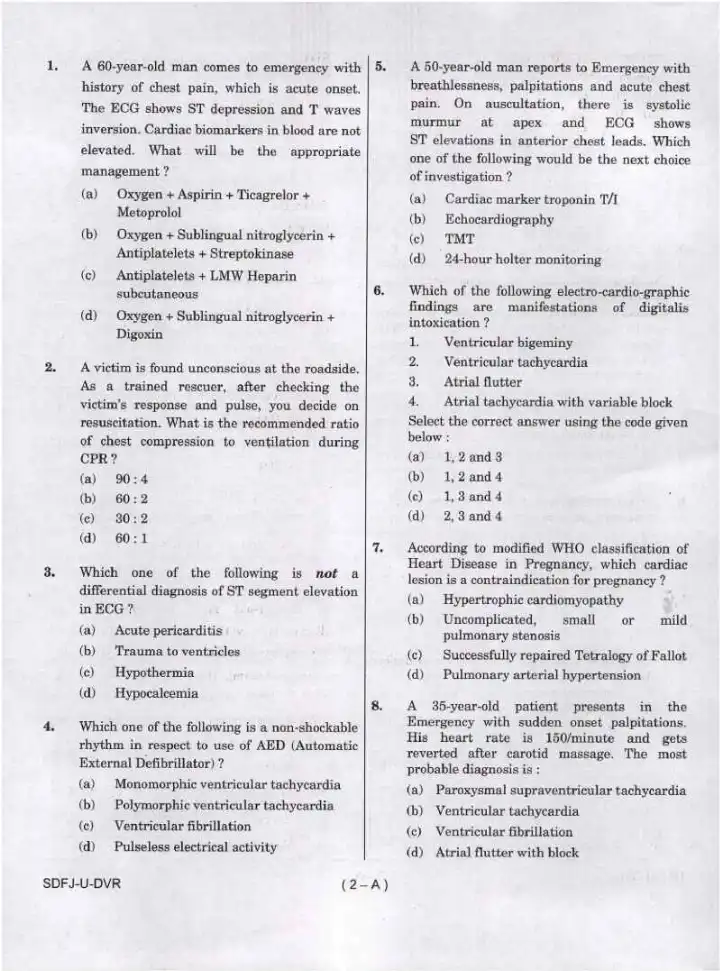
Q1. A 60-year-old man comes to emergency with history of chest pain, which is acute onset The ECG shows ST depression and T waves inversion. Cardiac biomarkers in blood are not elevated. What will be the appropriate management?

  • (a) Oxygen + Aspirin + Ticagrelor + Metoprolol
  • (b) Oxygen + Sublingual nitroglycerin + Antiplatelets + Streptokinase
  • (c) Antiplatelets + LMW Heparin subcutaneous
  • (d) Oxygen + Sublingual nitroglycerin + Digoxin
Q2. A victim is found unconscious at the roadside. As a trained rescuer, after checking the victim's response and pulse, you decide on resuscitation. What is the recommended ratio of chest compression to ventilation during CPR?

  • (a) 90:4
  • (b) 60:2
  • (c) 30:2
  • (d) 60:1

Q3. Which one of the following is not a differential diagnosis of ST segment elevation in ECG?

  • (a) Acute pericarditis
  • (b) Trauma to ventricles
  • (c) Hypothermia
  • (d) Hypocalcemia

Q4. Which one of the following is a non-shockable rhythm in respect to use of AED (Automatic External Defibrillator)?

  • (a) Monomorphic ventricular tachycardia
  • (b) Polymorphic ventricular tachycardia
  • (c) Ventricular fibrillation
  • (d) Pulseless electrical activity

Q5. A 50-year-old man reports to Emergency with breathlessness, palpitations and acute chest pain. On auscultation, there is systolic murmur at apex and ECG shows ST elevations in anterior chest leads. Which one of the following would be the next choice of investigation?

  • (a) Cardiac marker troponin T/I
  • (b) Echocardiography
  • (c) TMT
  • (d) 24-hour holter monitoring

Q6. Which of the following electro-cardio-graphic findings are manifestations of digitalis toxication?

  • (1) Ventricular bigeminy
  • (2) Ventricular tachycardia
  • (3) Atrial flutter
  • (4) Atrial tachycardia with variable block
  • (a) 1, 2 and 3
  • (b) 1, 2 and 4
  • (c) 1, 3 and 4
  • (d) 2, 3 and 4

Q7. According to modified WHO classification of Heart Disease in Pregnancy, which cardiac lesion is a contraindication for pregnancy?

  • (a) Hypertrophic cardiomyopathy
  • (b) Uncomplicated, small or mild pulmonary stenosis
  • (c) Successfully repaired Tetralogy of Fallot
  • (d) Pulmonary arterial hypertension

Q8. A 35-year-old patient presents in the Emergency with sudden onset palpitations. His heart rate is 150/minute and gets reverted after carotid massage. The most probable diagnosis is:

  • (a) Paroxysmal supraventricular tachycardia
  • (b) Ventricular tachycardia
  • (c) Ventricular fibrillation
  • (d) Atrial flutter with block

Question paper preview

Scanned pages 1–2 for reference. Download the official PDF for the full paper.

Page 1
UPSC CMS 2021 General Medicine and Pediatrics question paper page 1 instructions scan PDF download
Page 2
UPSC CMS 2021 General Medicine and Pediatrics question paper page 1 instructions scan PDF download

Free question paper download

Download question paper PDF

  • 14.7 MB
  • 24 pages
  • PDF format

Frequently asked questions

What is the name of the exam?

The exam is the Combined Medical Services Examination (CMS).

Which examination board conducts the CMS exam?

The Union Public Service Commission (UPSC) conducts the CMS exam.

What is the year of this question paper?

This question paper is from the year 2021.

What is the subject of this paper?

This paper is on General Medicine and Pediatrics, specifically Paper I.

How many questions are there in this paper?

There are 120 objective-type questions in this paper.

What is the maximum marks for this paper?

The maximum marks for this paper are 250.

← Back to Medical papers