
UPSC CMS 2016 Paper-I General Medicine Question Paper PDF
- Year 2016
- Conducted By UPSC
- Languages English
Exam Details
| Detail | Information |
|---|---|
| Examination | Combined Medical Services Examination |
| Year | 2016 |
| Conducting Body | UPSC |
| Paper | Paper-I |
| Subject | General Medicine |
| Question Type | Objective (MCQ) |
This page provides the question paper for the Combined Medical Services Examination (CMS) 2016, Paper-I, conducted by UPSC. This paper focuses on General Medicine and consists of objective-type multiple-choice questions. Aspirants can use this previous year's paper to understand the exam pattern, difficulty level, and important topics covered. Practicing with such papers is crucial for effective preparation for the CMS exam, helping candidates identify their strengths and weaknesses and refine their exam strategy. The paper is an invaluable resource for medical professionals aspiring to join government services through the CMS examination. This previous year Combined Medical Services Examination question paper (2016) is useful for Medical aspirants preparing for Central government recruitment. The paper was conducted by UPSC and reflects the official exam pattern, marking scheme and difficulty level seen in recent cycles. Use it for timed practice, topic-wise revision and understanding how questions are framed in the real examination. Download the free PDF on QuizCurrent to read instructions, attempt MCQs and compare your answers with the study notes provided on this page. Key syllabus areas include Cardiology, Cardiovascular System, Valvular Heart Disease, Myocardial Infarction, Nephrology, Nephrotic Syndrome, Acid-Base Balance, Renal Failure. Useful for Combined Medical Services Examination preparation. Helps understand the latest exam pattern. Useful for practice and self-assessment.
Major Topics Covered
- Cardiology
- Cardiovascular System
- Valvular Heart Disease
- Myocardial Infarction
- Nephrology
- Nephrotic Syndrome
- Acid-Base Balance
- Renal Failure
- Cirrhosis
- Hepato-renal Syndrome
- Neurology
- Parkinsonism
- Infectious Diseases
- Clinical Diagnosis
Why This Paper is Important
- Useful for Combined Medical Services Examination preparation
- Helps understand the latest exam pattern
- Useful for practice and self-assessment
- Covers frequently asked General Studies topics
- Helpful for analysing question trends
Related Resources
- UPSC CMS 2016 Paper-II
- UPSC CMS 2015 Paper-I
- UPSC CMS 2017 Paper-I
- UPSC CMS 2016 Paper-I Answer Key
- UPSC CMS Syllabus
- General Medicine Syllabus for Competitive Exams
- UPSC CMS Exam Pattern
- Medical Officer Exam Pattern
Instructions
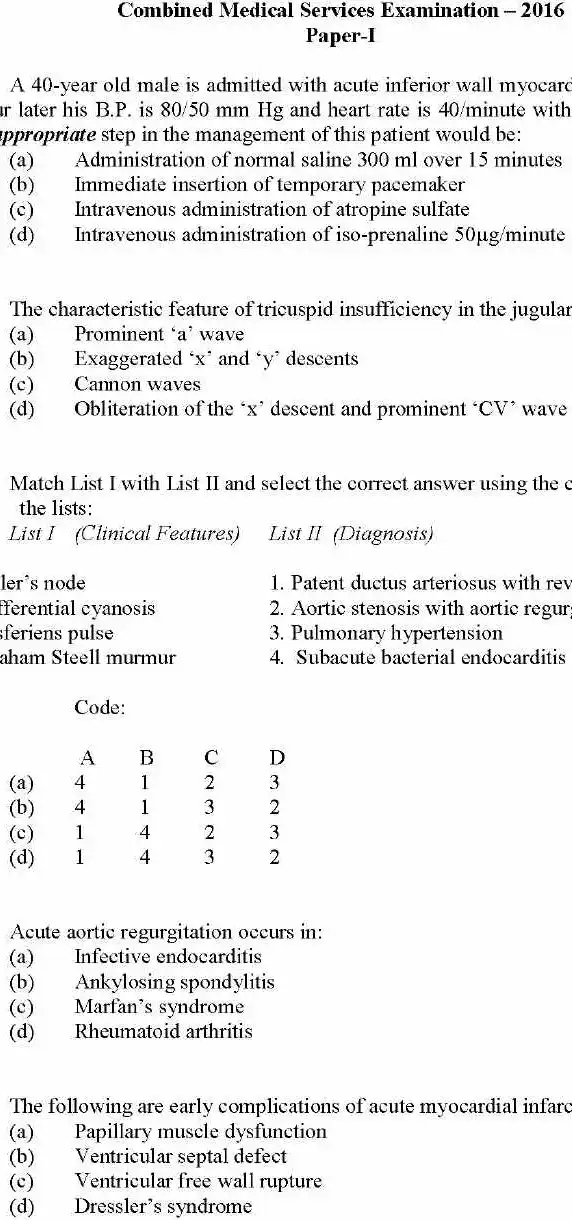
- an hour later his B.P. is 80/50 mm Hg and heart rate is 40/minute with sinus rhythm.
- The most appropriate step in the management of this patient would be: Administration of normal saline 300 ml over 15 minutes \left( a\right) Immediate insertion of temporary pacemaker (b) Intravenous administration of atropine sulfate (c) Intravenous administration of iso-prenaline 50µg/minute (d) The characteristic feature of tricuspid insufficiency in the jugular venous pulse is:
- Prominent 'a' wave (a) (b) Exaggerated 'x' and 'y' descents (c) Cannon waves Obliteration of the 'x' descent and prominent 'CV' wave (d)
- Match List I with List II and select the correct answer using the code given below the lists: List I (Clinical Features) List II (Diagnosis) A. Osler's node
- Patent ductus arteriosus with reversal of shunt
- Aortic stenosis with aortic regurgitation B. Differential cyanosis
- Pulmonary hypertension C. Bisferiens pulse D. Graham Steell murmur
- Infective endocarditis (a) Ankylosing spondylitis (b) (c) Marfan's syndrome Rheumatoid arthritis (d) The following are early complications of acute myocardial infarction except:
- Papillary muscle dysfunction (a) Ventricular septal defect (b) Ventricular free wall rupture (c) Dressler's syndrome (d)
Questions (page 2)
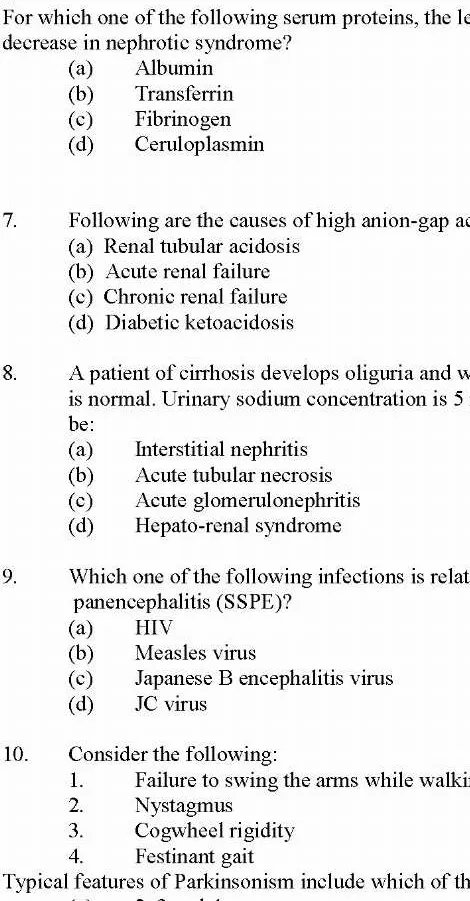
Q3. Festinant gait 2, 3 and 4 a) (b) 1, 2 and 4 1 and 3 only (c) (d) 1, 3 and 4
Q4. Typical features of Parkinsonism include which of the above?
Q6. For which one of the following serum proteins, the levels of protein do not decrease in nephrotic syndrome? Albumin
Q7. (a) Renal tubular acidosis (b) Acute renal failure (c) Chronic renal failure (d) Diabetic ketoacidosis
Q8. A patient of cirrhosis develops oliguria and worsening azotemia. Urinary sediment is normal. Urinary sodium concentration is 5 mEq/L. The most likely cause could be: Interstitial nephritis
Q9. panencephalitis (SSPE)? HIV
Q10. Consider the following: Failure to swing the arms while walking
Question paper preview
Scanned pages 1–2 for reference. Download the official PDF for the full paper.
Free question paper download
Download question paper PDF
Your download starts in 10s
Preparing your question paper file…
Frequently asked questions
What is the name of the exam?
The exam is the Combined Medical Services Examination (CMS).
Which year is this question paper from?
This question paper is from the year 2016.
Who conducts the Combined Medical Services Examination?
The Combined Medical Services Examination is conducted by the Union Public Service Commission (UPSC).
What is the subject of Paper-I?
Paper-I of the Combined Medical Services Examination covers General Medicine.
What is the question format for this paper?
The questions in this paper are of the objective, multiple-choice type.
Can I download the UPSC CMS 2016 Paper-I question paper?
Yes, you can find the question paper details and potentially download it from relevant exam preparation websites.