IFS Mechanical Engineering Paper I 2016 Question Paper PDF | UPSC

Central Government Jobs Engineer 2016

  • Year 2016
  • Conducted By UPSC
  • Questions 8
  • Maximum Marks 200
  • Duration Three Hours
  • Languages English

Exam Details

Detail Information
Examination Indian Forest Service Exam
Year 2016
Conducting Body UPSC
Paper Mechanical Engineering Paper - I
Subject Mechanical Engineering
Duration Three Hours
Maximum Marks 200
Number of Questions 8
Question Type Descriptive / Subjective

This is the Mechanical Engineering Paper-I from the Indian Forest Service (IFS) Exam conducted by UPSC in 2016. The paper is designed to test candidates' knowledge in Mechanical Engineering and consists of descriptive questions. It allows a total of three hours to complete and carries a maximum of 200 marks. Aspirants preparing for the IFS exam can use this paper to understand the question format, difficulty level, and important topics covered in Mechanical Engineering Paper-I, aiding their study plan and exam strategy.

Major Topics Covered

  • Mechanical Engineering
  • Design of stepped pulleys
  • Belt drives
  • Alloys
  • Heat-treatable alloys
  • Non-heat-treatable alloys
  • Material properties
  • Stress and strain
  • Angular speed
  • Wear volume
  • Adhesive wear
  • Unit cells
  • Slip planes
  • Slip direction
  • Ductility
  • Simple beams
  • Elastic curve
  • Flexural rigidity
  • Shaft dynamics
  • Critical speed
  • Vibrations
  • Involute gears
  • Gear interference
  • Bearing materials

Why This Paper is Important

  • Useful for Indian Forest Service Exam preparation
  • Helps understand the latest exam pattern
  • Useful for practice and self-assessment
  • Covers frequently asked General Studies topics
  • Helpful for analysing question trends

Related Resources

  • IFS Mechanical Engineering Paper II 2016
  • IFS Mechanical Engineering Paper I 2015
  • IES Mechanical Engineering Paper I 2016
  • IFS Mechanical Engineering Paper I 2016 Answer Key
  • IFS Mechanical Engineering Syllabus
  • UPSC Engineering Services Exam Syllabus
  • IFS Exam Pattern
  • UPSC Engineering Services Exam Pattern

Instructions

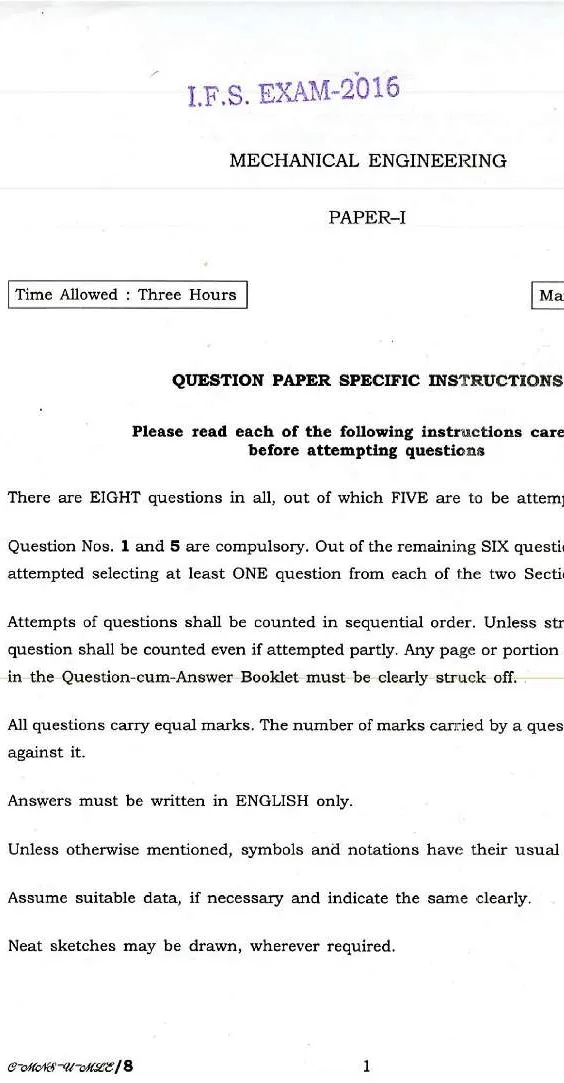
  • There are EIGHT questions in all, out of which FIVE are to be attempted.
  • Out of the remaining SIX questions, THREE are to be attempted selecting at least ONE question from each of the two Sections A and B.
  • Attempts of questions shall be counted in sequential order.
  • Unless struck off, attempt of a question shall be counted even if attempted partly.
  • Any page or portion of the page left blank in the Question-cum-Answer Booklet must be clearly struck off.
  • The number of marks carried by a question/part is indicated against it.
  • Answers must be written in ENGLISH only.
  • Unless otherwise mentioned, symbols and notations have their usual standard meanings.
  • Assume suitable data, if necessary and indicate the same clearly.
  • Neat sketches may be drawn, wherever required.

Questions (page 2)

Section A

Q1.

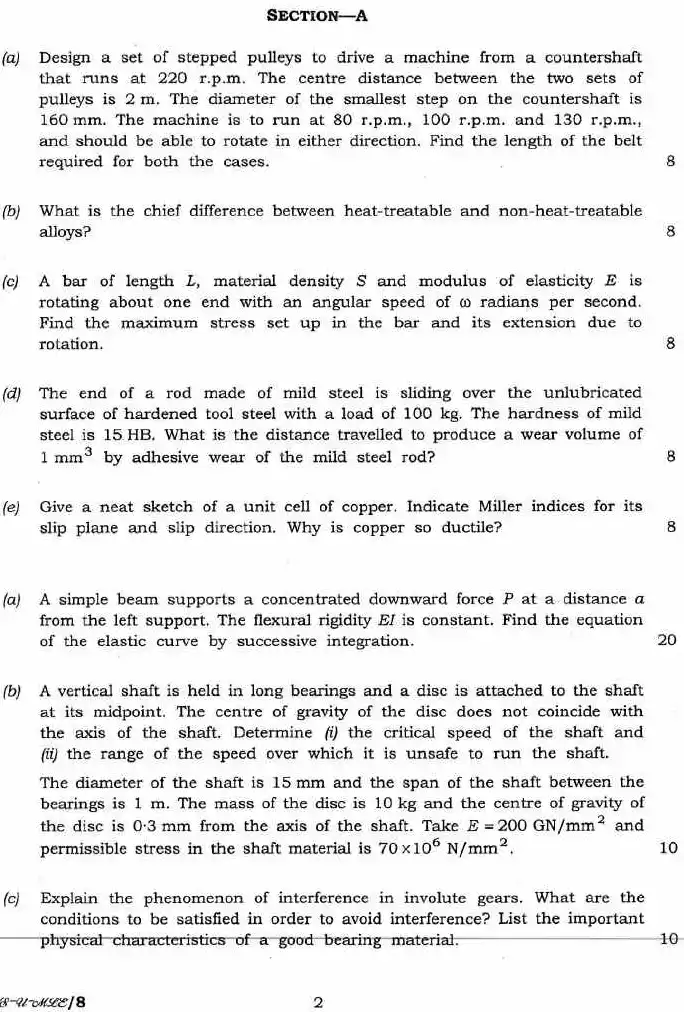
(a) Design a set of stepped pulleys to drive a machine from a countershaft that runs at 220 r. p. m. The centre distance between the two sets of pulleys is 2 m. The diameter of the smallest step on the countershaft is 160 mm. The machine is to run at 80 r. , 100 r. and 130 r. , and should be able to rotate in either direction. Find the length of the belt required for both the cases.

(b) What is the chief difference between heat-treatable and non-heat-treatable alloys?

(c) A bar of length L, material density S and modulus of elasticity E is rotating about one end with an angular speed of omega radians per second. Find the maximum stress set up in the bar and its extension due to rotation.

(d) The end of a rod made of mild steel is sliding over the unlubricated surface of hardened tool steel with a load of 100 kg. The hardness of mild steel is 15 HB. What is the distance travelled to produce a wear volume of 1 mm3 by adhesive wear of the mild steel rod?

(e) Give a neat sketch of a unit cell of copper. Indicate Miller indices for its slip plane and slip direction. Why is copper so ductile?
Section A

Q2.

(a) A simple beam supports a concentrated downward force P at a distance a from the left support. The flexural rigidity EI is constant. Find the equation of the elastic curve by successive integration.

(b) A vertical shaft is held in long bearings and a disc is attached to the shaft at its midpoint. The centre of gravity of the disc does not coincide with the axis of the shaft. Determine (i) the critical speed of the shaft and (ii) the range of the speed over which it is unsafe to run the shaft. The diameter of the shaft is 15 mm and the span of the shaft between the bearings is 1 m. The mass of the disc is 10 kg and the centre of gravity of the disc is 0.3 mm from the axis of the shaft. Take E = 200 GN/mm^2 and permissible stress in the shaft material is 70 imes 106 N/mm^2.

(c) Explain the phenomenon of interference in involute gears. What are the conditions to be satisfied in order to avoid interference? List the important physical characteristics of a good bearing material.

Question paper preview

Scanned pages 1–2 for reference. Download the official PDF for the full paper.

Page 1
Indian Forest Service 2016 Mechanical Engineering Paper I question paper page 1 instructions scan PDF download UPSC
Page 2
Indian Forest Service 2016 Mechanical Engineering Paper I question paper page 1 instructions scan PDF download UPSC

Free question paper download

Download question paper PDF

  • 3.1 MB
  • 6 pages
  • PDF format

Frequently asked questions

What is the name of the exam?

The exam is the Indian Forest Service (IFS) Exam.

Which paper is this question paper for?

This is for Mechanical Engineering Paper-I.

In which year was this exam conducted?

The exam was conducted in 2016.

Who conducts the Indian Forest Service Exam?

The exam is conducted by UPSC (Union Public Service Commission).

What is the total time allowed for the exam?

The time allowed for this paper is Three Hours.

What are the maximum marks for this paper?

The maximum marks for Mechanical Engineering Paper-I is 200.

← Back to Engineer papers