Section A
Q1.
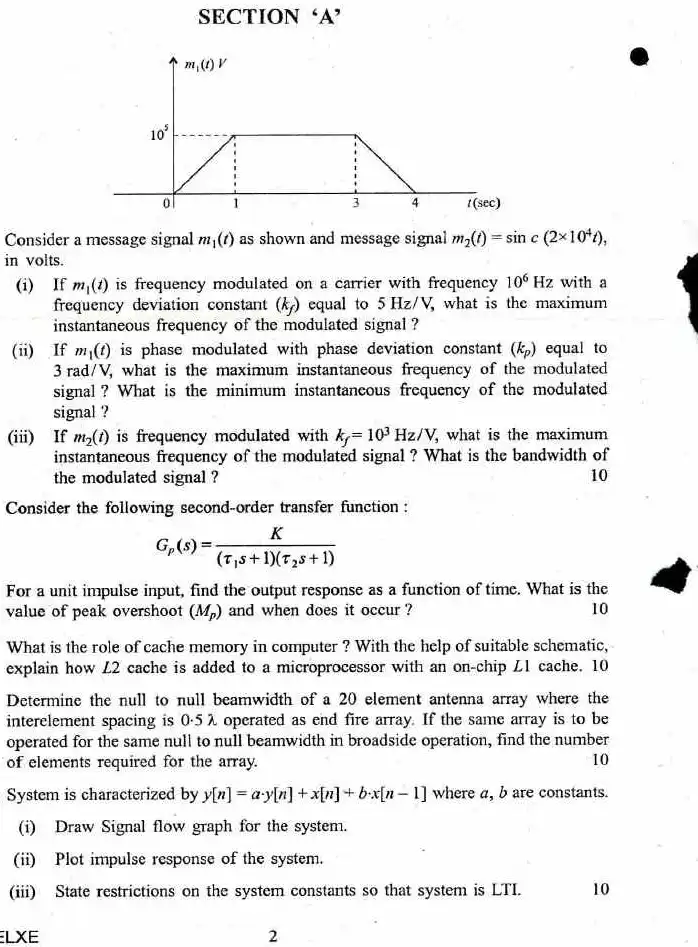
(a) Consider a message signal m1(t) as shown and message signal m2(t) = sin c (2 × 10⁴ t), in volts.
(i) If m1(t) is frequency modulated on a carrier with frequency 106 Hz with a frequency deviation constant (kf) equal to 5 Hz/V, what is the maximum instantaneous frequency of the modulated signal?
(ii) If m1(t) is phase modulated with phase deviation constant (kp) equal to 3 rad/V, what is the maximum instantaneous frequency of the modulated signal? What is the minimum instantaneous frequency of the modulated signal?
(iii) If m2(t) is frequency modulated with kf = 103 Hz/V, what is the maximum instantaneous frequency of the modulated signal? What is the bandwidth of the modulated signal?
(b) Consider the following second-order transfer function :
Gp(s) = (K)/((\taus s + 1)(\taus s + 1))
For a unit impulse input, find the output response as a function of time. What is the value of peak overshoot (Mp) and when does it occur?
(c) What is the role of cache memory in computer ? With the help of suitable schematic, explain how L2 cache is added to a microprocessor with an on-chip L1 cache.
(d) Determine the null to null beamwidth of a 20 element antenna array where the interelement spacing is 0.5 λ operated as end fire array. If the same array is to be operated for the same null to null beamwidth in broadside operation, find the number of elements required for the array.
(e) System is characterized by y[n] = a \cdot y[n] + x[n] + b \cdot x[n-1] where a, b are constants.
(i) Draw Signal flow graph for the system.
(ii) Plot impulse response of the system.
(iii) State restrictions on the system constants so that system is LTI.