UPSC Engineering Services 2019 Civil Engineering Paper II PDF

Central Government Jobs Engineer 2019

  • Year 2019
  • Conducted By UPSC
  • Maximum Marks 300
  • Duration Three Hours
  • Languages English

Exam Details

Detail Information
Examination Engineering Service (Main) Examination
Year 2019
Conducting Body UPSC
Paper Civil Engineering Paper - II
Subject Civil Engineering
Duration Three Hours
Maximum Marks 300
Question Type Mixed

The UPSC Engineering Service (Main) Examination 2019 Civil Engineering Paper II is a crucial component for aspirants targeting a career in engineering services under the Central Government. This paper, conducted by the Union Public Service Commission (UPSC), assesses candidates' in-depth knowledge of Civil Engineering principles. It is a mixed-type paper, featuring both objective and descriptive questions, carrying a maximum of 300 marks and requiring candidates to complete it within a strict time limit of three hours. Solving this paper is vital for understanding the exam pattern, question difficulty, and key topics, thereby aiding effective preparation for the ESE Main exam.

Major Topics Covered

  • Fluid Mechanics
  • Hydraulics
  • Open Channel Flow
  • Groundwater Hydrology
  • Gravity Dams
  • Population Estimation
  • Water Chemistry
  • Alkalinity

Why This Paper is Important

  • Useful for Engineering Service (Main) Examination preparation
  • Helps understand the latest exam pattern
  • Useful for practice and self-assessment
  • Covers frequently asked General Studies topics
  • Helpful for analysing question trends

Related Resources

  • Engineering Services (Main) Examination 2020 Civil Engineering Paper II
  • Engineering Services (Main) Examination 2018 Civil Engineering Paper II
  • Engineering Services (Preliminary) Examination 2019 Civil Engineering Paper I
  • UPSC Engineering Services 2019 Civil Engineering Paper II Answer Key
  • UPSC Engineering Services Civil Engineering Syllabus
  • ESE Main Civil Engineering Topics
  • UPSC Engineering Services Exam Pattern
  • ESE Main Exam Structure

Instructions

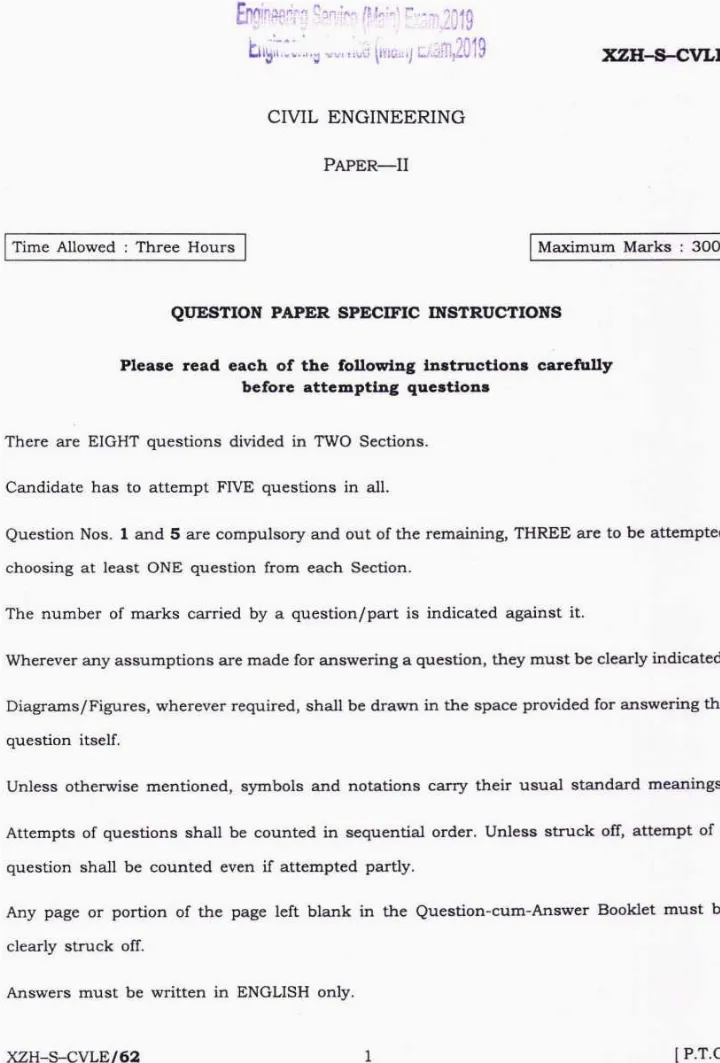
  • There are EIGHT questions divided in TWO Sections.
  • Candidate has to attempt FIVE questions in all.
  • Question Nos. 1 and 5 are compulsory and out of the remaining, THREE are to be attempted choosing at least ONE question from each Section.
  • The number of marks carried by a question/part is indicated against it.
  • Wherever any assumptions are made for answering a question, they must be clearly indicated.
  • Diagrams/Figures, wherever required, shall be drawn in the space provided for answering the question itself.
  • Unless otherwise mentioned, symbols and notations carry their usual standard meanings.
  • Attempts of questions shall be counted in sequential order.
  • Unless struck off, attempt of a question shall be counted even if attempted partly.
  • Any page or portion of the page left blank in the Question-cum-Answer Booklet must be clearly struck off.
  • Answers must be written in ENGLISH only.

Questions (page 2)

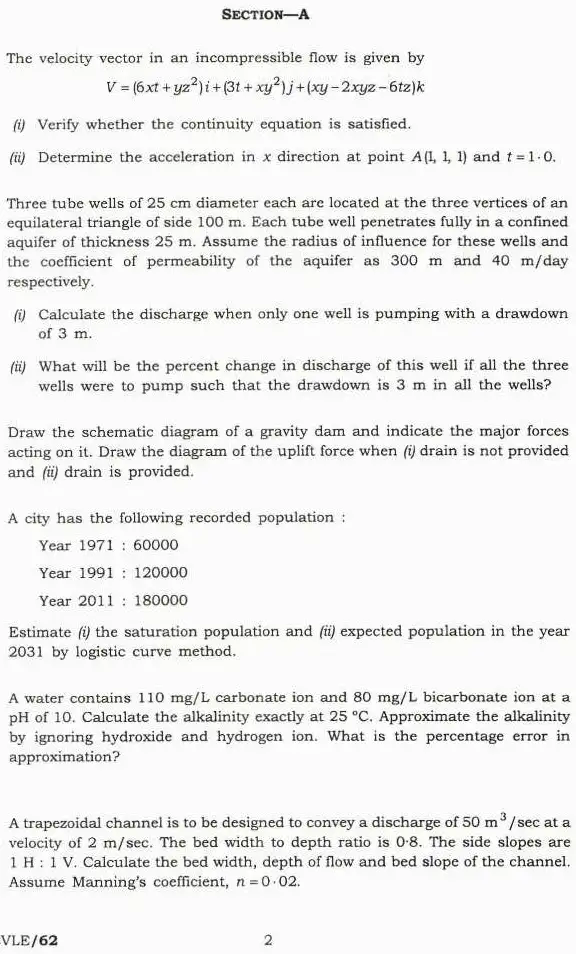
Section A

Q1.

(a) The velocity vector in an incompressible flow is given by V = (6xt + yz^{2})i + (3t + xy^{2})j + (xy - 2xyz - 6tz)k
(i) Verify whether the continuity equation is satisfied.
(ii) Determine the acceleration in x direction at point A(1, 1, 1) and t = 1.0.

(b) Three tube wells of 25 cm diameter each are located at the three vertices of an equilateral triangle of side 100 m. Each tube well penetrates fully in a confined aquifer of thickness 25 m. Assume the radius of influence for these wells and the coefficient of permeability of the aquifer as 300 m and 40 m/day respectively.
(i) Calculate the discharge when only one well is pumping with a drawdown of 3 m.
(ii) What will be the percent change in discharge of this well if all the three wells were to pump such that the drawdown is 3 m in all the wells?

(c) Draw the schematic diagram of a gravity dam and indicate the major forces acting on it. Draw the diagram of the uplift force when (i) drain is not provided and (ii) drain is provided.

(d) A city has the following recorded population :
Year 1971 : 60000
Year 1991 : 120000
Year 2011 : 180000
Estimate (i) the saturation population and (ii) expected population in the year 2031 by logistic curve method.

(e) A water contains 110 mg/L carbonate ion and 80 mg/L bicarbonate ion at a pH of 10. Calculate the alkalinity exactly at 25^{circ}C. Approximate the alkalinity by ignoring hydroxide and hydrogen ion. What is the percentage error in approximation?
Section A

Q2.

(a) A trapezoidal channel is to be designed to convey a discharge of 50 m3/sec at a velocity of 2 m/sec. The bed width to depth ratio is 0. The side slopes are 1 H : 1 V. Calculate the bed width, depth of flow and bed slope of the channel. Assume Manning's coefficient, n = 0.

Question paper preview

Scanned pages 1–2 for reference. Download the official PDF for the full paper.

Page 1
UPSC Engineering Services Main Exam 2019 Civil Engineering Paper II question paper page 1 scan, showing exam name, paper code XZH-S-CVLE, duration, marks, and specific instructions for candidates. PDF download available.
Page 2
UPSC Engineering Services Main Exam 2019 Civil Engineering Paper II question paper page 1 scan, showing exam name, paper code XZH-S-CVLE, duration, marks, and specific instructions for candidates. PDF download available.

Free question paper download

Download question paper PDF

  • 2.7 MB
  • 8 pages
  • PDF format

Frequently asked questions

What is the full name of the exam for which this paper was conducted?

The full name of the exam is the Engineering Service (Main) Examination, 2019.

Which paper is this question paper for?

This is the Civil Engineering Paper - II.

Who conducts the Engineering Service Examination?

The Engineering Service Examination is conducted by the UPSC (Union Public Service Commission).

What is the maximum marks for this paper?

The maximum marks for this paper are 300.

What is the time duration allowed for this paper?

The time allowed for this paper is three hours.

What is the paper code mentioned on the question paper?

The paper code mentioned is XZH-S-CVLE.

← Back to Engineer papers