Engineering Service Main 2019 Mechanical Engineering Paper II PDF

Central Government Jobs Engineer 2019

  • Year 2019
  • Conducted By UPSC
  • Maximum Marks 300
  • Duration Three Hours
  • Languages English

Exam Details

Detail Information
Examination Engineering Service (Main) Examination
Year 2019
Conducting Body UPSC
Paper Mechanical Engineering Paper-II
Subject Mechanical Engineering
Duration Three Hours
Maximum Marks 300
Question Type Mixed

This is the Mechanical Engineering Paper-II for the UPSC Engineering Service (Main) Examination held in 2019. The paper carries a maximum of 300 marks and is allotted a duration of three hours. It is designed to assess the in-depth knowledge of Mechanical Engineering candidates at the main examination stage. Aspirants can use this question paper to understand the complexity, types of questions asked, and the marking scheme, which is crucial for effective preparation and strategy development for the Engineering Service Exam.

Major Topics Covered

  • Mechanics of Materials
  • Statics
  • Dynamics
  • Friction
  • Thermodynamics
  • Heat Transfer
  • Kinematics
  • Mechanisms

Why This Paper is Important

  • Useful for Engineering Service (Main) Examination preparation
  • Helps understand the latest exam pattern
  • Useful for practice and self-assessment
  • Covers frequently asked General Studies topics
  • Helpful for analysing question trends

Related Resources

  • Engineering Service (Main) Examination, 2019 - Mechanical Engineering Paper-I
  • Engineering Service (Main) Examination, 2018 - Mechanical Engineering Paper-II
  • Engineering Service (Preliminary) Examination, 2019 - Mechanical Engineering Paper
  • ESE 2019 Mechanical Engineering Paper II Answer Key
  • ESE Mechanical Engineering Syllabus
  • Mechanical Engineering Thermodynamics Syllabus
  • Mechanical Engineering Strength of Materials Syllabus
  • ESE Main Exam Pattern

Instructions

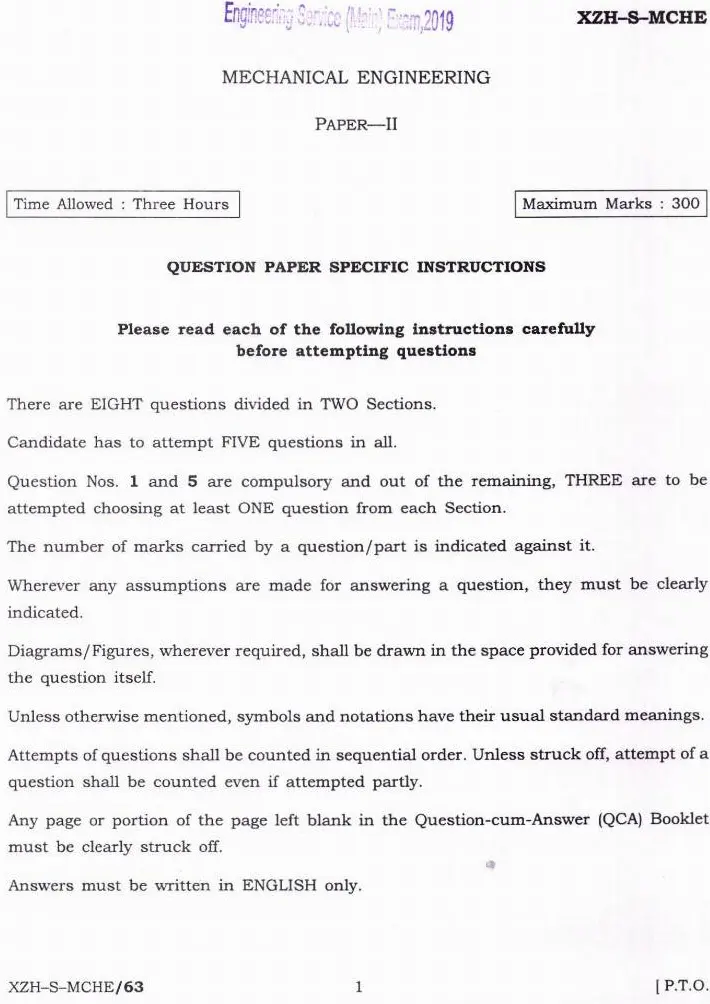
  • There are EIGHT questions divided in TWO Sections.
  • Candidate has to attempt FIVE questions in all.
  • Question Nos. 1 and 5 are compulsory and out of the remaining, THREE are to be attempted choosing at least ONE question from each Section.
  • The number of marks carried by a question/part is indicated against it.
  • Wherever any assumptions are made for answering a question, they must be clearly indicated.
  • Diagrams/Figures, wherever required, shall be drawn in the space provided for answering the question itself.
  • Unless otherwise mentioned, symbols and notations have their usual standard meanings.
  • Attempts of questions shall be counted in sequential order.
  • Unless struck off, attempt of a question shall be counted even if attempted partly.
  • Any page or portion of the page left blank in the Question-cum-Answer (QCA) Booklet must be clearly struck off.
  • Answers must be written in ENGLISH only.

Questions (page 2)

Section A

Q1.

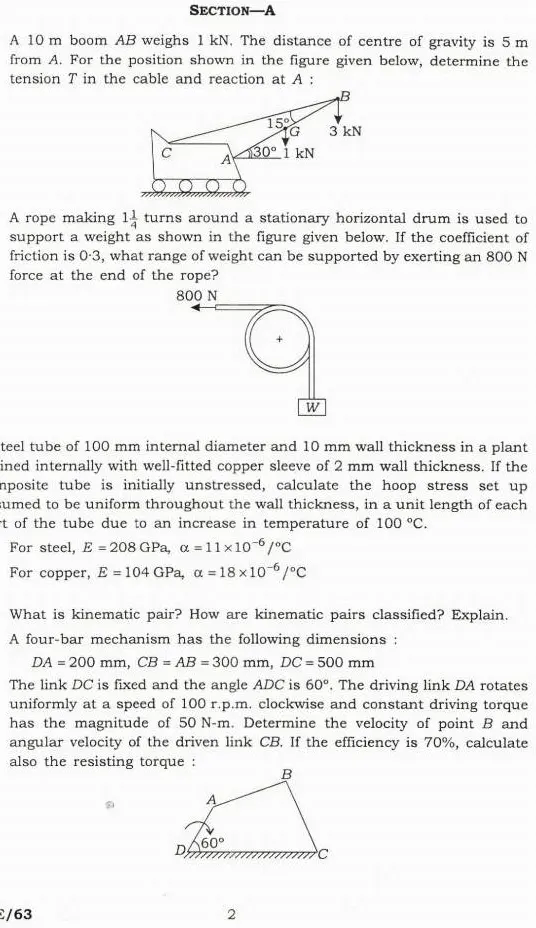
(a) A 10 m boom AB weighs 1 kN. The distance of centre of gravity is 5 m from A. For the position shown in the figure given below, determine the tension T in the cable and reaction at A:
6 3 kN 30° ikN

(a) A rope making 1¼ turns around a stationary horizontal drum is used to support a weight as shown in the figure given below. If the coefficient of friction is 0.3, what range of weight can be supported by exerting an 800 N force at the end of the rope?
6 800 N W

(b) A steel tube of 100 mm internal diameter and 10 mm wall thickness in a plant is lined internally with well-fitted copper sleeve of 2 mm wall thickness. If the composite tube is initially unstressed, calculate the hoop stress set up assumed to be uniform throughout the wall thickness, in a unit length of each part of the tube due to an increase in temperature of 100 °C. For steel, E = 208 GPa, α = 11 × 10-6 /°C For copper, E = 104 GPa, α = 18 × 10-6 /°C 12

(c) What is kinematic pair? How are kinematic pairs classified? Explain. 6

(c) A four-bar mechanism has the following dimensions: DA = 200 mm, CB = AB = 300 mm, DC = 500 mm The link DC is fixed and the angle ADC is 60°. The driving link DA rotates uniformly at a speed of 100 r.p.m. clockwise and constant driving torque has the magnitude of 50 N-m. Determine the velocity of point B and angular velocity of the driven link CB. If the efficiency is 70%, calculate also the resisting torque : 6
Question paper preview

Scanned pages 1–2 for reference. Download the official PDF for the full paper.

Page 1
UPSC Engineering Service Main 2019 Mechanical Engineering Paper II question paper page 1 instructions scan PDF download
Page 2
UPSC Engineering Service Main 2019 Mechanical Engineering Paper II question paper page 1 instructions scan PDF download

Free question paper download

Download question paper PDF

  • 2.8 MB
  • 8 pages
  • PDF format

Frequently asked questions

What is the name of the examination?

The examination is the Engineering Service (Main) Examination.

What year is this question paper from?

This question paper is from the 2019 examination.

Which paper is this question paper?

This is Mechanical Engineering Paper-II.

Who conducts the Engineering Service Examination?

The examination is conducted by UPSC (Union Public Service Commission).

What is the maximum marks for this paper?

The maximum marks for this paper are 300.

What is the time allowed for this paper?

The time allowed for this paper is three hours.

← Back to Engineer papers