
Engineering Service Main 2019 Mechanical Paper I
- Year 2019
- Questions 8
- Maximum Marks 300
- Duration Three Hours
- Languages English
Exam Details
| Detail | Information |
|---|---|
| Examination | Engineering Service (Main) Exam |
| Year | 2019 |
| Paper | Mechanical Engineering Paper I |
| Subject | Mechanical Engineering |
| Duration | Three Hours |
| Maximum Marks | 300 |
| Number of Questions | 8 |
| Question Type | Descriptive / Subjective |
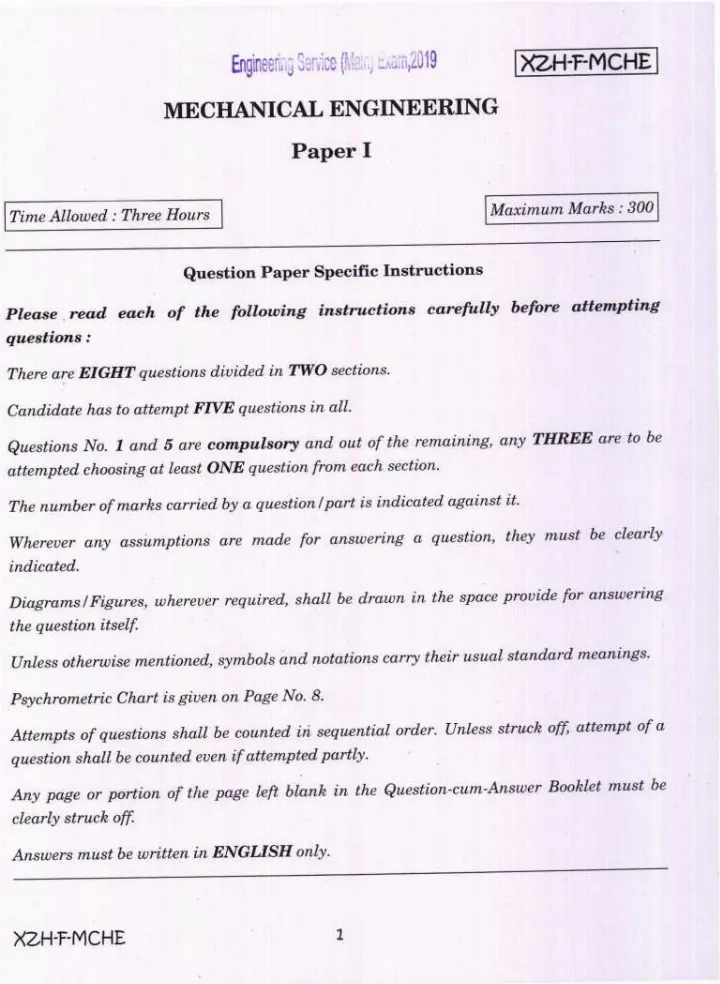
The document outlines the Engineering Service (Main) Examination 2019, Mechanical Engineering Paper I (Paper 1). It carries 300 marks with a three-hour duration. There are eight questions divided into two sections. Candidates must answer five questions in total, with Q1 and Q5 compulsory; from the remaining three, at least one must be from each section. Page 2 presents Section A with Q1 containing four parts (a)–(d), each valued at 12 marks: (a) flow in parallel pipes, (b) a three-reservoir thermodynamics problem, (c) thermostatic expansion valve operation, and (d) heat transfer in a nuclear fuel rod with cladding. Diagrams are to be drawn where required, and answers must be in English. The OCR-repaired content will inform the SEO metadata, topics, and FAQ for page 1 and page 2. This previous year Engineering Service (Main) Examination question paper (2019) is useful for Engineer aspirants preparing for Central government recruitment. The paper was conducted by UPSC and reflects the official exam pattern, marking scheme and difficulty level seen in recent cycles. Use it for timed practice, topic-wise revision and understanding how questions are framed in the real examination. Download the free PDF on QuizCurrent to read instructions, attempt MCQs and compare your answers with the study notes provided on this page. Key syllabus areas include Fluid Mechanics, Pipe Flow, Hydraulic Flow, Thermodynamics, Thermodynamic Cycles, Heat Transfer, Conduction, Convection. Useful for Engineering Service (Main) Exam preparation. Helps understand the latest exam pattern. Useful for practice and self-assessment.
Major Topics Covered
- Fluid Mechanics
- Pipe Flow
- Hydraulic Flow
- Thermodynamics
- Thermodynamic Cycles
- Heat Transfer
- Conduction
- Convection
- Radiation
- Nuclear Heat Transfer
- Nuclear Reactors
- Fuel Rod Cladding
- Thermostatic Expansion Valve
- Refrigeration Theory
- Expansion Devices
- Three Reservoir Engine
- Thermal Efficiency
- Energy Conversion
- Variable Load
- Section A
- Question Paper Instructions
Why This Paper is Important
- Useful for Engineering Service (Main) Exam preparation
- Helps understand the latest exam pattern
- Useful for practice and self-assessment
- Covers frequently asked General Studies topics
- Helpful for analysing question trends
Related Resources
- Engineering Service Mechanical Eng Paper II 2021
- Engineering Service Mechanical Engineering Paper I 2021 Question Paper PDF
- Engineering Service Main 2021 Electrical Engineering Paper II PDF
- UPSC Engineering Service 2021 Electronics & Telecommunication Paper II PDF
- Engineering Service 2021 ECE Paper I (Main) - Page 1-2
Instructions
- There are EIGHT questions divided in TWO sections.
- Candidate has to attempt FIVE questions in all.
- Questions No. 1 and 5 are compulsory and out of the remaining, any THREE are to be attempted choosing at least ONE question from each section.
- The number of marks carried by a question / part is indicated against it.
- Wherever any assumptions are made for answering a question, they must be clearly indicated.
- Diagrams/Figures, wherever required, shall be drawn in the space provide for answering the question itself.
- Unless otherwise mentioned, symbols and notations carry their usual standard meanings.
- Psychrometric Chart is given on Page No.
- Attempts of questions shall be counted in sequential order.
- Unless struck off, attempt of a question shall be counted even if attempted partly.
- Any page or portion of the page left blank in the Question-cum-Answer Booklet must be clearly struck off.
- Answers must be written in ENGLISH only.
Questions (page 2)
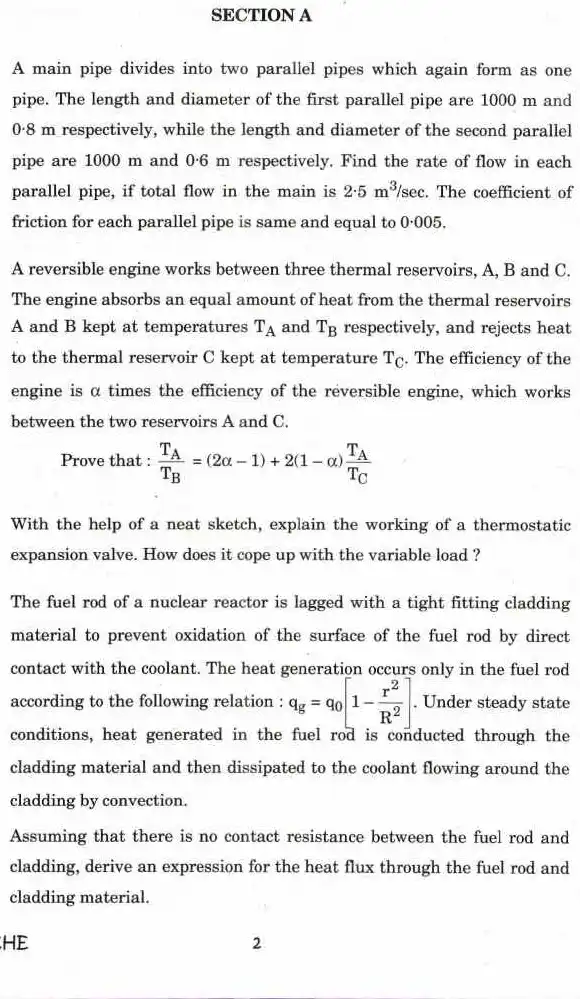
Q2. Q1.(b) A reversible engine works between three thermal reservoirs, A, B and C. The engine absorbs an equal amount of heat from the thermal reservoirs A and B kept at temperatures T_A and T_B respectively, and rejects heat to the thermal reservoir C kept at temperature T_C. The efficiency of the engine is α times the efficiency of the reversible engine, which works between the two reservoirs A and C. Prove that : T_A/T_B = (2α - 1) + 2(1 - α) T_A/T_C.
Q3. Q1.
(c) With the help of a neat sketch, explain the working of a thermostatic expansion valve. How does it cope up with the variable load?
Q4. Q1.(d) The fuel rod of a nuclear reactor is lagged with a tight fitting cladding material to prevent oxidation of the surface of the fuel rod by direct contact with the coolant. The heat generation occurs only in the fuel rod according to the following relation : qg = q0 |1 - r2/R^2|. Under steady state conditions, heat generated in the fuel rod is conducted through the cladding material and then dissipated to the coolant flowing around the cladding by convection. Assuming that there is no contact resistance between the fuel rod and cladding, derive an expression for the heat flux through the fuel rod and cladding material.
Question paper preview
Scanned pages 1–2 for reference. Download the official PDF for the full paper.
Free question paper download
Download question paper PDF
Your download starts in 10s
Preparing your question paper file…
Frequently asked questions
What is the exam name and year?
Engineering Service (Main) Examination, 2019.
Which paper is this?
Mechanical Engineering Paper I.
How many questions are in the paper?
Eight questions divided into two sections.
How many questions must be attempted?
Five questions in total; Q1 and Q5 are compulsory; at least one from each section among the remaining.
What is the maximum marks?
Maximum marks are 300.
What is the time duration?
Three hours.