Section A
Q1.
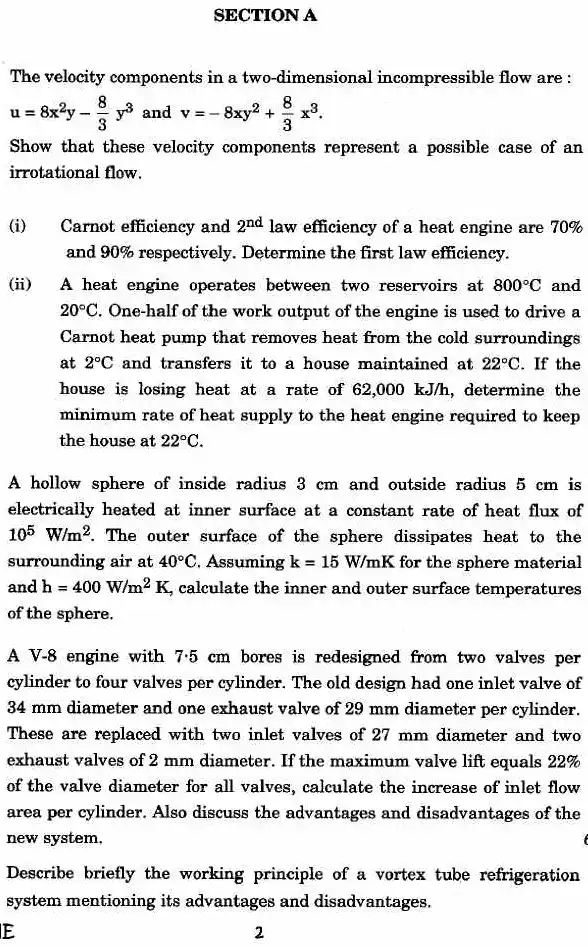
(a) The velocity components in a two-dimensional incompressible flow are : u = 8x2y - (8/3)y3 and v = -8xy2 + (8/3)x3. Show that these velocity components represent a possible case of an irrotational flow.
(b) (i) Carnot efficiency and 2nd law efficiency of a heat engine are 70% and 90% respectively. Determine the first law efficiency.
(ii) A heat engine operates between two reservoirs at 800°C and 20°C. One-half of the work output of the engine is used to drive a Carnot heat pump that removes heat from the cold surroundings at 2°C and transfers it to a house maintained at 22°C. If the house is losing heat at a rate of 62,000 kJ/h, determine the minimum rate of heat supply to the heat engine required to keep the house at 22 °C.
(c) A hollow sphere of inside radius 3 cm and outside radius 5 cm is electrically heated at inner surface at a constant rate of heat flux of 105 W/m^2. The outer surface of the sphere dissipates heat to the surrounding air at 40°C. Assuming k = 15 W/mK for the sphere material and h = 400 W/m^2 K, calculate the inner and outer surface temperatures of the sphere.
(d) A V-8 engine with 7.5 cm bores is redesigned from two valves per cylinder to four valves per cylinder. The old design had one inlet valve of 34 mm diameter and one exhaust valve of 29 mm diameter per cylinder. These are replaced with two inlet valves of 27 mm diameter and two exhaust valves of 2 mm diameter. If the maximum valve lift equals 22% of the valve diameter for all valves, calculate the increase of inlet flow area per cylinder. Also discuss the advantages and disadvantages of the new system.
(e) Describe briefly the working principle of a vortex tube refrigeration system mentioning its advantages and disadvantages.