
BPSC CCE Botany Question Paper 2023 PDF Download
- Conducted By BPSC
- Questions 100
- Maximum Marks 100
- Duration 2 Hours
- Languages English & Hindi
Exam Details
| Detail | Information |
|---|---|
| Examination | Combined Competitive Examinations (CCE) |
| Conducting Body | BPSC |
| Paper | Botany |
| Subject | Botany |
| Duration | 2 Hours |
| Maximum Marks | 100 |
| Number of Questions | 100 |
| Question Type | Objective (MCQ) |
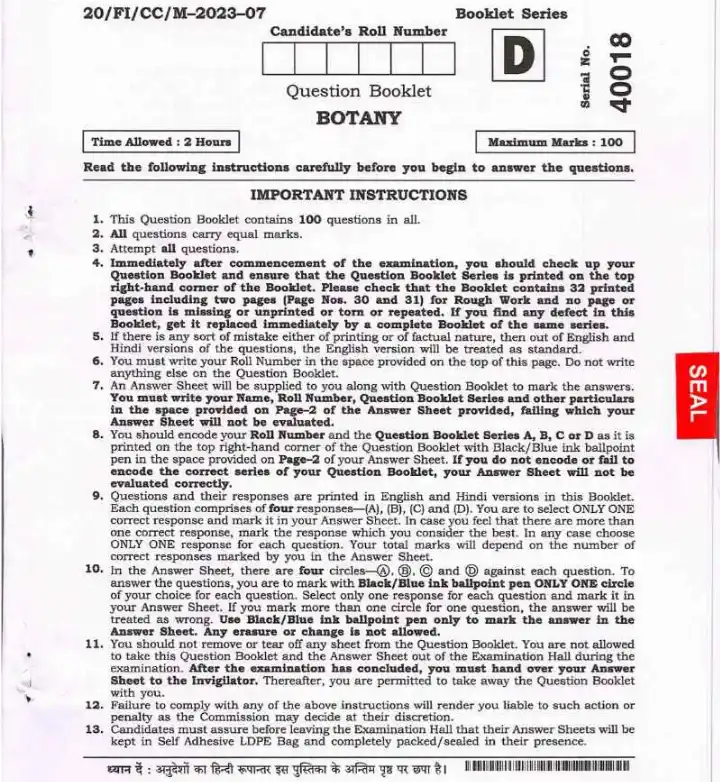
This document contains the Botany question paper for the Combined Competitive Examinations (CCE) conducted by BPSC. The paper consists of 100 objective type questions, with a total maximum mark of 100 and a time duration of 2 hours. This question booklet is a crucial resource for aspirants preparing for the Bihar Public Service Commission examinations, offering insights into the exam pattern, question difficulty, and key topics covered in Botany. This previous year Combined Competitive Examinations (CCE) question paper is useful for Administrative / Civil Services aspirants preparing for Bihar government recruitment. The paper was conducted by BPSC and reflects the official exam pattern, marking scheme and difficulty level seen in recent cycles. Use it for timed practice, topic-wise revision and understanding how questions are framed in the real examination. Download the free PDF on QuizCurrent to read instructions, attempt MCQs and compare your answers with the study notes provided on this page. Key syllabus areas include Botany, Microscopes, Cell Biology, Membrane Transport, Metabolism, Biochemistry. Useful for Combined Competitive Examinations (CCE) preparation. Helps understand the latest exam pattern. Useful for practice and self-assessment.
Major Topics Covered
- Botany
- Microscopes
- Cell Biology
- Membrane Transport
- Metabolism
- Biochemistry
Why This Paper is Important
- Useful for Combined Competitive Examinations (CCE) preparation
- Helps understand the latest exam pattern
- Useful for practice and self-assessment
- Covers frequently asked General Studies topics
- Helpful for analysing question trends
Related Resources
- BPSC CCE General Studies Question Paper
- BPSC CCE Hindi Question Paper
- Other BPSC Subject Papers
- BPSC CCE Botany Answer Key 2023
- BPSC CCE Botany Syllabus
- BPSC CCE Exam Pattern
- BPSC CCE Exam Pattern Details
- BPSC CCE
Instructions
- Candidates must assure before leaving the Examination Hall that their Answer Sheets will be kept in Self Adhesive LDPE Bag and completely packed/sealed in their presence. BIL BIBER DIN BENERA BIR BILIK SERIKAT DI RESIDEN SERIKA SERIKAT PERSENTAAN DI BERKATAN DI BERKATAN DI BIRANG ध्यान दें : अनुदेशों का हिन्दी रूपान्तर इस पुस्तिका के अन्तिम पृष्ठ पर छपा है।
- This Question Booklet contains 100 questions in all.
- All questions carry equal marks. Attempt all questions.
- Immediately after commencement of the examination, you should check up your Question Booklet and ensure that the Question Booklet Series is printed on the top right-hand corner of the Booklet.
- Please check that the Booklet contains 32 printed pages including two pages (Page Nos. 30 and
- for Rough Work and no page or question is missing or unprinted or torn or repeated.
- If you find any defect in this Booklet, get it replaced immediately by a complete Booklet of the same series.
- If there is any sort of mistake either of printing or of factual nature, then out of English and Hindi versions of the questions, the English version will be treated as standard.
- You must write your Roll Number in the space provided on the top of this page.
- Do not write SEAL anything else on the Question Booklet.
- An Answer Sheet will be supplied to you along with Question Booklet to mark the answers.
- You must write your Name, Roll Number, Question Booklet Series and other particulars in the space provided on Page-2 of the Answer Sheet provided, failing which your Answer Sheet will not be evaluated.
- You should encode your Roll Number and the Question Booklet Series A, B, C or D as it is printed on the top right-hand corner of the Question Booklet with Black/Blue ink ballpoint pen in the space provided on Page-2 of your Answer Sheet.
- If you do not encode or fail to encode the correct series of your Question Booklet, your Answer Sheet will not be evaluated correctly.
- Questions and their responses are printed in English and Hindi versions in this Booklet.
- Each question comprises of four responses—(A), (B), (C) and (D).
- You are to select ONLY ONE correct response and mark it in your Answer Sheet.
- In case you feel that there are more than one correct response, mark the response which you consider the best.
- In any case choose ONLY ONE response for each question.
- Your total marks will depend on the number of correct responses marked by you in the Answer Sheet.
- In the Answer Sheet, there are four circles—\left(\theta\right), \left(\theta\right), \left(\theta\right) and \left(\theta\right) against each question.
- To answer the questions, you are to mark with Black/Blue ink ballpoint pen ONLY ONE circle of your choice for each question.
- Select only one response for each question and mark it in your Answer Sheet.
- If you mark more than one circle for one question, the answer will be treated as wrong.
- Use Black/Blue ink ballpoint pen only to mark the answer in the Answer Sheet.
- Any erasure or change is not allowed.
- You should not remove or tear off any sheet from the Question Booklet.
- You are not allowed to take this Question Booklet and the Answer Sheet out of the Examination Hall during the examination.
- After the examination has concluded, you must hand over your Answer Sheet to the Invigilator.
- Thereafter, you are permitted to take away the Question Booklet with you.
- Failure to comply with any of the above instructions will render you liable to such action or penalty as the Commission may decide at their discretion.
Questions (page 2)
Formatted from page 2 OCR. Download the PDF for the full paper.
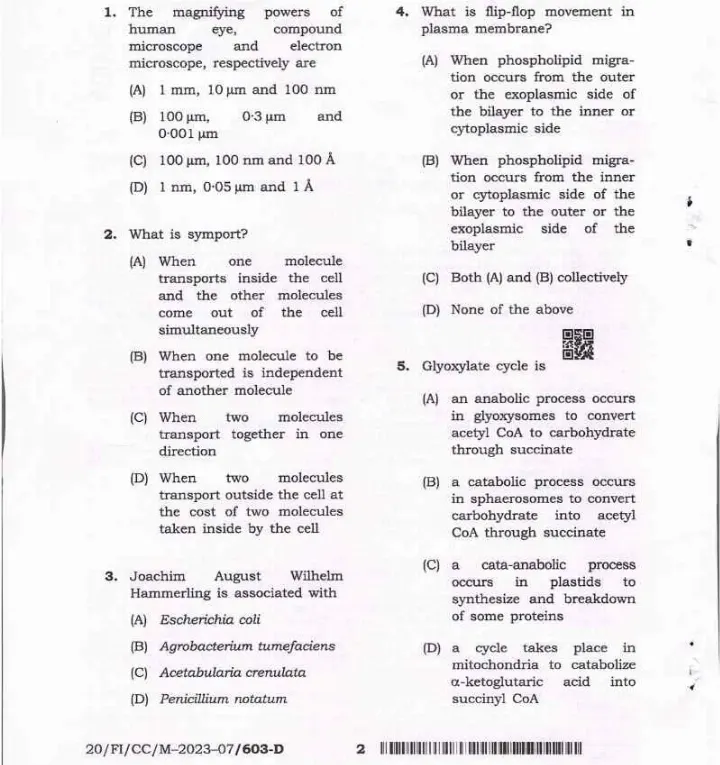
1. The magnifying powers of human eye, compound microscope and electro microscope, respectively are
(C) 100 m, 100 nm and 100 Å
(D) 1 nm, and 1 Å
2. What is symport?
(A) When one molecule transports inside the cell and the other molecule come out of the cell simultaneously
(B) When one molecule to be transported is independent of another molecule
(C) When two molecule transport together in one direction
(D) When two molecule transport outside the cell at the cost of two molecule taken inside by the cell
3. Joachim August Wilhel Hammerling is associated with
(A) Escherichia coli
(B) Agrobacterium tumefaciens
(C) Acetabularia crenulata
(D) Penicillium notatum
4. What is flip-flop movement in plasma membrane?
(A) When phospholipid migration occurs from the outer or the exoplasmic side of the bilayer to the inner or cytoplasmic side
(B) When phospholipid migration occurs from the inner or cytoplasmic side of the bilayer to the outer or the exoplasmic side of the bilayer
(C) Both (A) and (B) collectively
(D) None of the above
5. Glyoxylate cycle is
(A) an anabolic process occurs in glyoxysomes to convert acetyl CoA to carbohydrate through succinate
(B) a catabolic process occurs in sphaerosomes to convert carbohydrate into acetyl CoA through succinate
(C) a cata-anabolic process occurs in plastids to synthesize and breakdown of some proteins
(D) a cycle takes place in mitochondria to catabolize acid α-ketoglutaric into succinyl CoA
Question paper preview
Scanned pages 1–2 for reference. Download the official PDF for the full paper.
Free question paper download
Download question paper PDF
Your download starts in 10s
Preparing your question paper file…
Frequently asked questions
What is the name of the exam?
The exam is the Combined Competitive Examinations (CCE).
Which subject is covered in this question paper?
This question paper is for the subject of Botany.
Who conducts the Combined Competitive Examinations (CCE)?
The Combined Competitive Examinations (CCE) are conducted by BPSC (Bihar Public Service Commission).
What is the total number of questions in the Botany paper?
There are 100 questions in the Botany question paper.
What is the maximum marks for the Botany paper?
The maximum marks for the Botany paper is 100.
What is the time allowed for the Botany paper?
The time allowed for the Botany paper is 2 Hours.
← Back to Administrative / Civil Services papers · Bihar Government Jobs