Geology Paper I - IFS Main 2025 (DJSM-U-GELY)
- Year 2025
- Conducted By Union Public Service Commission
- Maximum Marks 200
- Duration Three Hours
- Languages English
Exam Details
| Detail | Information |
|---|---|
| Examination | Indian Forest Services (Main) Examination-2025 |
| Year | 2025 |
| Conducting Body | Union Public Service Commission |
| Paper | Geology |
| Subject | Geology |
| Duration | Three Hours |
| Maximum Marks | 200 |
This SEO JSON consolidates the Geology Paper I for the Indian Forest Services (Main) Examination 2025 (DJSM-U-GELY). It combines the exam header, full repair of Page 2 questions (Q1–Q3 with subparts), and page-1 instructions. Page 1 sets the format: eight questions in total, Q1 and Q5 compulsory, with three of the remaining six to be answered from Sections A and B. The repaired questions on Page 2 cover topics in structural geology (plunging and reclined folds, Karst cycle), photogrammetry and ground measurement (aerial camera parameters, ground resolution), mineral deformation, remote sensing for groundwater, oceanic topography, fault structures, and earthquake magnitude scales. The metadata, FAQ, tag clusters, and image SEO are prepared to optimize discoverability while remaining faithful to the OCR content.
Major Topics Covered
- Geology
- Orogeny
- Epeirogeny
- Karst cycle
- Folds
- Aerial photography
- Photogrammetry
- Ground resolution
- Ground coverage
- Remote sensing
- Groundwater exploration
- Mineral exploration
- Oceanic topography
- Coral reefs
- Fault structures
- Stress ellipsoids
- Earthquakes
- Magnitude scales
- Seismology
- Crustal deformation
Why This Paper is Important
- Useful for Indian Forest Services (Main) Examinatio preparation
- Helps understand the latest exam pattern
- Useful for practice and self-assessment
- Covers frequently asked General Studies topics
- Helpful for analysing question trends
Related Resources
- Indian Forest Service 2025 Zoology Paper II Question Paper PDF
- Indian Forest Service 2025 Statistics Paper II Question Paper PDF
- Indian Forest Service Statistics Paper I 2025 Question Paper PDF
- Indian Forest Service Physics Paper II 2025 UPSC Question Paper PDF
- Indian Forest Service Physics Paper I 2025 Question Paper PDF
Instructions
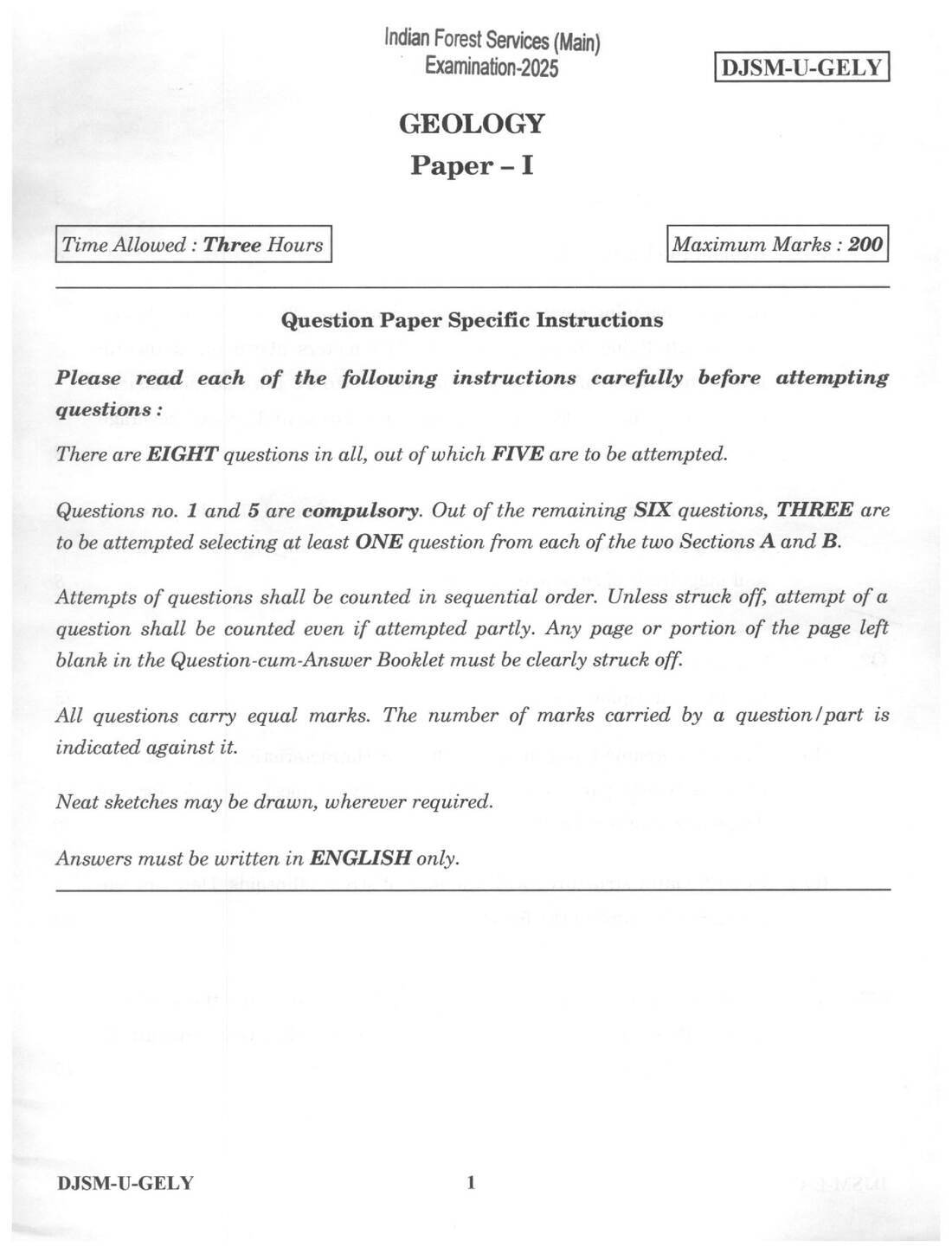
- There are EIGHT questions in all, out of which FIVE are to be attempted.
- Out of the remaining SIX questions, THREE are to be attempted selecting at least ONE question from each of the two Sections A and B.
- Attempts of questions shall be counted in sequential order.
- Unless struck off, attempt of a question shall be counted even if attempted partly.
- Any page or portion of the page left blank in the Question-cum-Answer Booklet must be clearly struck off.
- The number of marks carried by a question/part is indicated against it.
- Neat sketches may be drawn, wherever required.
- Answers must be written in ENGLISH only.
Questions (page 2)
Q2.
Q1.
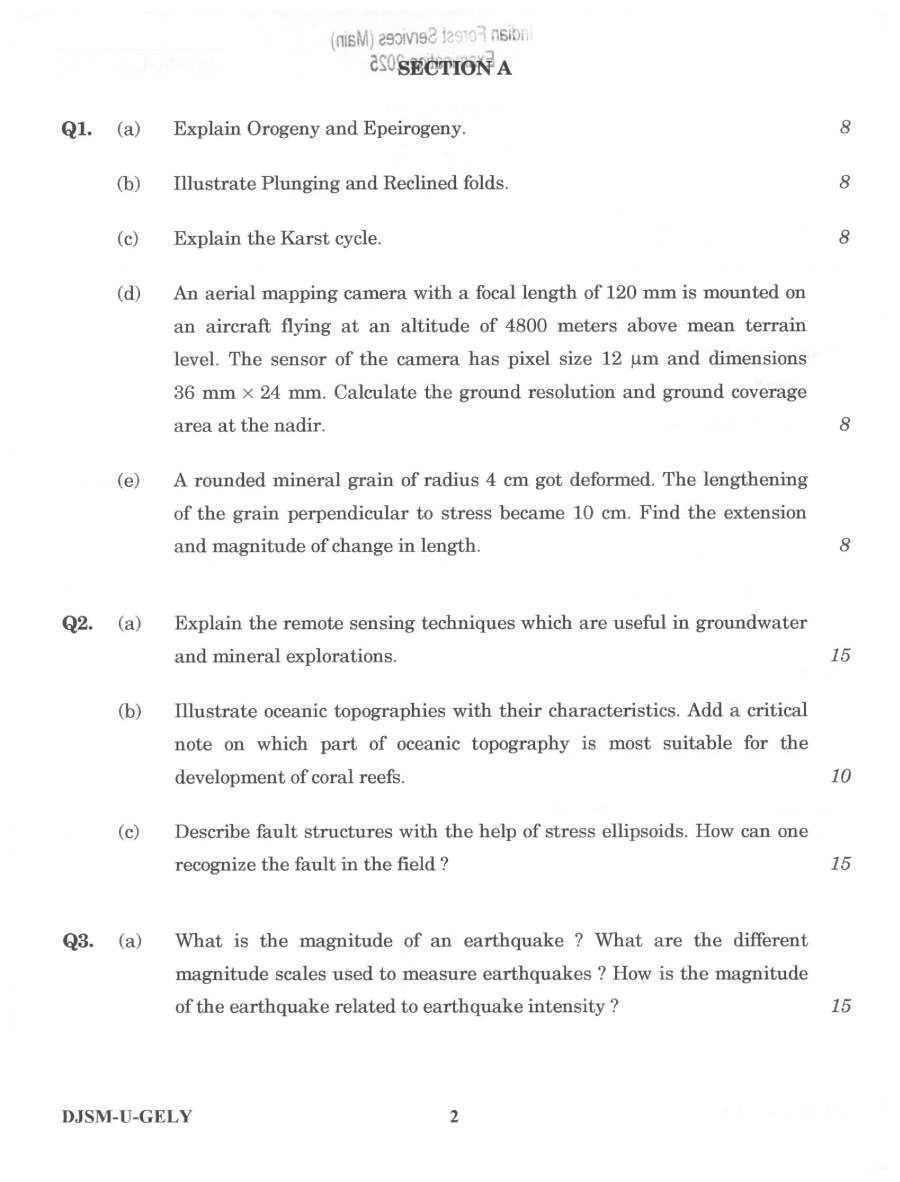
(c) Explain the Karst cycle. 8
Q3. Q1. (d) An aerial mapping camera with a focal length of 120 mm is mounted on an aircraft flying at an altitude of 4800 meters above mean terrain level. The sensor of the camera has pixel size 12 μm and dimensions 36 mm × 24 mm. Calculate the ground resolution and ground coverage area at the nadir. 8
Q4. Q1. (e) A rounded mineral grain of radius 4 cm got deformed. The lengthening of the grain perpendicular to stress became 10 cm. Find the extension and magnitude of change in length. 8
Q5. Q1. (f) Explain the remote sensing techniques which are useful in groundwater. 8
Q6. Q2. (a) Explain oceanic topographies with their characteristics. Add a critical note on which part of oceanic topography is most suitable for the development of coral reefs. 15
Q7. Q2. (b) Describe fault structures with the help of stress ellipsoids. How can one recognize the fault in the field? 10
Q8.
Q2.
(c) What is the magnitude of an earthquake? What are the different magnitude scales used to measure earthquakes? How is the magnitude of the earthquake related to earthquake intensity? 15
Q9. Q3. (a) What is the magnitude of an earthquake? What are the different magnitude scales used to measure earthquakes? How is the magnitude of the earthquake related to earthquake intensity? 15
Question paper preview
Scanned pages 1–2 for reference. Download the official PDF for the full paper.
Free question paper download
Download question paper PDF
Your download starts in 10s
Preparing your question paper file…
Frequently asked questions
What examination is this data for?
Indian Forest Services (Main) Examination 2025.
How many questions are there and which are compulsory?
There are eight questions in total; questions 1 and 5 are compulsory.
How many questions must be attempted from Sections A and B?
Out of the remaining six questions, three must be attempted with at least one from Section A and one from Section B.
In which language must answers be written?
Answers must be written in English only.
What is the paper code for Geology Paper I?
DJSM-U-GELY.
What is Orogeny and Epeirogeny?
Orogeny refers to mountain-building processes, while epeirogeny refers to broad vertical movements of the crust without mountain building.