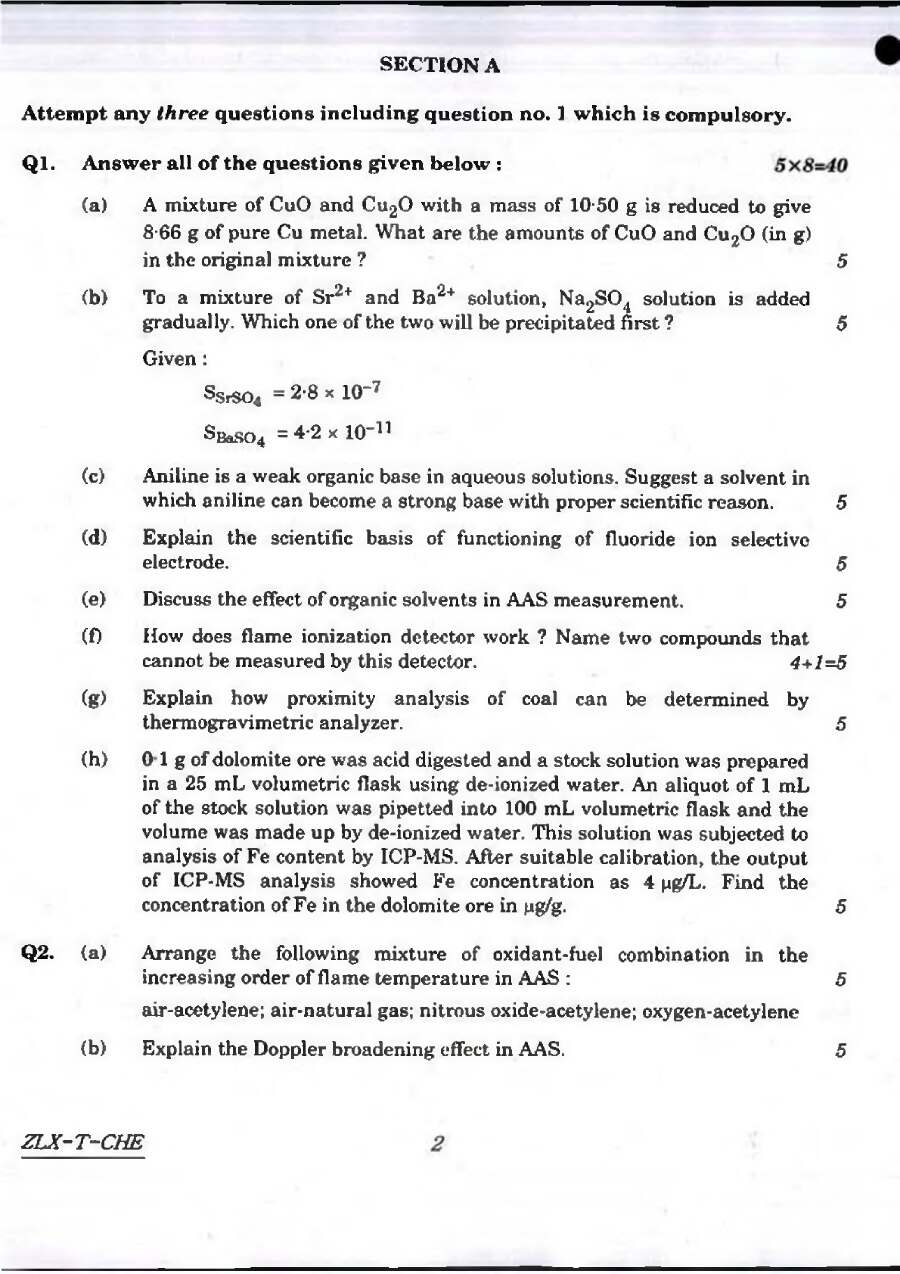
Section A
Q1. Answer all of the questions given below:
(a) A mixture of CuO and Cu2O with a mass of 10.50 g is reduced to give 8.66 g of pure Cu metal. What are the amounts of CuO and Cu2O (in g) in the original mixture?
(b)
To a mixture of Sr2+ and Ba2+ solution, Na2SO4 solution is added gradually. Which one of the two will be precipitated first?
Given:
SSrSO4 = 2.8 × 10⁻⁷
SBaSO4 = 4.2 × 10⁻¹¹
(c) Aniline is a weak organic base in aqueous solutions. Suggest a solvent in which aniline can become a strong base with proper scientific reason.
(d) Explain the scientific basis of functioning of fluoride ion selective electrode.
(e) Discuss the effect of organic solvents in AAS measurement.
(f) How does flame ionization detector work ? Name two compounds that cannot be measured by this detector.
(g) Explain how proximity analysis of coal can be determined by thermogravimetric analyzer.
(h) 0.1 g of dolomite ore was acid digested and a stock solution was prepared in a 25 mL volumetric flask using de-ionized water. An aliquot of 1 mL of the stock solution was pipetted into 100 mL volumetric flask and the volume was made up by de-ionized water. This solution was subjected to analysis of Fe content by ICP-MS. After suitable calibration, the output of ICP-MS analysis showed Fe concentration as 4 µg/L. Find the concentration of Fe in the dolomite ore in µg/g.