Combined Geo-Scientist 2019 Geo-Physics Paper III Question Paper PDF

Central Government Jobs Other Jobs 2019

  • Year 2019
  • Conducted By UPSC
  • Questions 10
  • Maximum Marks 200
  • Duration Three Hours
  • Languages English

Exam Details

Detail Information
Examination Combined Geo-Scientist & Geologist Examination
Year 2019
Conducting Body UPSC
Paper GEO-PHYSICS PAPER-III
Subject Geo-Physics
Duration Three Hours
Maximum Marks 200
Number of Questions 10
Question Type Descriptive / Subjective

This is the official question paper for the Combined Geo-Scientist & Geologist Examination 2019, specifically Paper III focusing on Geo-Physics. Conducted by UPSC, this paper carries a maximum of 200 marks and allows a duration of three hours for completion. It is designed to assess candidates' in-depth knowledge and analytical skills in Geo-Physics. Aspirants can use this paper to understand the exam's structure, question complexity, and the types of topics covered, aiding in their preparation strategy for this competitive examination.

Major Topics Covered

  • Radioactive decay
  • Gamma-ray radiation
  • Neutron flux
  • Reflection and transmission coefficients
  • Crustal model
  • Gravity anomaly
  • Heat flow
  • Subducting plate boundary
  • Dirac delta function
  • Testing function
  • Inverse z-transform
  • Path length
  • Path radiance
  • Remote sensing sensors
  • IRS-1A
  • Gamma-ray spectrometer
  • Aeromagnetic survey
  • Geomagnetic elements
  • Region of convergence
  • z-transform
  • Seismic system
  • Sediment layers
  • Ocean floor spreading
  • Sedimentation rate

Why This Paper is Important

  • Useful for Combined Geo-Scientist & Geologist Exami preparation
  • Helps understand the latest exam pattern
  • Useful for practice and self-assessment
  • Covers frequently asked General Studies topics
  • Helpful for analysing question trends

Related Resources

  • Combined Geo-Scientist & Geologist Examination 2019 - Paper I
  • Combined Geo-Scientist & Geologist Examination 2019 - Paper II
  • Combined Geo-Scientist & Geologist Examination 2018 - Geo-Physics Paper III
  • Combined Geo-Scientist & Geologist Examination 2019 Geo-Physics Paper III Answer Key
  • Combined Geo-Scientist & Geologist Examination Geo-Physics Syllabus
  • UPSC Geo-Scientist Exam Pattern
  • Combined Geo-Scientist & Geologist Examination Pattern
  • UPSC Exam Pattern for Geo-Scientist

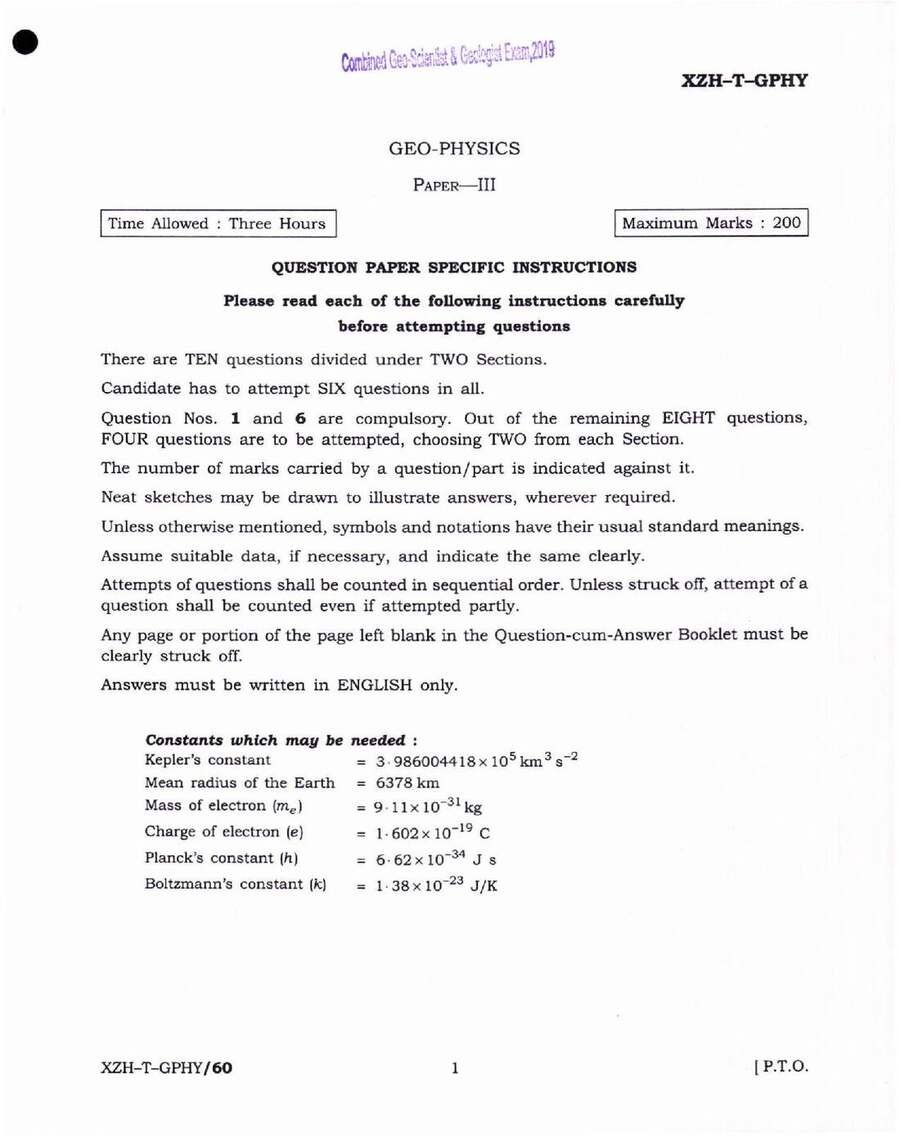
Instructions

  • There are TEN questions divided under TWO Sections.
  • Candidate has to attempt SIX questions in all.
  • Out of the remaining EIGHT questions, FOUR questions are to be attempted, choosing TWO from each Section.
  • The number of marks carried by a question/part is indicated against it.
  • Neat sketches may be drawn to illustrate answers, wherever required.
  • Unless otherwise mentioned, symbols and notations have their usual standard meanings.
  • Assume suitable data, if necessary, and indicate the same clearly.
  • Attempts of questions shall be counted in sequential order.
  • Unless struck off, attempt of a question shall be counted even if attempted partly.
  • Any page or portion of the page left blank in the Question-cum-Answer Booklet must be clearly struck off.
  • Answers must be written in ENGLISH only.

Questions (page 2)

Section A

Q1.

(a) State the process of radioactive decay on geologic source of gamma-ray radiation.

(b) Discuss radioactive nuclei produced by the neutron flux.

(c) Compute reflection and transmission coefficients of two-layer crustal model with the following parameters : Density of crustal layer-1 and layer-2 are 2.0 \text g/cm^3 and 2.5 \text g/cm^3, respectively. P-wave velocity in layer-1 and layer-2 are 2.5 km/s and 4.0 \text km/s, respectively.

(d) Why are free-air gravity anomaly and heat flow across a subducting plate boundary generally found to be low followed by high? Explain it using labelled diagram.

(e) What do you understand by Dirac delta function? Explain it in terms of testing function.

(f) Describe inverse z-transform. Derive the expressions for inverse z-transform using different methods.

(g) What do you understand by path length and path radiance? Explain path radiance in the light of total radiance reaching the sensor.

(h) What are the factors affecting designing of a sensor in remote sensing? Describe various sensors available in IRS-1A.

(i) Discuss the principle of three-channel gamma-ray spectrometer.
Section A

Q2.

(a) (i) Discuss the principle of three-channel gamma-ray spectrometer.
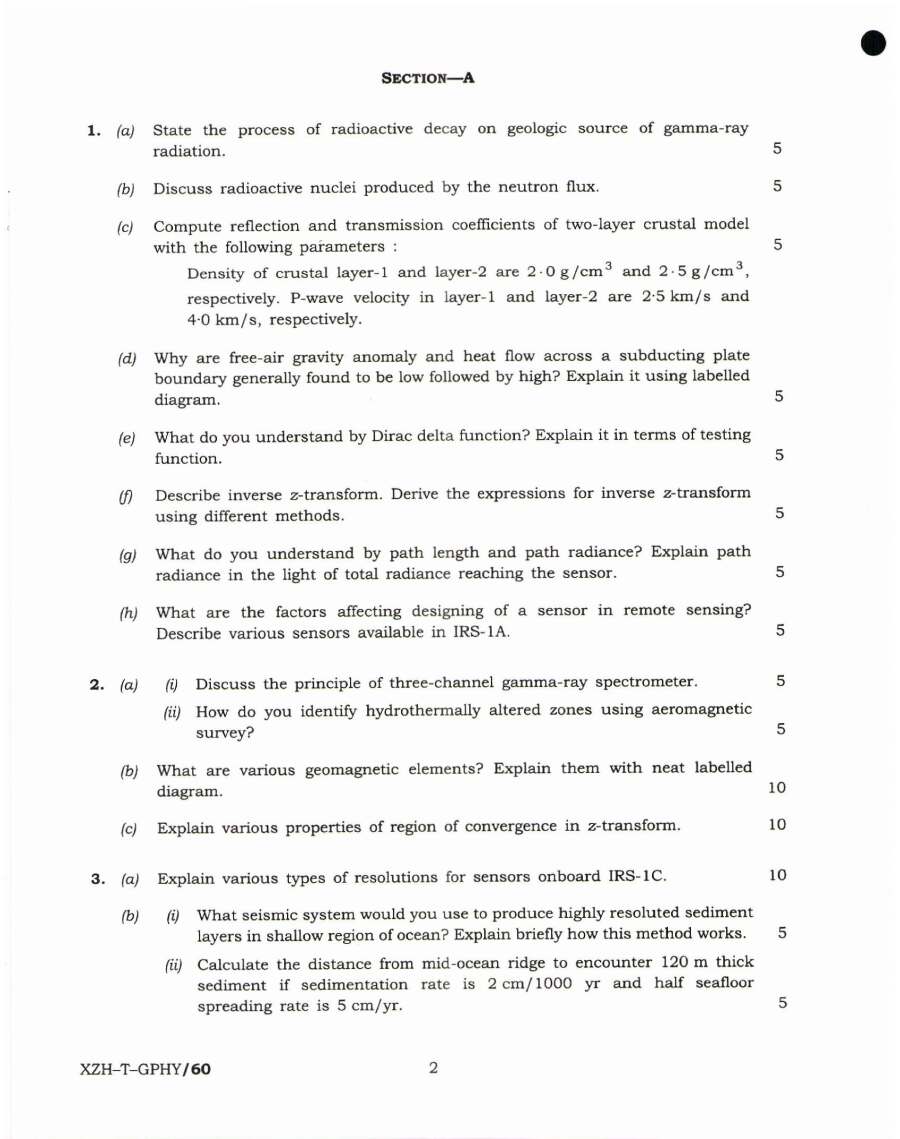
(ii) How do you identify hydrothermally altered zones using aeromagnetic survey?

(b) What are various geomagnetic elements? Explain them with neat labelled diagram.

(c) Explain various properties of region of convergence in z-transform.

Section A

Q3.

(a) (i) What seismic system would you use to produce highly resoluted sediment layers in shallow region of ocean? Explain briefly how this method works.

(b) (ii) Calculate the distance from mid-ocean ridge to encounter 120 m thick sediment if sedimentation rate is 2 cm/1000 yr and half seafloor spreading rate is 5 \text cm/yr.

Question paper preview

Scanned pages 1–2 for reference. Download the official PDF for the full paper.

Page 1
Combined Geo-Scientist & Geologist Examination 2019 Geo-Physics Paper III question paper page 1 scan, featuring exam header and instructions. UPSC exam PDF download.
Page 2
Combined Geo-Scientist & Geologist Examination 2019 Geo-Physics Paper III question paper page 1 scan, featuring exam header and instructions. UPSC exam PDF download.

Free question paper download

Download question paper PDF

  • 1.8 MB
  • 6 pages
  • PDF format

Frequently asked questions

What is the name of the examination?

The examination is the Combined Geo-Scientist & Geologist Examination.

Which year is this question paper from?

This question paper is from the year 2019.

Who conducts the Combined Geo-Scientist & Geologist Examination?

The examination is conducted by UPSC (Union Public Service Commission).

What is the subject of Paper III?

Paper III is specifically for Geo-Physics.

What is the maximum marks for this paper?

The maximum marks for Geo-Physics Paper-III is 200.

What is the time duration allowed for this paper?

The time allowed for this paper is Three Hours.

← Back to Other Jobs papers