Combined Geo-Scientist 2019 Hydrogeology Question Paper PDF

Central Government Jobs Other Jobs 2019

  • Year 2019
  • Conducted By UPSC
  • Maximum Marks 200
  • Duration Three Hours
  • Languages English

Exam Details

Detail Information
Examination Combined Geo-Scientist & Geologist Examination
Year 2019
Conducting Body UPSC
Paper Hydrogeology
Subject Hydrogeology
Duration Three Hours
Maximum Marks 200
Question Type Descriptive / Subjective

This document contains the question paper for the Hydrogeology subject of the Combined Geo-Scientist & Geologist Examination held in 2019, conducted by UPSC. The paper is designed to assess candidates' understanding of hydrogeological principles and applications. It allows a total of three hours to complete and is worth a maximum of 200 marks. The exam structure includes compulsory sections and optional choices, requiring candidates to demonstrate in-depth knowledge through descriptive answers and calculations. This paper is a valuable resource for aspirants preparing for the Geo-Scientist and Geologist exams.

Major Topics Covered

  • Groundwater Hardness
  • Darcy's Law
  • Transmissivity
  • Storage Coefficient
  • Piper Diagram
  • Lineament-based Exploration
  • Perennial Yield
  • Runoff Hydrographs
  • Diurnal Fluctuations
  • Water Table
  • Specific Yield
  • Specific Retention
  • Porosity
  • Aquifer
  • Hydrostatic Equilibrium
  • Coastal Areas
  • Saltwater Intrusion
  • Aquifer Contamination
  • Pump Test
  • Jacob's Method

Why This Paper is Important

  • Useful for Combined Geo-Scientist & Geologist Exami preparation
  • Helps understand the latest exam pattern
  • Useful for practice and self-assessment
  • Covers frequently asked General Studies topics
  • Helpful for analysing question trends

Related Resources

  • Combined Geo-Scientist & Geologist Examination 2019 - Geology Paper I
  • Combined Geo-Scientist & Geologist Examination 2019 - Geology Paper II
  • Combined Geo-Scientist & Geologist Examination 2019 - Civil Engineering Paper I
  • Combined Geo-Scientist & Geologist Examination 2019 - Civil Engineering Paper II
  • Combined Geo-Scientist & Geologist Examination 2019 Hydrogeology Answer Key
  • Combined Geo-Scientist & Geologist Examination Syllabus
  • Hydrogeology Syllabus for UPSC Exams
  • Combined Geo-Scientist & Geologist Examination Pattern

Instructions

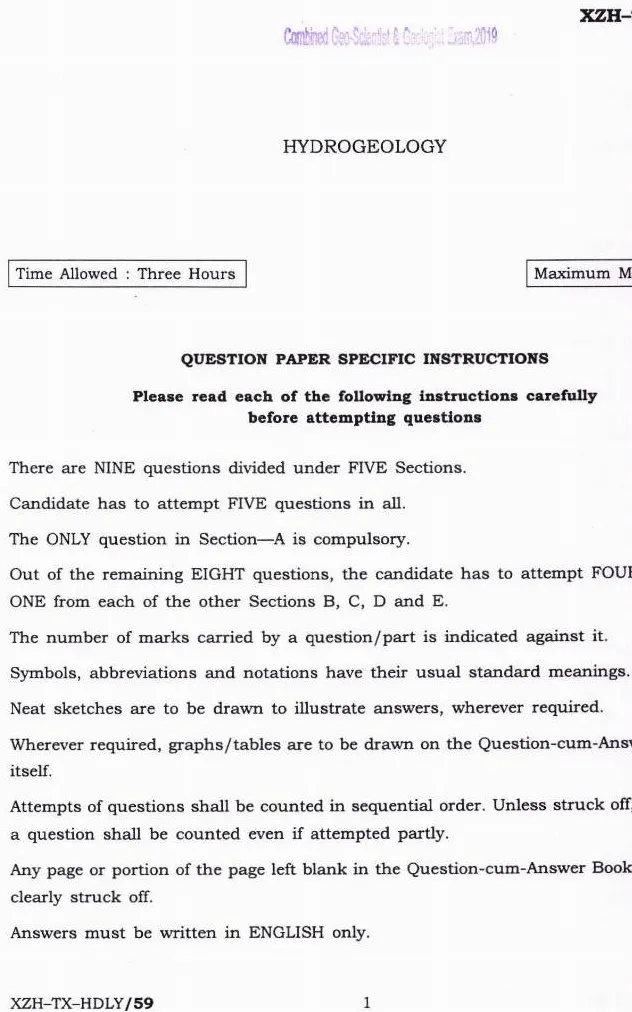
  • There are NINE questions divided under FIVE Sections.
  • Candidate has to attempt FIVE questions in all.
  • The ONLY question in Section—A is compulsory.
  • Out of the remaining EIGHT questions, the candidate has to attempt FOUR, choosing ONE from each of the other Sections B, C, D and E.
  • The number of marks carried by a question/part is indicated against it.
  • Symbols, abbreviations and notations have their usual standard meanings.
  • Neat sketches are to be drawn to illustrate answers, wherever required.
  • Wherever required, graphs/tables are to be drawn on the Question-cum-Answer Booklet itself.
  • Attempts of questions shall be counted in sequential order.
  • Unless struck off, attempt of a question shall be counted even if attempted partly.
  • Any page or portion of the page left blank in the Question-cum-Answer Booklet must be clearly struck off.
  • Answers must be written in ENGLISH only.

Questions (page 2)

Section A

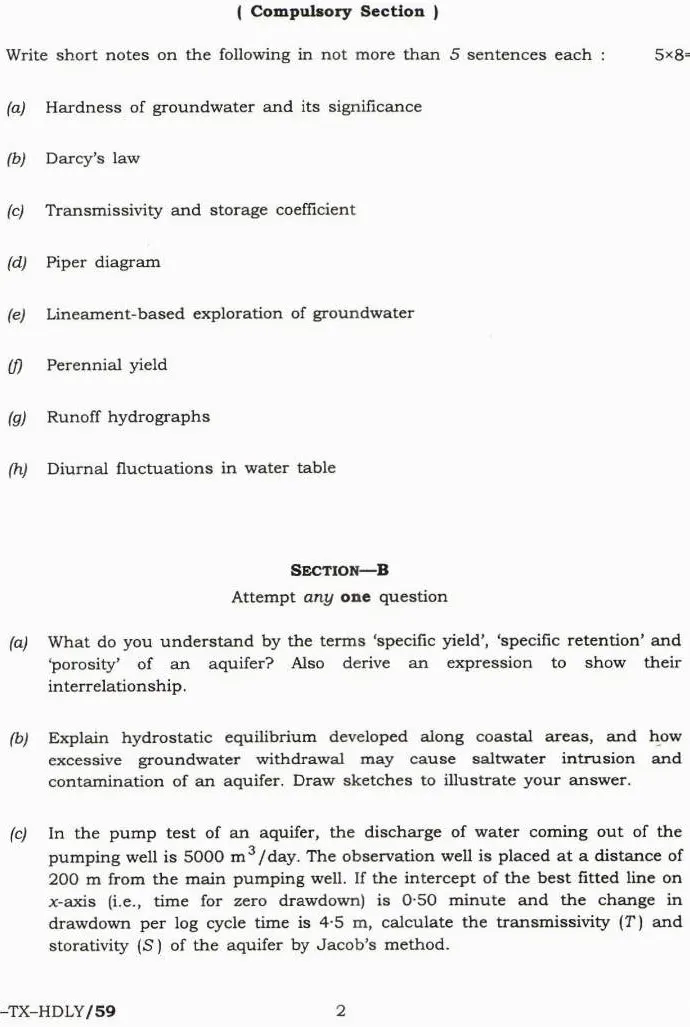
Q1. Write short notes on the following in not more than 5 sentences each :

(a) Hardness of groundwater and its significance

(b) Darcy's law

(c) Transmissivity and storage coefficient

(d) Piper diagram

(e) Lineament-based exploration of groundwater

(f) Perennial yield

(g) Runoff hydrographs

(h) Diurnal fluctuations in water table
Section B

Q2.

(a) What do you understand by the terms 'specific yield', 'specific retention' and 'porosity' of an aquifer? Also derive an expression to show their interrelationship.

(b) Explain hydrostatic equilibrium developed along coastal areas, and how excessive groundwater withdrawal may cause saltwater intrusion and contamination of an aquifer. Draw sketches to illustrate your answer.

(c) In the pump test of an aquifer, the discharge of water coming out of the pumping well is 5000 m3/day. The observation well is placed at a distance of 200 m from the main pumping well. If the intercept of the best fitted line on x-axis (i.e., time for zero drawdown) is 0.50 minute and the change in drawdown per log cycle time is 4.5 m, calculate the transmissivity (T) and storativity (S) of the aquifer by Jacob's method.

Question paper preview

Scanned pages 1–2 for reference. Download the official PDF for the full paper.

Page 1
Combined Geo-Scientist & Geologist 2019 Hydrogeology question paper page 1 instructions scan PDF download
Page 2
Combined Geo-Scientist & Geologist 2019 Hydrogeology question paper page 1 instructions scan PDF download

Free question paper download

Download question paper PDF

  • 1.1 MB
  • 4 pages
  • PDF format

Frequently asked questions

What is the name of the examination?

The examination is the Combined Geo-Scientist & Geologist Examination.

Which year is this question paper from?

This question paper is from the year 2019.

Who conducts the Combined Geo-Scientist & Geologist Examination?

The examination is conducted by UPSC (Union Public Service Commission).

What is the subject of this question paper?

The subject of this question paper is Hydrogeology.

What is the maximum marks for the Hydrogeology paper?

The maximum marks for the Hydrogeology paper is 200.

What is the time duration allowed for the exam?

The time allowed for the exam is Three Hours.

← Back to Other Jobs papers