UPSC Civil Services Main 2019 Geology Paper II PDF

Central Government Jobs Other Jobs 2019

  • Year 2019
  • Conducted By UPSC
  • Questions 8
  • Maximum Marks 250
  • Duration Three Hours
  • Languages Hindi & English

Exam Details

Detail Information
Examination Civil Services Main Examination
Year 2019
Conducting Body UPSC
Paper Geology Paper - II
Subject Geology
Duration Three Hours
Maximum Marks 250
Number of Questions 8
Question Type Mixed

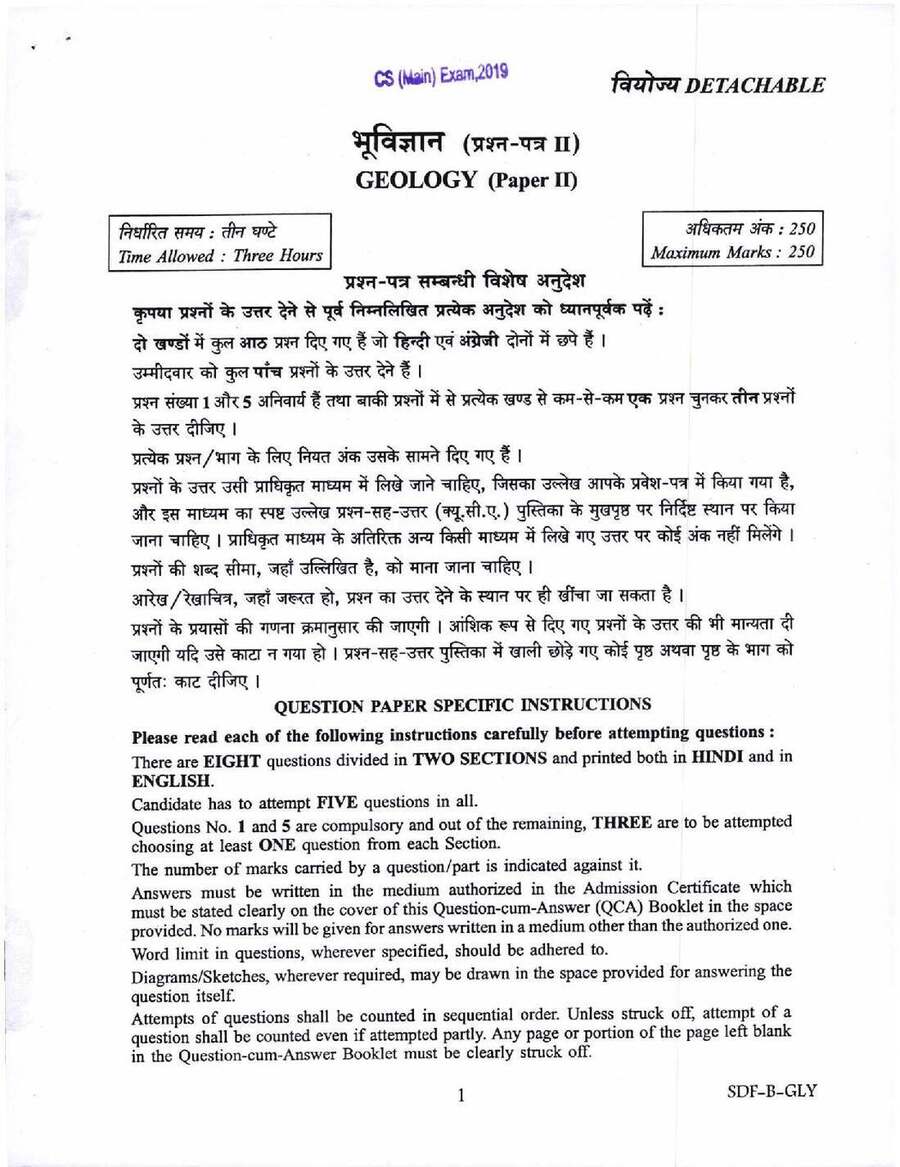
This is the Geology Paper II for the UPSC Civil Services Main Examination held in 2019. The paper carries a maximum of 250 marks and is allotted a time of three hours. It consists of eight questions divided into two sections, with compulsory questions and a requirement to choose at least one from each section. Aspirants must answer a total of five questions. This paper is crucial for candidates specializing in Geology for the Civil Services exam, providing insights into the types of questions asked and the depth of knowledge required.

Major Topics Covered

  • Miller Indices
  • Hermann Maugin notation
  • Crystal faces
  • Porphyritic texture
  • Vitrophyric texture
  • Petrogenesis
  • Partial melting
  • Magma generation
  • Thermodynamic phase rule
  • Degree of freedom
  • ACF diagram
  • Ripple marks
  • Geological significance
  • Interference figure
  • Uniaxial minerals
  • Optic axis
  • Pyroxene group
  • Hypersthene
  • Projection diagram
  • Tetragonal system
  • Binary eutectic
  • Diopside-Anorthite system
  • Crystallization
  • Basaltic magma

Why This Paper is Important

  • Useful for Civil Services Main Examination preparation
  • Helps understand the latest exam pattern
  • Useful for practice and self-assessment
  • Covers frequently asked General Studies topics
  • Helpful for analysing question trends

Related Resources

  • UPSC Civil Services Main Examination 2018 Geology Paper II
  • UPSC Civil Services Main Examination 2020 Geology Paper II
  • UPSC Civil Services Main Examination 2019 Geology Paper I
  • UPSC Civil Services Main 2019 Geology Paper II Answer Key
  • Civil Services Main 2019 Geology Paper II Solutions
  • UPSC Civil Services Main Syllabus Geology
  • Geology Optional Subject Syllabus UPSC
  • UPSC Civil Services Main Exam Pattern

Instructions

  • पुस्तिका के मुखपृष्ठ पर निर्दिष्ट स्थान पर किया जाना चाहिए।
  • प्राधिकृत माध्यम के अतिरिक्त अन्य किसी माध्यम में लिखे गए उत्तर पर कोई अंक नहीं मिलेंगे।
  • प्रश्नों की शब्द सीमा, जहाँ उल्लिखित है, को माना जाना चाहिए ।
  • आरेख/रेखाचित्र, जहाँ जरूरत हो, प्रश्न का उत्तर देने के स्थान पर ही खींचा जा सकता है।
  • प्रश्नों के प्रयासों की गणना क्रमानुसार की जाएगी।
  • आंशिक रूप से दिए गए प्रश्नों के उत्तर की भी मान्यता दी जाएगी यदि उसे काटा न गया हो ।
  • प्रश्न-सह-उत्तर पुस्तिका में खाली छोड़े गए कोई पृष्ठ अथवा पृष्ठ के भाग को पूर्णतः काट दीजिए ।

  • There are EIGHT questions divided in TWO SECTIONS and printed both in HINDI and in ENGLISH.
  • Candidate has to attempt FIVE questions in all.
  • Questions No. 1 and 5 are compulsory and out of the remaining, THREE are to be attempted choosing at least ONE question from each Section.
  • The number of marks carried by a question/part is indicated against it.
  • Answers must be written in the medium authorized in the Admission Certificate which must be stated clearly on the cover of this Question-cum-Answer (QCA) Booklet in the space provided.
  • No marks will be given for answers written in a medium other than the authorized one.
  • Word limit in questions, wherever specified, should be adhered to.
  • Diagrams/Sketches, wherever required, may be drawn in the space provided for answering the question itself.
  • Attempts of questions shall be counted in sequential order.
  • Unless struck off, attempt of a question shall be counted even if attempted partly.
  • Any page or portion of the page left blank in the Question-cum-Answer Booklet must be clearly struck off.

Questions (page 2)

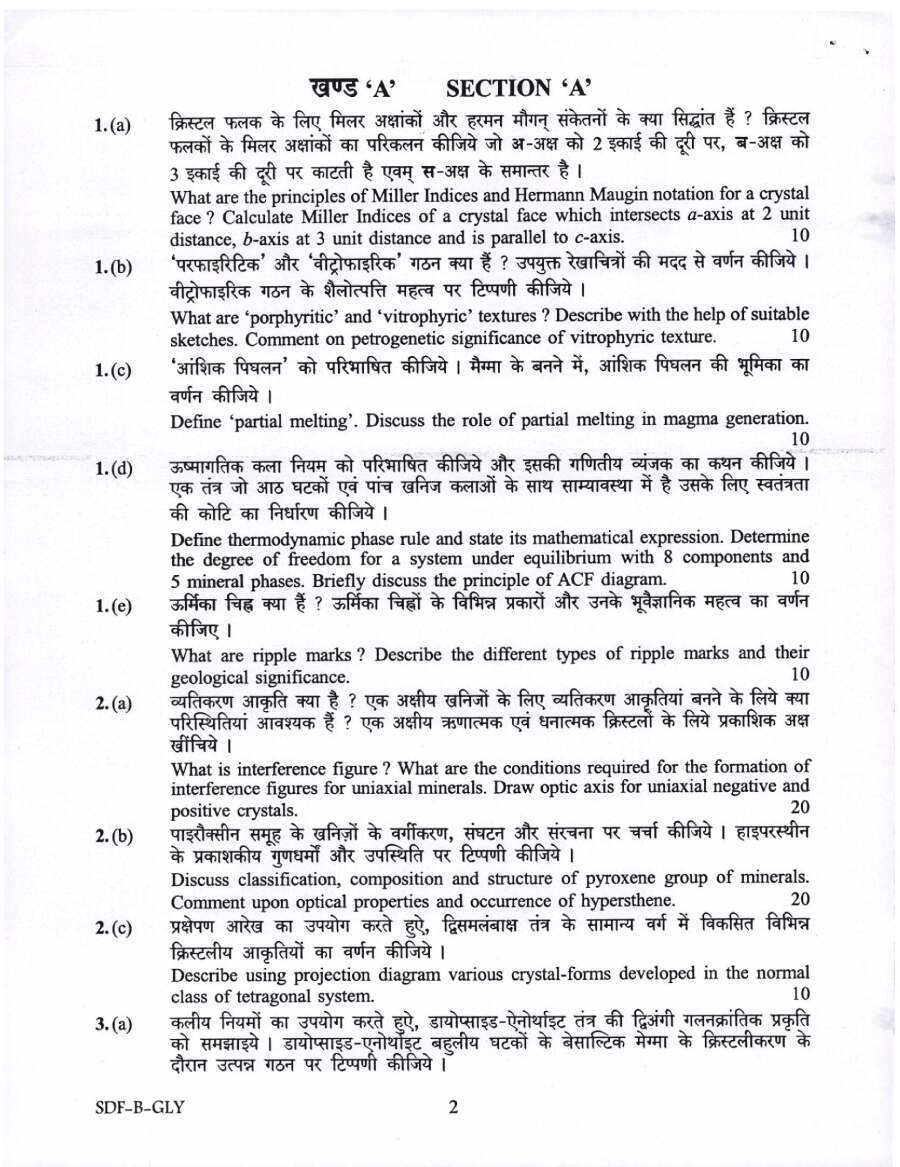
Section A

Q1.

(a) क्रिस्टल फलक के लिए मिलर अक्षांकों और हरमन मौगन् संकेतनों के क्या सिद्धांत हैं ? क्रिस्टल
फलकों के मिलर अक्षांकों का परिकलन कीजिये जो अ-अक्ष को 2 इकाई की दूरी पर, ब-अक्ष को 3 इकाई की दूरी पर काटती है एवम् स-अक्ष के समान्तर है।
What are the principles of Miller Indices and Hermann Maugin notation for a crystal face ? Calculate Miller Indices of a crystal face which intersects a-axis at 2 unit distance, b-axis at 3 unit distance and is parallel to c-axis.

(b) ‘परफाइरिटिक’ और ‘वीट्रोफाइरिक’ गठन क्या हैं ? उपयुक्त रेखाचित्रों की मदद से वर्णन कीजिये ।
वीटोफाइरिक गठन के शैलोत्पत्ति महत्व पर टिप्पणी कीजिये।
What are 'porphyritic' and 'vitrophyric' textures ? Describe with the help of suitable sketches. Comment on petrogenetic significance of vitrophyric texture.

(c) ‘आंशिक पिघलन’ को परिभाषित कीजिये । मैग्मा के बनने में, आंशिक पिघलन की भूमिका का
वर्णन कीजिये ।
Define 'partial melting'. Discuss the role of partial melting in magma generation.

(d) ऊष्मागतिक कला नियम को परिभाषित कीजिये और इसकी गणितीय व्यंजक का कथन कीजिये ।
एक तंत्र जो आठ घटकों एवं पांच खनिज कलाओं के साथ साम्यावस्था में है उसके लिए स्वतंत्रता की कोटि का निर्धारण कीजिये ।
Define thermodynamic phase rule and state its mathematical expression. Determine the degree of freedom for a system under equilibrium with 8 components and 5 mineral phases. Briefly discuss the principle of ACF diagram.

(e) ऊर्मिका चिह्न क्या हैं ? ऊर्मिका चिह्नों के विभिन्न प्रकारों और उनके भूवैज्ञानिक महत्व का वर्णन
कीजिये ।
What are ripple marks? Describe the different types of ripple marks and their geological significance.
Section A

Q2.

(a) व्यतिकरण आकृति क्या है ? एक अक्षीय खनिजों के लिए व्यतिकरण आकृतियां बनने के लिये क्या
परिस्थितियां आवश्यक हैं ? एक अक्षीय ऋणात्मक एवं धनात्मक क्रिस्टलों के लिये प्रकाशिक अक्ष
खीचिये ।
What is interference figure? What are the conditions required for the formation of interference figures for uniaxial minerals. Draw optic axis for uniaxial negative and positive crystals.

(b) पाइरौक्सीन समूह के खनिज़ों के वर्गीकरण, संघटन और संरचना पर चर्चा कीजिये। हाइपरस्थीन
के प्रकाशकीय गुणधर्मों और उपस्थिति पर टिप्पणी कीजिये।
Discuss classification, composition and structure of pyroxene group of minerals. Comment upon optical properties and occurrence of hypersthene.

(c) प्रक्षेपण आरेख का उपयोग करते हुए, द्विसमलंबाक्ष तंत्र के सामान्य वर्ग में विकसित विभिन्न
क्रिस्टलीय आकृतियों का वर्णन कीजिये ।
Describe using projection diagram various crystal-forms developed in the normal class of tetragonal system.

Section A

Q3.

(a) क्लीय नियमों का उपयोग करते हुए, डायोप्साइड-ऐनोर्थाइट तंत्र की द्विअंगी गलनक्रांतिक प्रकृति
को समझाइये । डायोप्साइड-एनोर्थोइट बहुलीय घटकों के बेसाल्टिक मेंग्मा के क्रिस्टलीकरण के
दौरान उत्पन्न गठन पर टिप्पणी कीजिये ।
Explain using projection diagram various crystal-forms developed in the normal class of tetragonal system. Comment upon the formation of basaltic magma with multi-component diopside-anorthite.

Question paper preview

Scanned pages 1–2 for reference. Download the official PDF for the full paper.

Page 1
UPSC Civil Services Main 2019 Geology Paper II question paper page 1 instructions scan PDF download
Page 2
UPSC Civil Services Main 2019 Geology Paper II question paper page 1 instructions scan PDF download

Free question paper download

Download question paper PDF

  • 1.8 MB
  • 4 pages
  • PDF format

Frequently asked questions

What is the name of the exam?

The exam is the Civil Services Main Examination.

Which paper is this question set for?

This is for Geology Paper - II.

What is the conducting body?

The conducting body is UPSC (Union Public Service Commission).

In which year was this exam conducted?

This exam was conducted in 2019.

What is the maximum marks for Geology Paper - II?

The maximum marks for Geology Paper - II is 250.

What is the time allowed for this paper?

The time allowed for this paper is Three Hours.

← Back to Other Jobs papers