UPSC Civil Services Main 2019 Economics Paper II PDF

Central Government Jobs Other Jobs 2019

  • Year 2019
  • Conducted By UPSC
  • Questions 8
  • Maximum Marks 250
  • Duration Three Hours
  • Languages English & Hindi

Exam Details

Detail Information
Examination Civil Services Main Examination
Year 2019
Conducting Body UPSC
Paper Economics Paper - II
Subject Economics
Duration Three Hours
Maximum Marks 250
Number of Questions 8
Question Type Descriptive / Subjective

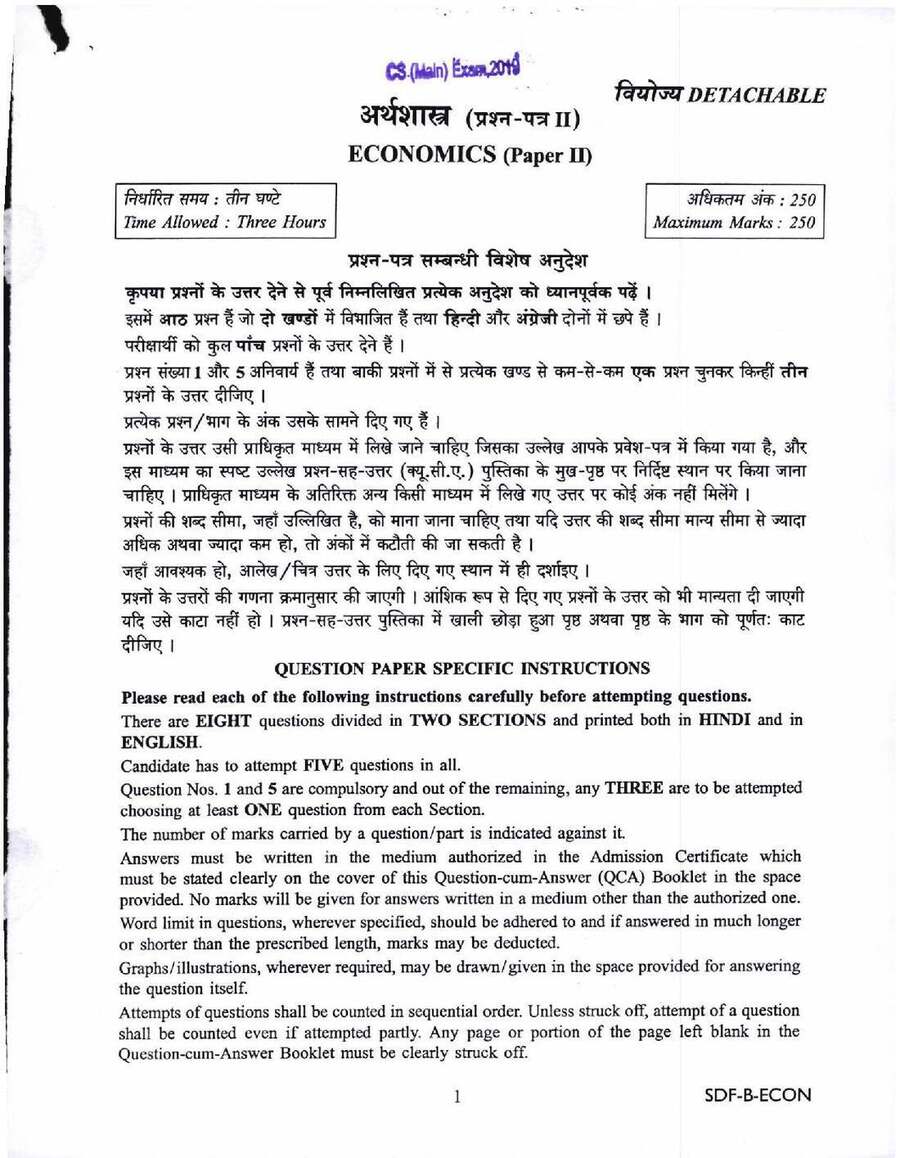
This is the Economics Paper II for the UPSC Civil Services Main Examination held in 2019. The paper, conducted by UPSC, has a maximum mark of 250 and a time duration of three hours. It consists of eight descriptive questions divided into two sections, with questions 1 and 5 being compulsory. Aspirants must attempt a total of five questions, selecting at least one from each section. The paper covers critical economic topics relevant to India's development, including agriculture, industrialization, economic policies, and historical economic trends during the British period. This question paper is a valuable resource for candidates preparing for the Civil Services Main Examination.

Major Topics Covered

  • Indian Agriculture
  • Commercialization of Agriculture
  • Indian Railways
  • Industrialisation
  • Five Year Plans
  • Mahalanobis Model
  • C. N. Vakil
  • Post-liberalisation Economy
  • Agricultural Prices
  • Farmers' Distress
  • Competition Act, 2002
  • MRTP Act
  • Cotton Textile Industry
  • Deindustrialisation
  • Economic Drain Theory
  • Tenancy Reforms
  • Revenue Reforms
  • Green Revolution
  • Land Reforms

Why This Paper is Important

  • Useful for Civil Services Main Examination preparation
  • Helps understand the latest exam pattern
  • Useful for practice and self-assessment
  • Covers frequently asked General Studies topics
  • Helpful for analysing question trends

Related Resources

  • UPSC Civil Services Main Examination 2019 Economics Paper I
  • UPSC Civil Services Main Examination 2018 Economics Paper II
  • UPSC Civil Services Main Examination 2020 Economics Paper II
  • UPSC Civil Services Main 2019 Economics Paper II Answer Key
  • UPSC Civil Services Main Examination Economics Syllabus
  • Indian Economy Syllabus for UPSC Mains
  • UPSC Civil Services Main Examination Pattern
  • UPSC Mains Exam Structure

Instructions

  • पुस्तिका के मुख-पृष्ठ पर निर्दिष्ट स्थान पर किया जाना चाहिए।
  • प्राधिकृत माध्यम के अतिरिक्त अन्य किसी माध्यम में लिखे गए उत्तर पर कोई अंक नहीं मिलेंगे।
  • प्रश्नों की शब्द सीमा, जहाँ उल्लिखित है, को माना जाना चाहिए तथा यदि उत्तर की शब्द सीमा मान्य सीमा से ज्यादा अधिक अथवा ज्यादा कम हो, तो अंकों में कटौती की जा सकती है ।
  • जहाँ आवश्यक हो, आलेख /चित्र उत्तर के लिए दिए गए स्थान में ही दर्शाइए ।
  • प्रश्नों के उत्तरों की गणना क्रमानुसार की जाएगी ।
  • आंशिक रूप से दिए गए प्रश्नों के उत्तर को भी मान्यता दी जाएगी यदि उसे काटा नहीं हो ।
  • प्रश्न-सह-उत्तर पुस्तिका में खाली छोड़ा हुआ पृष्ठ अथवा पृष्ठ के भाग को पूर्णत: काट दीजिए ।

  • There are EIGHT questions divided in TWO SECTIONS and printed both in HINDI and in ENGLISH.
  • Candidate has to attempt FIVE questions in all.
  • Question Nos. 1 and 5 are compulsory and out of the remaining, any THREE are to be attempted choosing at least ONE question from each Section.
  • The number of marks carried by a question/part is indicated against it.
  • Answers must be written in the medium authorized in the Admission Certificate which must be stated clearly on the cover of this Question-cum-Answer (QCA) Booklet in the space provided.
  • No marks will be given for answers written in a medium other than the authorized one.
  • Word limit in questions, wherever specified, should be adhered to and if answered in much longer or shorter than the prescribed length, marks may be deducted.
  • Graphs/illustrations, wherever required, may be drawn/given in the space provided for answering the question itself.
  • Attempts of questions shall be counted in sequential order.
  • Unless struck off, attempt of a question shall be counted even if attempted partly.
  • Any page or portion of the page left blank in the Question-cum-Answer Booklet must be clearly struck off.

Questions (page 2)

Section A

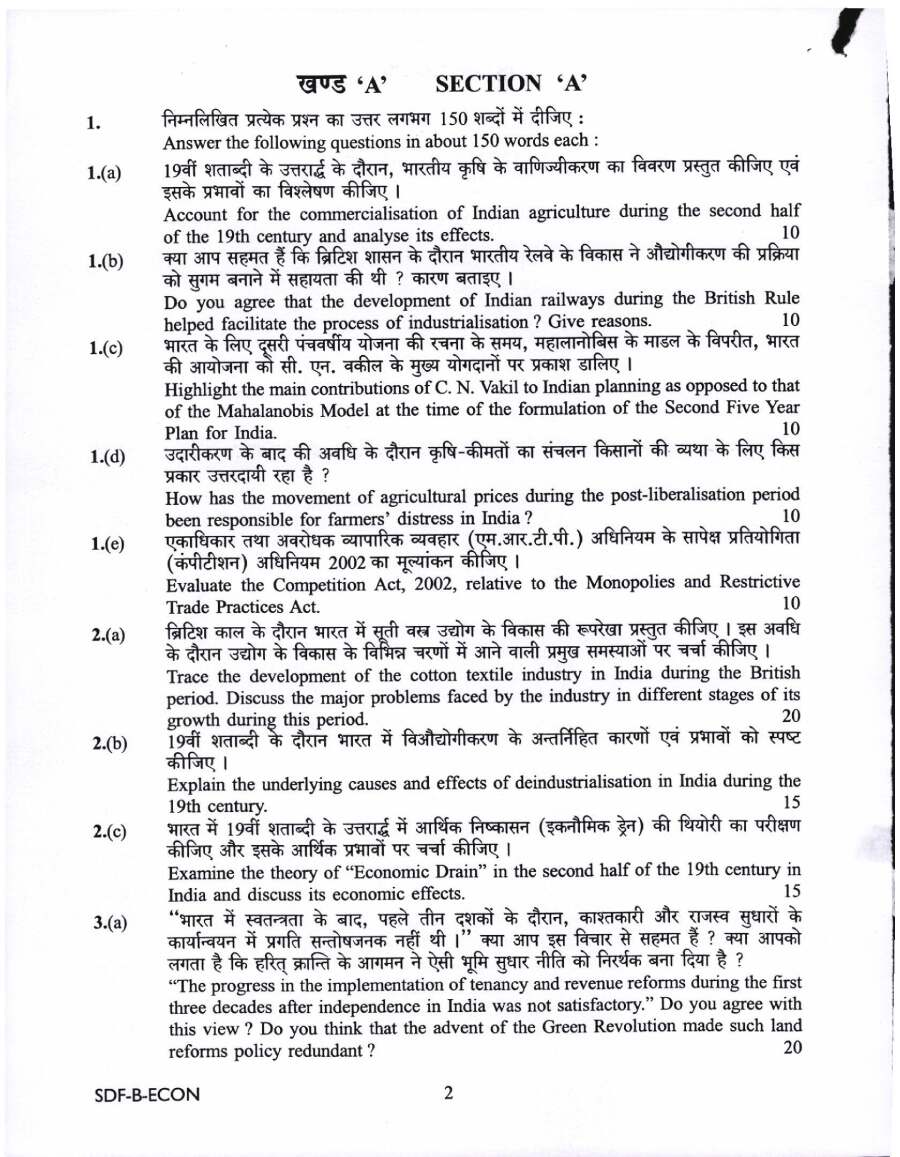
Q1. निम्नलिखित प्रत्येक प्रश्न का उत्तर लगभग 150 शब्दों में दीजिए:
Answer the following questions in about 150 words each :

(a) 19वीं शताब्दी के उत्तरार्द्ध के दौरान, भारतीय कृषि के वाणिज्यीकरण का विवरण प्रस्तुत कीजिए एवं इसके प्रभावों का विश्लेषण कीजिए ।
Account for the commercialisation of Indian agriculture during the second half of the 19th century and analyse its effects.

(b) क्या आप सहमत हैं कि ब्रिटिश शासन के दौरान भारतीय रेलवे के विकास ने औद्योगीकरण की प्रक्रिया को सुगम बनाने में सहायता की थी ? कारण बताइए।
Do you agree that the development of Indian railways during the British Rule helped facilitate the process of industrialisation? Give reasons.

(c) भारत के लिए दूसरी पंचवर्षीय योजना की रचना के समय, महालानोबिस के माडल के विपरीत, भारत की आयोजना को सी. एन. वकील के मुख्य योगदानों पर प्रकाश डालिए ।
Highlight the main contributions of C. N. Vakil to Indian planning as opposed to that of the Mahalanobis Model at the time of the formulation of the Second Five Year Plan for India.

(d) उदारीकरण के बाद की अवधि के दौरान कृषि-कीमतों का संचलन किसानों की व्यथा के लिए किस प्रकार उत्तरदायी रहा है ?
How has the movement of agricultural prices during the post-liberalisation period been responsible for farmers' distress in India?

(e) एकाधिकार तथा अवरोधक व्यापारिक व्यवहार (एम.आर.टी.पी.) अधिनियम के सापेक्ष प्रतियोगिता (कंपीटीशन) अधिनियम 2002 का मूल्यांकन कीजिए ।
Evaluate the Competition Act, 2002, relative to the Monopolies and Restrictive Trade Practices Act.
Section A

Q2.

(a) ब्रिटिश काल के दौरान भारत में सूती वस्त्र उद्योग के विकास की रूपरेखा प्रस्तुत कीजिए। इस अवधि के दौरान उद्योग के विकास के विभिन्न चरणों में आने वाली प्रमुख समस्याओं पर चर्चा कीजिए ।
Trace the development of the cotton textile industry in India during the British period. Discuss the major problems faced by the industry in different stages of its growth during this period.

(b) 19वीं शताब्दी के दौरान भारत में विऔद्योगीकरण के अन्तर्निहित कारणों एवं प्रभावों को स्पष्ट कीजिए ।
Explain the underlying causes and effects of deindustrialisation in India during the 19th century.

(c) भारत में 19वीं शताब्दी के उत्तरार्द्ध में आर्थिक निष्कासन (इकनौमिक ड्रेन) की थियोरी का परीक्षण कीजिए और इसके आर्थिक प्रभावों पर चर्चा कीजिए।
Examine the theory of "Economic Drain" in the second half of the 19th century in India and discuss its economic effects.

Section A

Q3.

(a) “भारत में स्वतन्त्रता के बाद, पहले तीन दशकों के दौरान, काश्तकारी और राजस्व सुधारों के कार्यान्वयन् में प्रगति सन्तोषजनक नहीं थी।” क्या आप इस विचार से सहमत हैं ? क्या आपको लगता है कि हरित् क्रान्ति के आगमन ने ऐसी भूमि सुधार नीति को निरर्थक बना दिया है ?
"The progress in the implementation of tenancy and revenue reforms during the first three decades after independence in India was not satisfactory." Do you agree with this view ? Do you think that the advent of the Green Revolution made such land reforms policy redundant?

Question paper preview

Scanned pages 1–2 for reference. Download the official PDF for the full paper.

Page 1
UPSC Civil Services Main 2019 Economics Paper II question paper page 1 instructions scan PDF download
Page 2
UPSC Civil Services Main 2019 Economics Paper II question paper page 1 instructions scan PDF download

Free question paper download

Download question paper PDF

  • 1.9 MB
  • 4 pages
  • PDF format

Frequently asked questions

What is the name of the exam for which this paper was conducted?

This paper is from the Civil Services Main Examination.

Which year is this question paper from?

This question paper is from the year 2019.

Who conducts the Civil Services Main Examination?

The Civil Services Main Examination is conducted by the UPSC (Union Public Service Commission).

What is the subject of this paper?

The subject of this paper is Economics, specifically Paper II.

What is the maximum marks for this paper?

The maximum marks for Economics Paper II is 250.

What is the time allowed to complete this paper?

The time allowed for this paper is Three Hours.

← Back to Other Jobs papers