Section A
Q1.
(a)
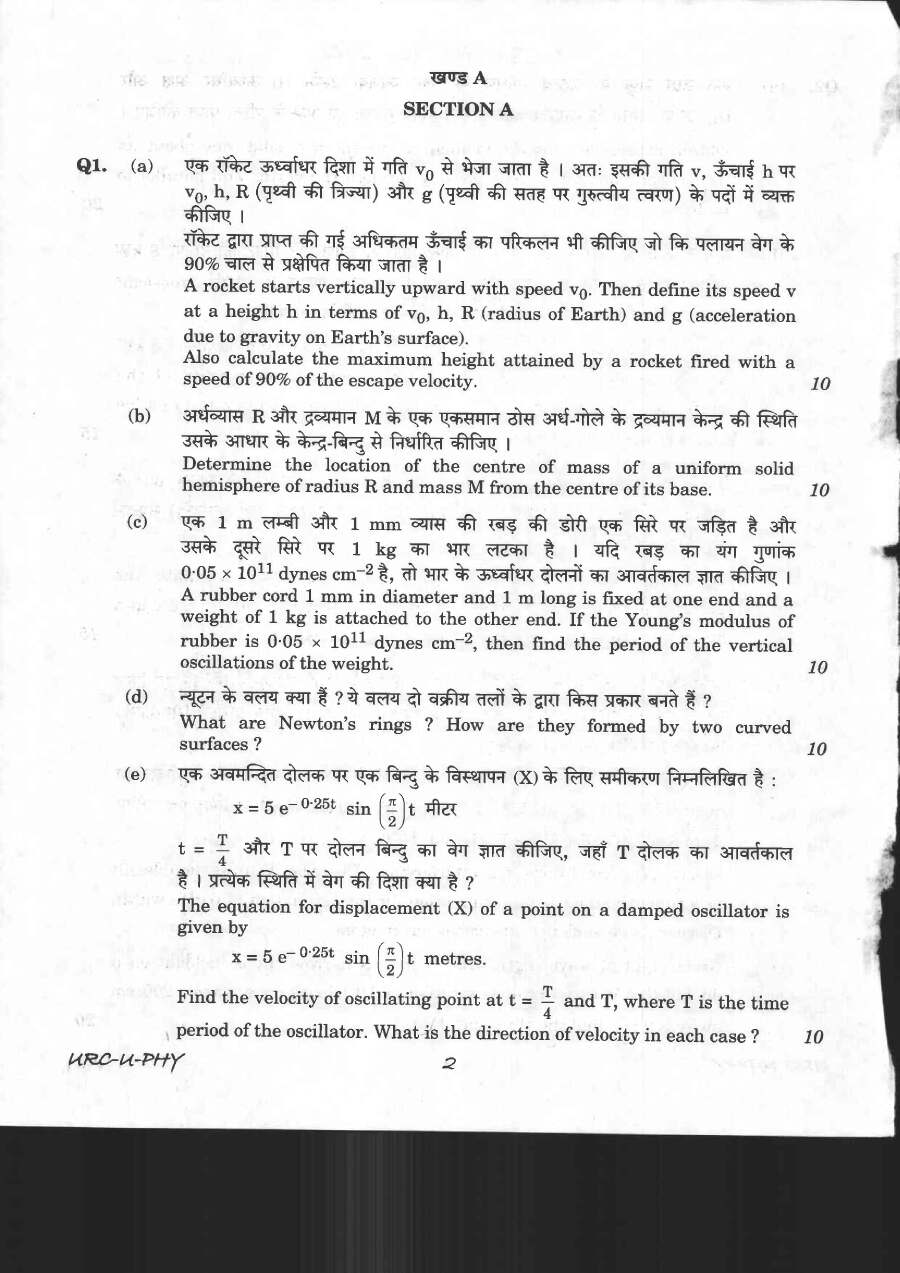
एक रॉकेट ऊर्ध्वाधर दिशा में गति v0 से भेजा जाता है । अतः इसकी गति v, ऊँचाई h पर v0, h, R (पृथ्वी की त्रिज्या) और g (पृथ्वी की सतह पर गुरुत्वीय त्वरण) के पदों में व्यक्त कीजिए । रॉकेट द्वारा प्राप्त की गई अधिकतम ऊँचाई का परिकलन भी कीजिए जो कि पलायन वेग के 90% चाल से प्रक्षेपित किया जाता है।
A rocket starts vertically upward with speed v0. Then define its speed v at a height h in terms of v0, h, R (radius of Earth) and g (acceleration due to gravity on Earth's surface). Also calculate the maximum height attained by a rocket fired with a speed of 90% of the escape velocity.
(b)
अर्धव्यास R और द्रव्यमान M के एक एकसमान ठोस अर्ध-गोले के द्रव्यमान केन्द्र की स्थिति उसके आधार के केन्द्र-बिन्दु से निर्धारित कीजिए।
Determine the location of the centre of mass of a uniform solid hemisphere of radius R and mass M from the centre of its base.
(c)
एक 1 m लम्बी और 1 mm व्यास की रबड़ की डोरी एक सिरे पर जड़ित है और उसके दूसरे सिरे पर 1 kg का भार लटका है । यदि रबड़ का यंग गुणांक 0.05 imes 10^{11} dynes cm^{-2} है, तो भार के ऊर्ध्वाधर दोलनों का आवर्तकाल ज्ञात कीजिए।
A rubber cord 1 mm in diameter and 1 m long is fixed at one end and a weight of 1 kg is attached to the other end. If the Young's modulus of rubber is 0.05 imes 10^{11} dynes cm^{-2}, then find the period of the vertical oscillations of the weight.
(d)
न्यूटन के वलय क्या हैं ? ये वलय दो वक्रीय तलों के द्वारा किस प्रकार बनते हैं ?
What are Newton's rings ? How are they formed by two curved surfaces?
(e)
एक अवमन्दित दोलक पर एक बिन्दु के विस्थापन (X) के लिए समीकरण निम्नलिखित है :
x = 5 e^{-0.25t} sin left(rac{pi}{2}
ight)t मीटर
t = rac{T}{4} और T पर दोलन बिन्दु का वेग ज्ञात कीजिए, जहाँ T दोलक का आवर्तकाल है। प्रत्येक स्थिति में वेग की दिशा क्या है ?
The equation for displacement (X) of a point on a damped oscillator is given by
x = 5 e^{-0.25t} sin left(rac{pi}{2}
ight)t metres.
Find the velocity of oscillating point at t = rac{T}{4} and T, where T is the time period of the oscillator. What is the direction of velocity in each case?