IFS Physics Paper II 2020 - Main Examination

Central Government Jobs Other Jobs 2020

  • Year 2020
  • Conducted By Union Public Service Commission
  • Questions 8
  • Maximum Marks 200
  • Duration Three Hours Maximum Marks: 200
  • Languages English

Exam Details

Detail Information
Examination Indian Forest Service (Main) Examination
Year 2020
Conducting Body Union Public Service Commission
Paper Physics Paper - II
Subject Physics
Duration Three Hours Maximum Marks: 200
Maximum Marks 200
Number of Questions 8
Question Type Mixed (section a and b) with compulsory q1 and q5

This page contains the Physics Paper II for the Indian Forest Service (Main) Examination, 2020. It outlines the exam structure (eight questions with Q1 and Q5 compulsory, three sections) and presents Section A questions on the uncertainty principle, harmonic oscillator, hydrogen atom, and related topics, along with a descriptive second question on expectation value and a quantum probability problem. The document also notes the provided useful constants, language requirements (English), and guidance on neat sketches and clear data handling.

Major Topics Covered

  • Quantum Mechanics
  • Uncertainty Principle
  • Angular Momentum
  • L^2 and L_x commutators
  • Zeeman Effect
  • Normal Zeeman splitting
  • Hydrogen atom
  • Harmonic oscillator
  • Particle in a box
  • Raman spectroscopy
  • Infrared active vibrations
  • Expectation value
  • Wave function
  • Probability in quantum mechanics
  • Measurement in quantum systems
  • Atomic physics
  • Spin and angular momentum
  • Energy levels
  • Potential wells
  • Energy variation with quantum number n

Why This Paper is Important

  • Useful for Indian Forest Service (Main) Examination preparation
  • Helps understand the latest exam pattern
  • Useful for practice and self-assessment
  • Covers frequently asked General Studies topics
  • Helpful for analysing question trends

Related Resources

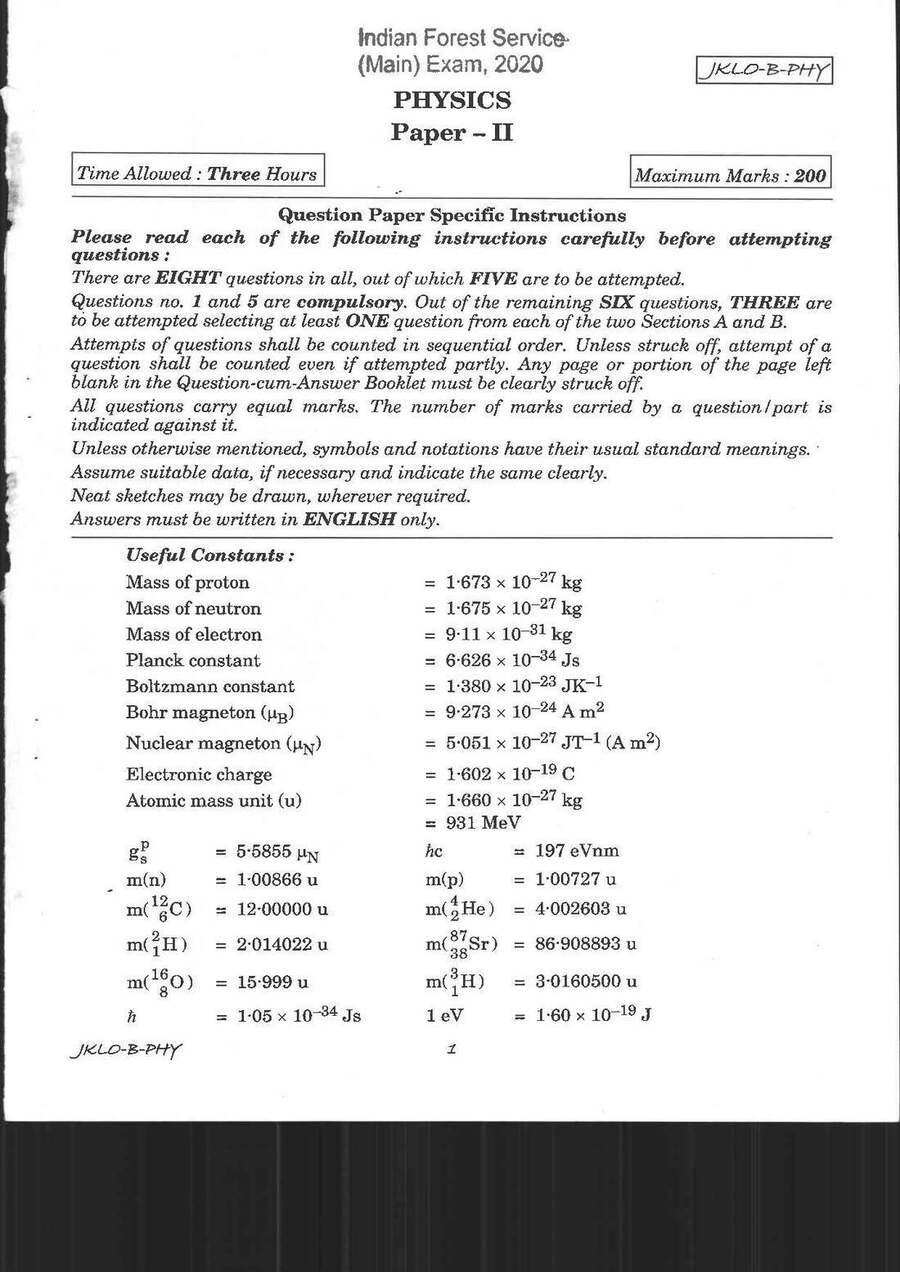
Instructions

  • There are EIGHT questions in all, out of which FIVE are to be attempted.
  • Out of the remaining SIX questions, THREE are to be attempted selecting at least ONE question from each of the two Sections A and B.
  • Attempts of questions shall be counted in sequential order.
  • Unless struck off, attempt of a question shall be counted even if attempted partly.
  • Any page or portion of the page left blank in the Question-cum-Answer Booklet must be clearly struck off.
  • The number of marks carried by a question/part is indicated against it.
  • Unless otherwise mentioned, symbols and notations have their usual standard meanings.
  • Assume suitable data, if necessary and indicate the same clearly.
  • Neat sketches may be drawn, wherever required.
  • Answers must be written in ENGLISH only.
  • Useful Constants: Mass of proton = 1.673 \times 10^{-27} kg Mass of neutron = 1.675 \times 10^{-27} kg = 9.11 \times 10^{-31} kg Mass of electron = 6.626 \times 10^{-34} Js Planck constant = 1.380 \times 10^{-23} JK-1 Boltzmann constant = 9.273 \times 10^{-24} A m2 Bohr magneton (\mu_R) = 5.051 \times 10^{-27} JT-1 (A m2) Nuclear magneton (\mu_N) = 1.602 \times 10^{-19} C Electronic charge = 1.660 \times 10^{-27} kg Atomic mass unit (u) = 931 MeV g_s^p = 197 eVnm = 5.5855 \mu_N ħc = 1.00866 u = 1.00727 u m(n) m(p) m(^{12}_{6}C) = 12.00000 u m(\frac{4}{2}He) = 4.002603 u m(^{2}_{1}H) = 2.014022 \text{ u} m(\frac{87}{38}Sr) = 86.908893 u m(^{3}_{1}H) = 3.0160500 \text{ u} m(^{16}_{8}O) = 15.999 u 1 \text{ eV} = 1.60 \times 10^{-19} \text{ J} = 1.05 \times 10^{-34} Js \hbar

Questions (page 2)

Q0.

(a) Q1.
(i) Justify that this principle is not just a negative statement but a useful tool, with one example. The lifetime of an excited state of an atom is about 10^-8 s.
(ii) Calculate the minimum uncertainty in the energy of the excited state.

(b) Draw a neat sketch showing potential wells and energy levels of the following: Harmonic oscillator
(i) (ii) Hydrogen atom Particle in a box
(iii)

(c) List the contrasting points and mention the variation of En with n of the above plots. Prove the following: [L2, Lx] = 0
(i) [Lx, Ly] = i ħ L3
(ii) The calcium line of wavelength λ = 4226.73 Å (P → S) exhibits normal Zeeman splitting when placed in a uniform magnetic field of 4 Weber/m^3. Calculate the wavelength of three components of normal Zeeman pattern and the separation between them.

(d) Zeeman splitting when placed in a uniform magnetic field of 4 Weber/m^3. Calculate the wavelength of three components of normal Zeeman pattern and the separation between them.

(e) A Raman line associated with a vibrational mode which is both Raman and infrared active is found at 4600 Å when excited by light of wavelength 4358 Å. Calculate the wavelength of the corresponding infrared band.
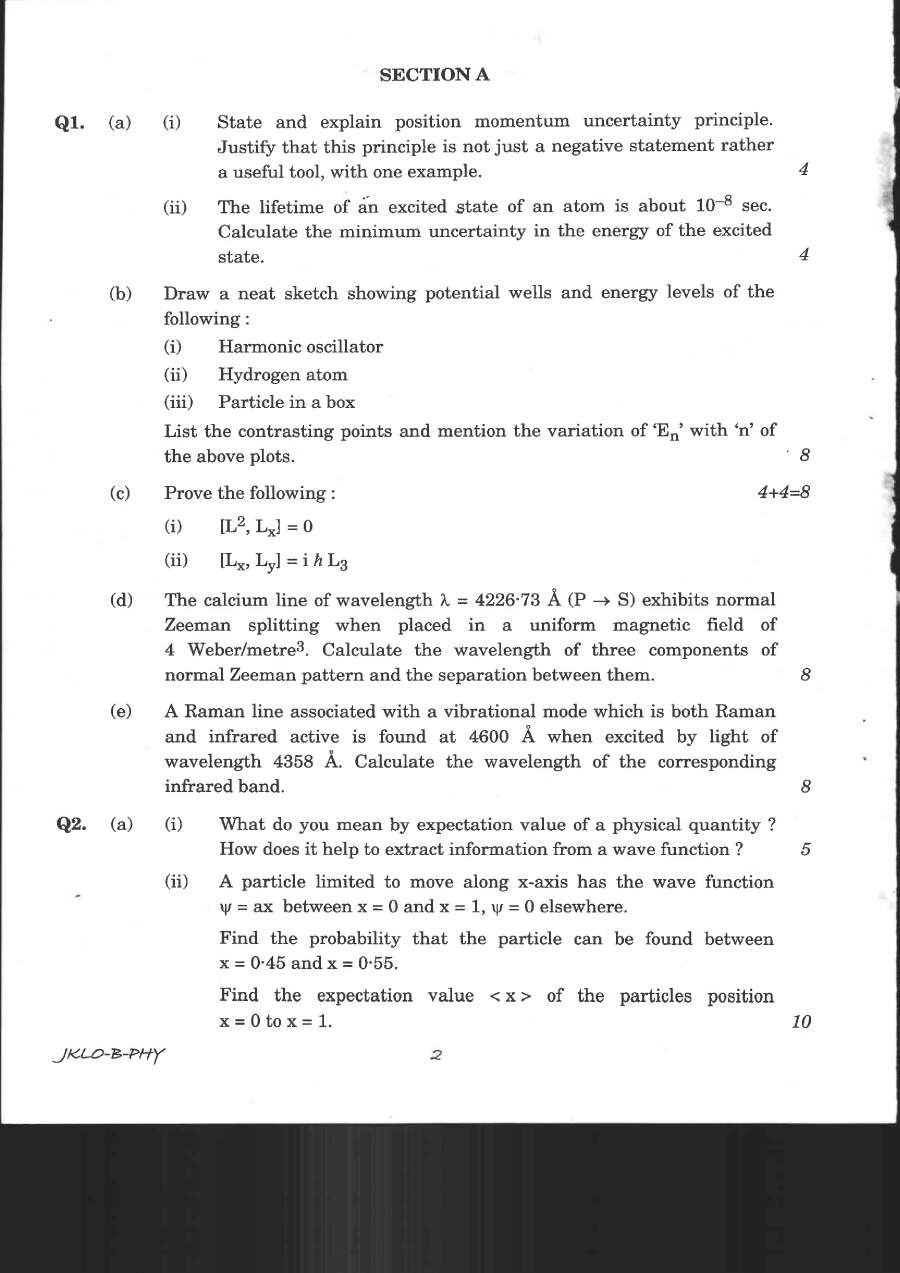
Q0. Q2. What do you mean by expectation value of a physical quantity?
(i) (a) How does it help to extract information from a wave function?
(ii) A particle limited to move along x-axis has the wave function ψ = ax between x = 0 and x = 1, ψ = 0 elsewhere. Find the probability that the particle can be found between x = 0.45 and x = 0.55. Find the expectation value ⟨x⟩ of the particle's position from x = 0 to x = 1.

Question paper preview

Scanned pages 1–2 for reference. Download the official PDF for the full paper.

Page 1
IFS Physics Paper II 2020 - Main Examination — page 1 instructions scan PDF download
Page 2
IFS Physics Paper II 2020 - Main Examination — page 1 instructions scan PDF download

Free question paper download

Download question paper PDF

  • 448 KB
  • 8 pages
  • PDF format

Frequently asked questions

What is the exam name?

Indian Forest Service (Main) Examination, Physics Paper II, 2020.

Which body conducts the IFS exam?

Union Public Service Commission (UPSC) conducts the IFS exam.

What is the maximum marks for Physics Paper II?

200 marks.

How many questions must be attempted?

Eight questions in total; five to be attempted; Q1 and Q5 are compulsory; candidates may choose from Sections A and B as per instructions.

In what language should answers be written?

Answers must be written in English only.

What are the time limits?

Three hours.

← Back to Other Jobs papers