UPSC CMS 2023 Surgery Gynaecology Obstetrics Paper II Question Paper PDF

Central Government Jobs Medical 2023

  • Year 2023
  • Conducted By UPSC
  • Questions 120
  • Maximum Marks 250
  • Duration Two Hours

Exam Details

Detail Information
Examination Combined Medical Services Examination
Year 2023
Conducting Body UPSC
Paper Paper-II (Surgery, Gynaecology & Obstetrics, Preventive & Social Medicine)
Subject Surgery, Gynaecology & Obstetrics, Preventive & Social Medicine
Duration Two Hours
Maximum Marks 250
Number of Questions 120
Question Type Objective (MCQ)

This is the question paper for Paper-II of the UPSC Combined Medical Services Examination held in 2023. This paper covers subjects including Surgery, Gynaecology & Obstetrics, and Preventive & Social Medicine. It consists of 120 objective-type questions and is allocated a maximum of 250 marks, with a time limit of two hours. Aspirants can use this paper to understand the exam pattern, difficulty level, and the types of questions asked in these specific subjects, aiding their preparation for the CMS exam.

Major Topics Covered

  • Surgery
  • Gynaecology
  • Obstetrics
  • Preventive Medicine
  • Social Medicine
  • Collagen Remodelling
  • Gas Gangrene Infection
  • Tumour Growth
  • Scrotal Swelling
  • Hernia
  • Varicocele
  • Sigmoid Colon
  • Oedema
  • Deep Vein Thrombosis
  • Hemangioma
  • Salmon Patch

Why This Paper is Important

  • Useful for Combined Medical Services Examination preparation
  • Helps understand the latest exam pattern
  • Useful for practice and self-assessment
  • Covers frequently asked General Studies topics
  • Helpful for analysing question trends

Related Resources

  • UPSC CMS 2022 Paper II
  • UPSC CMS 2021 Paper II
  • UPSC CMS 2023 Paper I
  • UPSC CMS 2023 Paper II Answer Key
  • UPSC CMS Syllabus
  • Surgery Syllabus for Medical Exams
  • Gynaecology Syllabus for Medical Exams
  • Obstetrics Syllabus for Medical Exams

Instructions

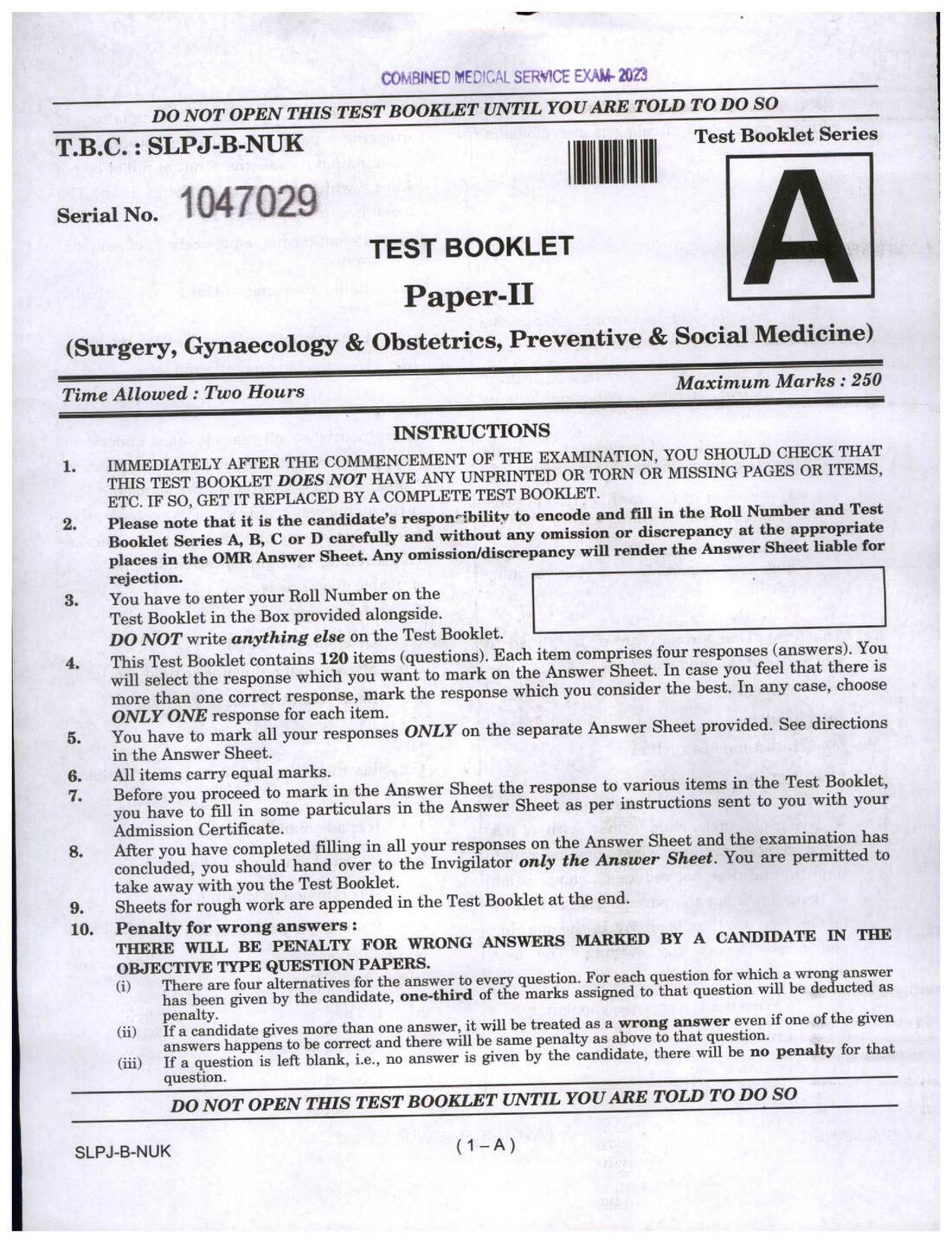
  • IF SO, GET IT REPLACED BY A COMPLETE TEST BOOKLET.
  • Please note that it is the candidate's responsibility to encode and fill in the Roll Number and Test
  • Booklet Series A, B, C or D carefully and without any omission or discrepancy at the appropriate places in the OMR Answer Sheet.
  • Any omission/discrepancy will render the Answer Sheet liable for rejection.
  • You have to enter your Roll Number on the
  • Test Booklet in the Box provided alongside.
  • DO NOT write anything else on the Test Booklet.
  • This Test Booklet contains 120 items (questions).
  • Each item comprises four responses (answers).
  • You will select the response which you want to mark on the Answer Sheet.
  • more than one correct response, mark the response which you consider the best.
  • In any case, choose ONLY ONE response for each item.
  • You have to mark all your responses ONLY on the separate Answer Sheet provided.
  • in the Answer Sheet. All items carry equal marks.
  • Before you proceed to mark in the Answer Sheet the response to various items in the Test Booklet,
  • you have to fill in some particulars in the Answer Sheet as per instructions sent to you with your Admission Certificate.
  • After you have completed filling in all your responses on the Answer Sheet and the examination has concluded, you should hand over to the Invigilator only the Answer Sheet.
  • take away with you the Test Booklet. Sheets for rough work are appended in the Test Booklet at the end.
  • THERE WILL BE PENALTY FOR WRONG ANSWERS MARKED BY A CANDIDATE IN THE OBJECTIVE TYPE QUESTION PAPERS.
  • There are four alternatives for the answer to every question.
  • For each question for which a wrong answer has been given by the candidate, one-third of the marks assigned to that question will be deducted as (i) penalty.
  • If a candidate gives more than one answer, it will be treated as a wrong answer even if one of the given answers happens to be correct and there will be same penalty as above to that question.
  • (ii) If a question is left blank, i.e., no answer is given by the candidate, there will be no penalty for that (iii) question.
  • DO NOT OPEN THIS TEST BOOKLET UNTIL YOU ARE TOLD TO DO SO (1 - A)

Questions (page 2)

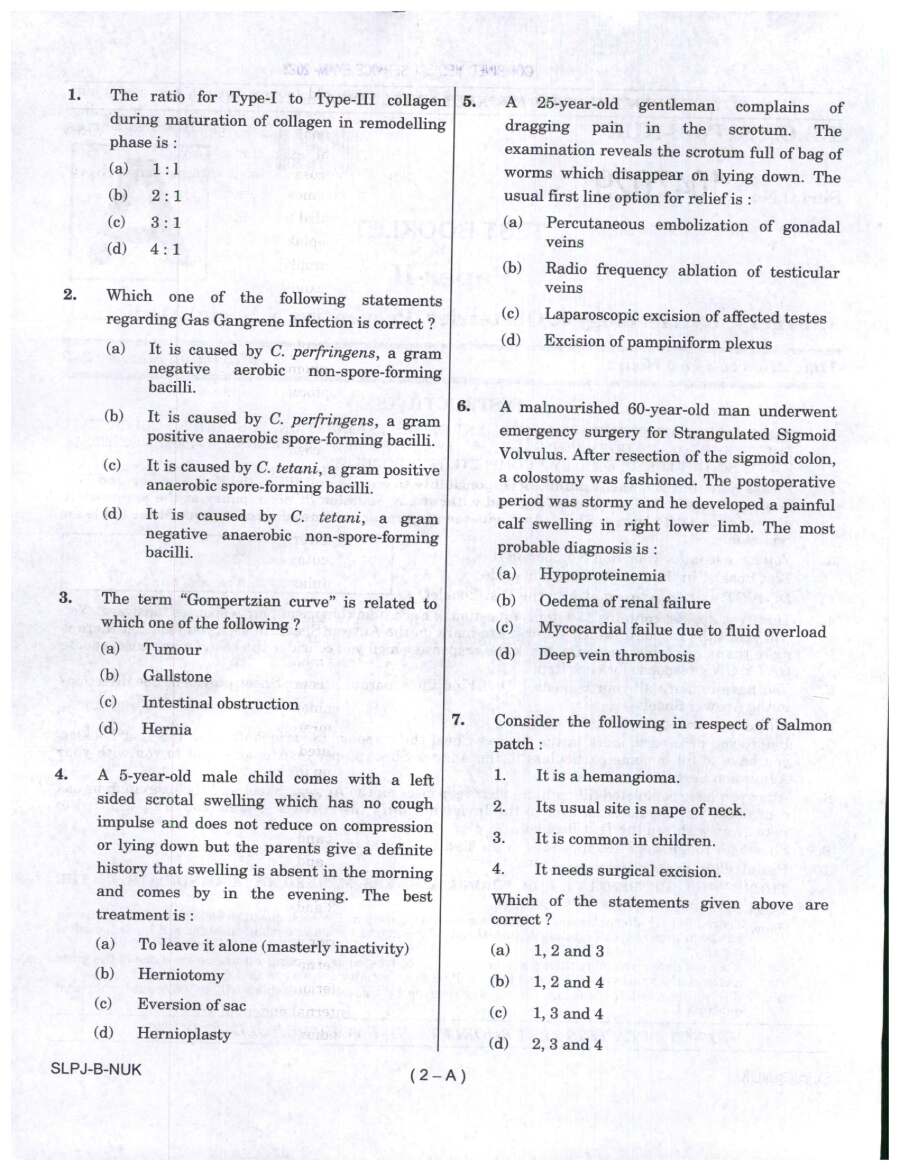
Q1. The ratio for Type-I to Type-III collagen during maturation of collagen in remodelling phase is :

  • (a) 1:1
  • (b) 2:1
  • (c) 3:1
  • (d) 4:1

Q2. Which one of the following statements regarding Gas Gangrene Infection is correct?

  • (a) It is caused by C. perfringens, a gram negative aerobic non-spore-forming bacilli.
  • (b) It is caused by C. perfringens, a gram positive anaerobic spore-forming bacilli.
  • (c) It is caused by C. tetani, a gram positive anaerobic spore-forming bacilli.
  • (d) It is caused by C. tetani, a gram negative anaerobic non-spore-forming bacilli.

Q3. The term "Gompertzian curve" is related to which one of the following?

  • (a) Tumour
  • (b) Gallstone
  • (c) Intestinal obstruction
  • (d) Hernia

Q4. A 5-year-old male child comes with a left sided scrotal swelling which has no cough impulse and does not reduce on compression or lying down but the parents give a definite history that swelling is absent in the morning and comes by in the evening. The best treatment is :

  • (a) To leave it alone (masterly inactivity)
  • (b) Herniotomy
  • (c) Eversion of sac
  • (d) Hernioplasty

Q5. A 25-year-old gentleman complains of dragging pain in the scrotum. The examination reveals the scrotum full of bag of worms which disappear on lying down. The usual first line option for relief is :

  • (a) Percutaneous embolization of gonadal veins
  • (b) Radio frequency ablation of testicular veins
  • (c) Laparoscopic excision of affected testes
  • (d) Excision of pampiniform plexus

Q6. A malnourished 60-year-old man underwent emergency surgery for Strangulated Sigmoid Volvulus. After resection of the sigmoid colon, a colostomy was fashioned. The postoperative period was stormy and he developed a painful calf swelling in right lower limb. The most probable diagnosis is :

  • (a) Hypoproteinemia
  • (b) Oedema of renal failure
  • (c) Myocardial failue due to fluid overload
  • (d) Deep vein thrombosis

Q7. Consider the following in respect of Salmon patch :

  • (1) It is a hemangioma.
  • (2) Its usual site is nape of neck.
  • (3) It is common in children.
  • (4) It needs surgical excision.
  • (a) 1, 2 and 3
  • (b) 1, 2 and 4
  • (c) 1, 3 and 4
  • (d) 2, 3 and 4

Question paper preview

Scanned pages 1–2 for reference. Download the official PDF for the full paper.
Page 1
UPSC Combined Medical Services Examination 2023 Paper II question paper page 1 instructions and header scan PDF download
Page 2
UPSC Combined Medical Services Examination 2023 Paper II question paper page 1 instructions and header scan PDF download

Free question paper download

Download question paper PDF

  • 12.8 MB
  • 24 pages
  • PDF format

Frequently asked questions

What is the name of the exam?

The exam is the Combined Medical Services Examination.

Which year is this question paper for?

This question paper is for the year 2023.

Who conducts the Combined Medical Services Examination?

The examination is conducted by UPSC (Union Public Service Commission).

What is the subject matter of Paper-II?

Paper-II covers Surgery, Gynaecology & Obstetrics, and Preventive & Social Medicine.

How many questions are there in Paper-II?

There are 120 objective-type items (questions) in Paper-II.

What is the maximum marks for Paper-II?

The maximum marks for Paper-II are 250.

← Back to Medical papers